Epic volcanic activity flooded Mercury's north polar region
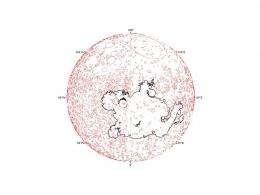
A View Looking Down on the North Pole of Mercury (Center)
(PhysOrg.com) -- Ever since the Mariner 10 mission in 1974 snapped the first pictures of Mercury, planetary scientists have been intrigued by smooth plains covering parts of the surface. Some suspected past volcanic activity, but there were no telltale signs like protruding volcanoes. Also, Mercury's northern plains are the same brightness as its cratered highlands, yet different from volcanic deposits on the Moon, which are darker than the highlands.
"For more than 35 years we have been uncertain about the role of volcanic activity on Mercury," said James W, Head III, professor of geological sciences at Brown University.
In a paper published in Science, Head and more than two dozen colleagues from Brown and other institutions used data from the orbiting MESSENGER spacecraft to examine Mercury's largely unseen northern high latitudes. They report that the smooth plains there are the result of volcanic activity. Early in the planet's history -- some 3.5 to 4 billion years ago, the scientists say -- huge volumes of lava poured out from cracks in Mercury's surface, flooding the surrounding, low-lying plains "like a bathtub," Head said. The lava flows, the scientists write, fill craters more than a mile deep and cover 6 percent of Mercury's surface, an area that would cover nearly 60 percent of the continental United States. The volume would have been enough to bury the state of Texas more than four miles deep.
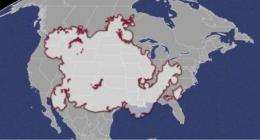
Lava flows on Mercury more than 3.5 billion years ago -- a mile deep in places -- would have covered nearly 60 percent of the continental United States. Credit: Image courtesy of James Head research group, Brown University
The lava flows, "don't build a volcano like we see on Hawaii; rather, they cover up the place where the lava is coming out, and they're very difficult to understand in the context of the current Earth eruption conditions," said Head, who has studied volcanism on planets and moons for more than four decades."But one thing is clear," added Jennifer Whitten, a graduate student in Head's research group and a contributing author on the paper. "So much lava comes out so rapidly, that it's an entirely different type of volcanism than we see at Hawaii. This gives us big clues about what's going on in the interior of Mercury."
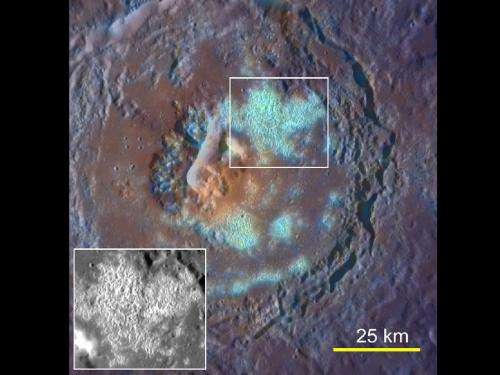
An Example of a Large Crater (Tyagaraja, 97 km in Diameter) with a Floor Partially Covered by Large Numbers of Coalesced Hollows
Head explained that the lava flows give scientists insights into how planets are born, how they evolved and whether they're still active. "For example, on the Moon, we see very little evidence of activity of volcanic processes over the last 2 to 3 billion years," he added.To confirm the plains were caused by very rapid volcanism, the researchers looked at a feature about 125 miles outside the volcanic zone. There, they saw evidence of a fissure vent, with wide river-like channels emanating from the crack. "These features are similar to lava flows and very fluid flows that erode much of the surrounding terrain," said Debra Hurwitz, also a graduate student with Head, who studies similar features on the Moon and Mars and is a contributing author on the paper.
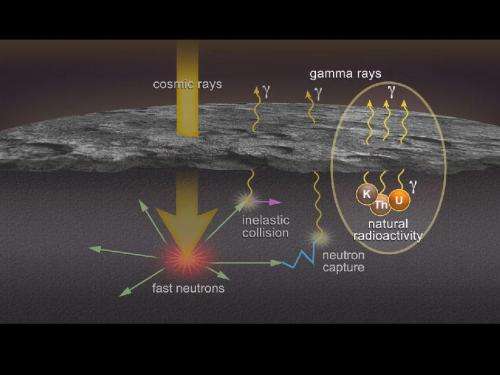
Schematic Illustration of the Operation of MESSENGER's Gamma-Ray Spectrometer (GRS)
The team believes this is similar to what happened in the smooth plains, but the clues have been largely erased by the sheer volume of lava that poured out."When trying to understand the origin of the smooth plains, it is helpful to look at the margin of the plains and its surroundings," said Caleb Fassett, a postdoctoral researcher at Brown now teaching at Mount Holyoke College, and a contributing author on the paper. "Where the plains thin and meet surrounding terrain, the differences between the plains and pre-existing terrain can help give us insight into how the plains were formed."
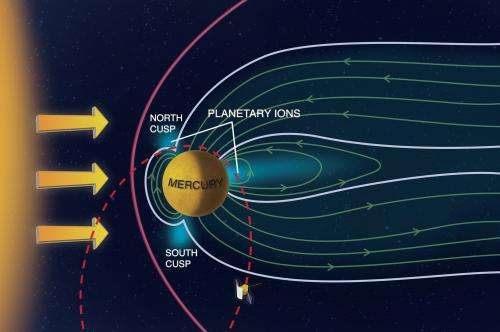
The MESSENGER spacecraft is currently in orbit around planet Mercury. The Fast Imaging Plasma Spectrometer (FIPS) on board is taking the first global measurements of the charged particles in Mercury's space environment. FIPS found that at the magnetic cusps near the planet's poles, the solar wind is able to bear down on Mercury enough to blast particles from its surface into its wispy atmosphere. Shannon Kohlitz, Media Academica, LLC
The MESSENGER spacecraft has been orbiting Mercury since March. The same spacecraft executed three flybys of Mercury in previous years, which gave the scientists their first look at the smooth plains. The team hopes that other instruments on MESSENGER will allow them to better understand the minerals and chemical composition in the northern high latitudes, as well as to compare the volcanic activity there with other regions that experienced volcanism."This one deposit is so huge," Head said, "volcanism has got to be important elsewhere."
Provided by
Brown University
-
From lemons to lemonade: Reaction uses carbon dioxide to make carbon-based semiconductor,
32 comments
-
Thioridazine kills cancer stem cells in human while avoiding toxic side-effects of conventional cancer treatments,
3 comments
-
SpaceX private rocket blasts off for space station (Update),
42 comments
-
Climate scientists say they have solved riddle of rising sea,
31 comments
-
SpaceX capsule has 'new car' smell, astronauts say (Update),
2 comments
-
revamping general concept and cosmological principle
May 25, 2012
-
Transiting Exoplanet Light Curve
May 25, 2012
-
Math behind Theoretical Physics
May 24, 2012
-
Do we know whats at the center of galaxies yet?
May 23, 2012
-
Structure of the Milky Way?
May 20, 2012
-
What would it take to terraform Pluto and Charon?
May 19, 2012
- More from Physics Forums - General Astronomy
More news stories
Sophisticated simulations predict future warming
The chances of our planet being hit by a global warming of 3 degrees Celsius by 2050 is as likely as it being hit by an increase of 1.4 degrees, new research shows. Presented in the journal Nature Geoscience, the British study ...
Space & Earth / Earth Sciences
May 22, 2012 |
4.4 / 5 (9) |
51
Kyoto Protocol architect 'frustrated' by climate dialogue
UN climate talks are going nowhere, as politicians dither or bicker while the pace of warming dangerously speeds up, one of the architects of the Kyoto Protocol told AFP.
May 23, 2012 |
3.7 / 5 (7) |
39
Aliens don't want to eat us, says former SETI director
Alien life probably isnt interested in having us for dinner, enslaving us or laying eggs in our bellies, according to a recent statement by former SETI director Jill Tarter.
Space & Earth / Space Exploration
May 25, 2012 |
4.4 / 5 (13) |
37
Dragon arrives at space station in historic 1st (Update 2)
The privately bankrolled Dragon capsule made a historic arrival at the International Space Station on Friday, triumphantly captured by astronauts wielding a giant robot arm.
Space & Earth / Space Exploration
May 25, 2012 |
5 / 5 (10) |
19
What's the big deal about private space launches?
(AP) -- The first private spaceship is headed to the International Space Station. Some questions and answers about the cargo mission by Space Exploration Technologies, known as SpaceX:
Space & Earth / Space Exploration
May 22, 2012 |
5 / 5 (6) |
32
Nvidia trumpets Tegra 3 phone design wins for 2012
(Phys.org) -- Nvidias competitive war paint has a name, Tegra 3. On the heels of Nvidia announcements about lowering costs of its Tegra 3 processors and Nvidia-enabled tablets running Android Ice Cream ...
Browser wars flare in mobile space
The browser wars are heating up again, but this time the fight is for dominance of the mobile Internet.
Scientist: Evolution debate will soon be history
(AP) -- Richard Leakey predicts skepticism over evolution will soon be history. Not that the avowed atheist has any doubts himself.
Dell tablet leak: 10.1-inch display, two-battery choice
(Phys.org) -- Headline after headline talks about vendors tablets in the wings as likely number-one contenders for the iPad. Such claims have justifiably been taken with a grain of salt, considering ...
Keep food safety in mind this memorial day weekend
(HealthDay) -- Picnics, parades and cookouts are as much a part of Memorial Day weekend as tributes to the United States' war veterans.
Social welfare cuts ultimately come with heavy price, researchers say
(Phys.org) -- Slashing government funding for Medicaid, food stamps and other programs that serve the poor while politically popular with some lawmakers and many conservatives may do more harm ...


Sep 29, 2011
Rank: 3 / 5 (2)
Because that is so much easier to visualize. How about "enough to cover the island of Manhattan in 31,841 miles of lava" or "enough lava to fill 1.79x10^12 Olympic-size swimming pools"?
Hat tip to the Discovery Channel for every show they've ever had about big stuff.
Sep 29, 2011
Rank: 1 / 5 (4)
The picture, "Schematic Illustration of the Operation of MESSENGER's Gamma-Ray Spectrometer (GRS)" seems totally out of place.
Could we ask Professor James W. Head, III to explain if his finding confirms or denies earlier reports that the terrestrial planets accreted heterogeneously [1,2] ?
1. "Inhomogeneous accumulation of the earth from the primitive solar nebula," Earth Planet. Sci. Lett. 6, 346-348 (1969).
2. "The noble gas record of the terrestrial planets", Geochem. J. 15, 247-267 (1981)
http://www.omatum...eGas.pdf
With kind regards,
Oliver K. Manuel
http://myprofile....anuelo09