Early detection of plant disease
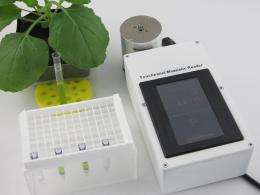
Each year, plant viruses and fungal attacks lead to crop losses of up to 30 percent. That is why it is important to detect plant disease early on. Yet laboratory tests are expensive and often time-consuming. Researchers are now developing a low-cost quick test for use on site.
The farmer casts a worried gaze at his potato field: where only recently a lush green field of plants was growing, much of the foliage has now turned brown – presumably the result of a fungal disease. Usually, by the time the disease becomes visible, it is already too late. The course of the disease is then so advanced that there is little the farmer can do to counteract the damage done. To determine early on whether and how severely his plants are diseased, he would have to submit samples to a laboratory on a regular basis. There, researchers usually employ the ELISA method, a conventional detection method based on an antibody-antigen reaction. “These tests are expensive, though. It also takes up to two weeks before the farmer has the results of the tests. And by then, the disease has usually spread out across the entire field,” explains Dr. Florian Schröper of the Fraunhofer Institute for Molecular Biology and Applied Ecology IME in Aachen, Germany.
Researchers at the IME are now working on a new quick test that is to provide the farmer a low-cost analysis right there in the field. At the heart of the test is a magnetic reader devised by scientists at the Peter Grünberg Institute of the Forschungszentrum Jülich. The device has several excitation and detection coils arrayed in pairs. The excitation coils generate a high- and low-frequency magnetic field, while the detection coils measure the resulting mixed field. If magnetic particles penetrate the field, the measuring signal is modified. The result is shown on a display, expressed in millivolts. This permits conclusions about the concentration of magnetic particles in the field.
Researchers are making use of this mechanism to track down pathogens. “What we detect is not the virus itself but the magnetic particles that bond with the virus particles,” Schröper notes. These are first equipped with antibodies so that these can specifically target and dock onto the pathogens. This way, essentially there is a virus particle “stuck” to each magnetic particle. To ensure that these are in proportion to one another, researchers use a method that functions similarly to the ELISA principle. They introduce plant extract into a tiny filtration tube filled with a polymer matrix to which specific antibodies were bound. When the plant solution passes through the tube, the virus particles are trapped in the matrix. Following a purification step, the experts add the magnetic particles modified with antibodies. These, in turn, dock onto the antigens in the matrix. A subsequent purification step removes all of the unbound particles. The tube is then placed in an appliance in the magnet reader to measure the concentration of magnetic particles. The researchers have already achieved promising results in initial tests involving the grapevine virus: the measured values reached a level of sensitivity ten times that of the ELISA method. Currently, Schröper and his team are working to expand their tests to other pathogens such as the mold spore Aspergillus flavus.
The mobile mini-lab needs to be made more user-friendly, however, before it is ready for widespread use in the field. Rather than grapple with measurements in millivolts, farmers should be able to consult the display and determine directly how severe the level of crop disease is. If possible, the scientists also want to reduce the number of analytical steps, and hence the detection time involved.
Provided by Fraunhofer-Gesellschaft


