DNA confirms existence of NZ bird thought extinct
Sep 26, 2011
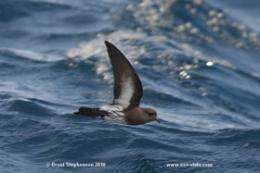
New Zealand Storm-petrel. Credit: Brent Stephenson

(PhysOrg.com) -- An examination of ancient and modern DNA by the University of Otago has confirmed that the New Zealand storm-petrel, once thought to be extinct, is a bird which continues to fly our southern skies.

University of Otago Senior Lecturer in Dr Bruce Robertson, who led the study, says the research confirms that the storm petrel is a “distinct ” of seabird, rather than an extinct plumage variant or subspecies, and hence is worthy of a species recovery programme.

The exciting find has been just published on-line in the journal Molecular Phylogenetics and Evolution.

The authors, Dr. Robertson, Dr. Brent Stephenson of Eco-Vista, and Dr. Sharyn Goldstien of Canterbury University, used DNA methods to confirm conclusively this finding using DNA samples from museum skins and birds recently captured, since the first bird thought to be the extinct storm petrel flew into the wheelhouse of a fishing vessel operating in the Hauraki Gulf in 2003.

Scientists had evidence of the existence of a NZ storm-petrel with three museum skins collected in the 1800s and held by the museums in England and France. Using ancient sequencing, samples from two of the 150-year-old skins were tested and matched against blood samples from living birds.

“We found they were one and the same, and these are a distinct species of storm-petrel,” he says.

“Since 2003, researchers had largely accepted that the bird was the NZ storm-petrel, but until we had taxonomic certainty, the conservation effort to protect the bird was paralysed; there was always going to be this controversy because no one knew exactly what the museum skins were.

“Hopefully now the NZ Storm-Petrel will be given a conservation priority that would be given to a nationally endangered species. This will help us to fund further study of the bird, such as where it breeds.”

Dr. Robertson adds that once scientists have more information, they can better direct conservation efforts and begin a species recovery program.

The four-year study, which started in 2006, was also funded by the Department of and the National Geographic Fund.

Explore further: Small but speedy: Short plants live in the evolutionary fast lane

Provided by University of Otago

not rated yet
add to favorites email to friend print save as pdf

Related Stories

Mysterious Fiji petrel sighting raises hopes

Sep 14, 2009

The first ever positive identification at sea of one of the world's most mysterious and endangered seabirds has raised hopes for the survival of the Fijian petrel, conservationists said Monday.

Black rat does not bother Mediterranean seabirds

Oct 02, 2009

Human activities have meant invasive species have been able to populate parts of the world to which they are not native and alter biodiversity there over thousands of years. Now, an international team of scientists ...

Scientists 'rebuild' giant moa using ancient DNA

Jul 01, 2009

(PhysOrg.com) -- Scientists have performed the first DNA-based reconstruction of the giant extinct moa bird, using prehistoric feathers recovered from caves and rock shelters in New Zealand.

Recommended for you

Researcher admits mistakes in stem cell study

8 hours ago

A blockbuster study in which US researchers reported that they had turned human skin cells into embryonic stem cells contained errors, its lead author has acknowledged. ...

Scientists discover how rapamycin slows cell growth

10 hours ago

University of Montreal researchers have discovered a novel molecular mechanism that can potentially slow the progression of some cancers and other diseases of abnormal growth. In the May 23 edition of the prestigious journal ...

Bittersweet: Bait-averse cockroaches shudder at sugar

11 hours ago

Sugar isn't always sweet to German cockroaches, especially to the ones that avoid roach baits. In a study published May 24 in the journal Science, North Carolina State University entomologists show the ne ...

User comments : 0

More news stories

White tiger mystery solved

White tigers today are only seen in zoos, but they belong in nature, say researchers reporting new evidence about what makes those tigers white. Their spectacular white coats are produced by a single change ...

Controlling mood through the motions of mitochondria

(Medical Xpress)—Regulating the distribution of power in neurons is done by a system that makes the national electric grid look simple by comparison. Each neuron has several thousand mitochondria confined ...