Critters on ocean floor communicating in synchronized rumbles
September 8, 2011

Critters on ocean floor communicating in synchronized rumbles

Enlarge

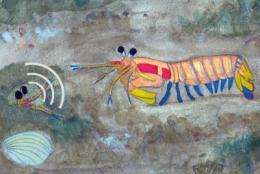
This watercolor by scientist Erica Staaterman shows a California mantis shrimp "rumbling" or making noise. A study featured in Aquatic Biology uncovered the fact each individual shrimp seems to have its own "voice." The males make rhythmic "rumbles" in groups of three that may help to attract females to their burrows or defend their territories against neighboring males. Credit: Erica Staaterman

September- Understanding animal communication has long been a fascinating and vast area of research for those who dare to welcome the challenge. Some species use body language to express their message while others use calls and loud noises. In fact, some animals communicate in frequencies that are inaudible to humans, either above or below our hearing range.

But how do critters on the ocean floor use communication to fend off , attract mates and protect their homes? This was the question six scientists, including two students from the University of Miami Rosenstiel School of Marine & Atmospheric Science, Erica Staaterman and Austin Gallagher set out to answer. Their destination was the muddy water off the coast of Catalina Island, California. Their subject was the California mantis shrimp (Hemisquilla californiensis), a benthic crustacean that measures 8 - 10 inches.

"Rarely are there studies of benthic acoustics (sounds from the oceans floor)," said Staaterman. "There has always been suspicion that burrow-dwelling creatures like the mantis shrimp make some sort of noise, and our research is going to help us better understand life and communication on the ocean floor."

After collecting data using various instruments that included a coupled audio–video system, a hydrophone array and an autonomous recording unit, the team was able to develop theories about communication on the .

The study uncovered the fact that made noise, each individual seeming to have its own 'voice.' The males made rhythmic 'rumbles' in groups of three that may help to attract females to their burrows or defend their territories against neighboring males.

"These sounds recorded in the field were different than what we recorded in tanks, so to hear these creatures communicating in the wild was very special. Our research team noted the 'rumbles' were so synchronized that it sounded like a chorus, similar to that of groups of birds or frogs," she added.

Aquatic Biology journal made the study their August cover story. At the time of the research, Staaterman was a staff member at the University of Massachusetts working under the supervision of Dr. Sheila Patek and Gallagher was an assistant on the research team before both relocated to the University of Miami's Rosenstiel School.

Provided by University of Miami search and more info website

Filter


Move the slider to adjust rank threshold, so that you can hide some of the comments.


Display comments: newest first

Isaacsname
Sep 08, 2011

Rank: not rated yet
Here's some links for those of you that follow such research

International Bioacoustics Council

http://www.ibac.i...nks.html
xznofile
Sep 08, 2011

Rank: not rated yet
it's not clear if the writer means 3 rumbles or 3 male shrimp.
Rank 5 /5 (2 votes)
Relevant PhysicsForums posts

More news stories

Scientist: Evolution debate will soon be history

(AP) -- Richard Leakey predicts skepticism over evolution will soon be history. Not that the avowed atheist has any doubts himself.

Biology / Evolution

created 16 hours ago | popularity 3.3 / 5 (17) | comments 51

More plant species responding to global warming than previously thought

(Phys.org) -- Far more wild plant species may be responding to global warming than previous large-scale estimates have suggested.

Biology / Ecology

created May 22, 2012 | popularity 4.6 / 5 (14) | comments 18 | with audio podcast

Thousands of shellfish found dead in Peru

Thousands of crustaceans were found dead off the coast of Lima following the mystery mass death of dolphins and pelicans, the Peruvian Navy said Friday.

Biology / Ecology

created May 26, 2012 | popularity 4.8 / 5 (4) | comments 7

For monogamous sparrows, it doesn't pay to stray (but they do it anyway)

It's quite common for a female song sparrow to stray from her breeding partner and mate with the male next door, but a new study shows that sleeping around can be costly.

Biology / Plants & Animals

created May 22, 2012 | popularity 5 / 5 (2) | comments 7 | with audio podcast

Study uncovers secret to speedy burrowing by razor clams

(Phys.org) -- If you look at a razor burrowing clam sitting in a bucket, you’d never guess that it could burrow itself down into the soil, much less do it with any speed. Razor clams look like fat straws, ...

Biology / Plants & Animals

created May 25, 2012 | popularity 1 / 5 (1) | comments 3 | with audio podcast report


Nvidia trumpets Tegra 3 phone design wins for 2012

(Phys.org) -- Nvidia’s competitive war paint has a name, Tegra 3. On the heels of Nvidia announcements about lowering costs of its Tegra 3 processors and Nvidia-enabled tablets running Android Ice Cream ...

Browser wars flare in mobile space

The browser wars are heating up again, but this time the fight is for dominance of the mobile Internet.

Dell tablet leak: 10.1-inch display, two-battery choice

(Phys.org) -- Headline after headline talks about vendors’ tablets in the wings as likely number-one contenders for the iPad. Such claims have justifiably been taken with a grain of salt, considering ...

Keep food safety in mind this memorial day weekend

(HealthDay) -- Picnics, parades and cookouts are as much a part of Memorial Day weekend as tributes to the United States' war veterans.

Social welfare cuts ultimately come with heavy price, researchers say

(Phys.org) -- Slashing government funding for Medicaid, food stamps and other programs that serve the poor – while politically popular with some lawmakers and many conservatives – may do more harm ...

Is a classical electrodynamics law incompatible with special relativity?

(Phys.org) -- The laws of classical electromagnetism that were developed in the 19th century are the same laws that scientists use today. They include Maxwell’s four equations along with the Lorentz la ...