Climate scientist studies ancient shorelines
The seas are rising, as they have during past periods of warming in earth’s history. Estimates of how high they will go in the next few thousand years range from five meters, putting greater Miami underwater, to 40 meters, wiping most of Florida off the map. “The range of estimates is huge to the point of meaninglessness,” says Maureen “Mo” Raymo, a climate scientist at Columbia University’s Lamont-Doherty Earth Observatory.
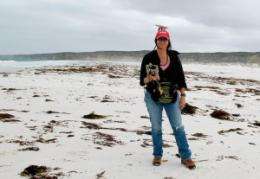
On a desolate coast in Australia, Raymo aims to close the gap. By analyzing ancient fossils, sand dunes and coral reefs, she wants to pinpoint where the seas stood 3 million years ago, when warming temperatures and collapsing ice sheets pushed the seas much higher than today. This information could help scientists narrow their estimates for how ice sheets today will respond to hotter temperatures and rising greenhouse gas levels, she says.
Raymo joined Lamont this summer from Boston University and now oversees the Lamont-Doherty Core Repository, the world’s largest collection of seafloor sediments. Captivated by Jacques Cousteau’s stories at sea, she knew from an early age she would become a scientist. Her father, a physics professor and science journalist, encouraged her by casting her in the starring role of her own comic book, “Maureen’s Adventures Under the Sea.” In her new office, Raymo recently quoted her favorite line: “Deep beneath the ocean Maureen sees a terrifying sight at the port-hole! But for the sake of science she must go out and investigate.”
With a geology degree from Brown University, Raymo came to Lamont in the 1980s to investigate, and to earn her PhD. With advisor William Ruddiman, a climate scientist, she proposed the controversial “uplift weathering hypothesis” that rising mountain ranges could cool earth’s climate. Over time, the exposed rock of new mountain ranges, such as the Himalayas, reacts with carbon dioxide in a chemical weathering process that removes carbon dioxide from the air to cool the planet globally, she says. At Lamont, she also wrote a book with her dad, “Written in Stone,” about the geology of the Northeast that still sells hundreds of copies a year.
More recently, Raymo came up with another big idea to explain why ice ages came and went more frequently between 3 million and 1 million years ago—arriving every 41,000 years instead of every 100,000 years. After watching the documentary March of the Penguins, Raymo started to think about earth’s orbital cycles, and how shrinking ice cover in Antarctica coupled with cyclical changes in the direction of earth’s rotating axis, might alter the timing of ice ages. In a 2006 paper in Science, she proposed that the Antarctic ice sheet was far more dynamic in the past than generally accepted.
“I had all of these pictures of penguins and Antarctica in my head and woke up in the middle of the night with the idea,” she says. “I seem to have my best ideas when I’m not sitting at my desk.”
Beyond science, her interests include travel and reading up on all things William Morris, the British writer, textile designer and socialist. Her last house was partly wallpapered with Morris’s botanical designs.
One of Raymo’s goals for the core lab is to add instruments that can more closely analyze the cores’ chemical composition. She also wants to broaden access to the collection by training more scientists to tap into its data.
“We have more cores, from more places on earth, than any other institution,” she says. “They are a treasure trove for understanding how earth’s climate and life have evolved in the past. Humans are currently conducting a giant, unplanned experiment by pumping climate-altering greenhouse gases into the air. The geologic record is the closest thing we have to a control experiment.”
Provided by Columbia University


