China to launch space station's first module
Sep 20, 2011
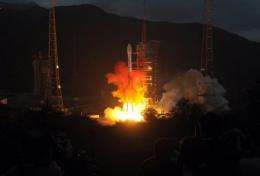
A Chinese rocket blasts off from the launch centre in Xichang in the southwestern province of Sichuan, 2010. China said it will launch its Tiangong-1 space module later this month, marking its first step towards building a Chinese space station.

China said Tuesday it will launch its Tiangong-1 space module later this month, marking its first step towards building a Chinese space station.

The Asian giant sees its space programme as a symbol of its global stature, growing technical expertise, and the Communist Party's success in turning around the fortunes of the formerly poverty-stricken nation.

It had originally planned to place the unmanned Tiangong-1, or "Heavenly Palace", in orbit last year, but was forced to delay the move for "technical reasons".

A spokesman for the Jiuquan Satellite Centre in the northwestern province of Gansu, who refused to be named, told AFP the module will be launched some time between September 27 and 30, just ahead of China's National Day on October 1.

According to the official Xinhua news agency, both Tiangong-1 and the Long March 2-F rocket that will take the module into space are already in place on a launch platform at the centre.

Weighing eight tonnes, the module is due to stay in orbit around earth for two years.

In April, Yang Liwei, the first Chinese astronaut, told reporters China would attempt its first between Tiangong-1 and another called Shenzhou 8 in the second half of the year.

If this succeeds, the module will then dock with two other rockets -- Shenzhou 9 and 10 -- in 2012, both of which will have on board.

Before 2016, China will launch a space laboratory and, Yang said, "around 2020, we plan to realise the construction of a space station in orbit for long-term stays in space".

China's space station will be made up of the module, two laboratories, a and a manned rocket, with a total weight of 60 tonnes, compared to 137 tonnes for the Russian station Mir and 419 tonnes for the (ISS), state media has said.

became the world's third nation to put a man in space independently -- after the United States and Russia -- when Yang piloted the one-man Shenzhou-5 space mission in 2003.

In September 2008, the Shenzhou-7, piloted by three astronauts, carried out China's first space walk.

Explore further: NASA-built nanosatellite launch adapter system ready for flight

add to favorites email to friend print save as pdf

Related Stories

China to attempt first space rendezvous

Apr 29, 2011

China will attempt its first space docking between two unmanned vehicles this year, the first step in efforts to build a Chinese space station, a senior official said Friday.

China launches second lunar probe (Update 2)

Oct 01, 2010

China on Friday celebrated 61 years of communist rule with the launch of its second lunar probe -- the next step in its ambitious programme to become the second country to put a man on the moon.

Recommended for you

Building a better team—on Mars

14 hours ago

Sometime in the next quarter-century, NASA plans to send the first humans to Mars, a mission that will push the boundaries of teamwork for a handful of astronauts who will spend as long as three years together ...

User comments : 7

Adjust slider to filter visible comments by rank

Display comments: newest first

omatumr
1.4 / 5 (10) Sep 20, 2011
Congratulations to China!

May you focus attention on the nearby star that heats planet Earth and determines our destiny!

See NASA's latest news on Solar Flare Secrets:

http://science.na...etlives/

With kind regards,
Oliver K. Manuel
http://myprofile....anuelo09
Magnette
4.3 / 5 (6) Sep 20, 2011
Oliver, there is no mention in the article that China is going up there to study solar flares so please explain the relevance of your link or are you just plain old fashioned spamming again?
Cave_Man
5 / 5 (3) Sep 20, 2011
I wonder if China has anything to do with the recent supply shuttle that was lost by Russia. Seems like perfect timing, to show we are failing and they are starting fresh and succeeding.

But that's prob just paranoia. Although it's too bad we can't just work together, with China helping us we could probably build a moon base a few decades earlier.
omatumr
2 / 5 (6) Sep 20, 2011
Oliver, there is no mention in the article that China is going up there to study solar flares so please explain the relevance of your link or are you just plain old fashioned spamming again?


Thanks for your question, Magnette.

I wanted to encourage Chinese space scientists to focus more attention on the Sun - Earth heat source [1] - and less attention on exotic stellar objects billions of light years away that are intriguing to scientists - - - but of little interest to the public!

Do not repeat NASA's mistake! Is that okay?

1. "Earth's Heat Source - The Sun", Energy and Environment 20, 131-144 (2009)

http://arxiv.org/pdf/0905.0704

With kind regards,
Oliver K. Manuel
http://myprofile....anuelo09
Vendicar_Decarian
3 / 5 (4) Sep 20, 2011
"I wanted to encourage Chinese space scientists" - OmaTard

What sun? You think it's a neutron star remember?

Maybe you could write them a letter rather than posting links to nonsense here.
omatumr
1 / 5 (2) Sep 20, 2011
I wonder if China has anything to do with the recent supply shuttle that was lost by Russia. Seems like perfect timing, to show we are failing and they are starting fresh and succeeding.

But that's prob just paranoia. Although it's too bad we can't just work together, with China helping us we could probably build a moon base a few decades earlier.


Yes, a remarkable coincidence.
OverweightAmerican
1 / 5 (4) Sep 21, 2011
The chinese are making a rocket? What is it - a giant hot-pot?

More news stories

NASA's BARREL mission launches 20 balloons

(Phys.org) —In Antarctica in January, 2013 – the summer at the South Pole – scientists released 20 balloons, each eight stories tall, into the air to help answer an enduring space weather question: ...

Power of US tornado dwarfs Hiroshima bomb

Wind, humidity and rainfall combined precisely to create Monday's massive killer tornado in Oklahoma. The awesome amount of energy released dwarfed the power of the atomic bomb that leveled Hiroshima.

If you can remember it, you can remember it wrong

(Medical Xpress)—Native peoples in regions where cameras are uncommon sometimes react with caution when their picture is taken. The fear that something must have been stolen from them to create the photo ...

Encouraging signs for bee biodiversity

Declines in the biodiversity of pollinating insects and wild plants have slowed in recent years, according to a new study. Researchers led by the University of Leeds and the Naturalis Biodiversity Centre in the Netherlands ...

B vitamins could delay dementia

(Medical Xpress)—Despite spending billions of dollars on research and development, drug companies have been unable to come up with effective treatments for dementia and Alzheimer's Disease (AD). Now, A. ...