1.6 children per woman
For the first time, the Max Planck Institute for Demographic Research presents corrected birth rates that are considerably higher than the official figures. Researchers also anticipate a reversal in the trend in German childbearing behavior.
The official birthrate (the so-called “total fertility rate”) underestimates the tendency to have children, because rather than providing the final number of children a cohort of women have given birth to over the course of their lives, the rate is only an estimate of it (2010: 1.46 for East Germany and 1.39 for West Germany). This figure underestimates the final number of children if women delay the birth of their children until they are older, which is still the case in Germany. For the first time for Germany, scientists at the Max Planck Institute for Demographic Research (MPIDR) in Rostock have succeeded in separating out the so-called “tempo effect” of ageing mothers from the birth rates: the corrected average value for the years 2001 to 2008 is, according to these calculations, around 1.6 children per woman for both West and East Germany.
MPIDR researchers Joshua Goldstein und Michaela Kreyenfeld, who have published their results in the journal Population and Development Review, were able to calculate these corrections because, for the first time, they had a time series of reliable data on the ages at which women in Germany had their first, second, or subsequent children. These time series, which are essential for making the tempo corrections, had not been previously available in Germany, because the official birth statistics could not provide these data in the past.
The MPIDR demographers were able to create a precise time series based on hospital data (see the table on the fact sheet). The data showed that the maternal age at childbirth has been rising as sharply in the East as in the West: by nearly two and a half months per year on average since 2001. “Clear differences between the birth trends in the East in the West do, however, remain,” demographer Michaela Kreyenfeld said. In particular, she noted, East German women become mothers earlier: in 2008, the average age at entering motherhood was 27.5 years in the East, a full year earlier than in the West.
The 1970s cohorts are starting to have more children
Although the tempo-corrected birthrate provides a more reliable picture of childbearing behavior than the total fertility rate, it is still only an estimate. This number is also calculated on an annual basis in order to reflect current childbearing behaviour. Real childbearing behaviour can only be calculated retrospectively based on birth cohorts with so-called “completed fertility.”
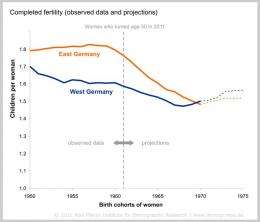
Thus, Goldstein and Kreyenfeld also researched this number, which can only be determined for individual birth cohorts when the women in each cohort have reached the age of around 50. For the 1961 cohort (who turn 50 years old this year), the final number of children is 1.6 in the West and 1.8 in the East. The MPIDR demographers predicted the future development of completed fertility rates by birth cohort.
These projections indicate that, for women who were born at the beginning of the 1960s, completed fertility falls to between 1.5 and 1.6 children per woman, thus continuing the downward trend of previous decades (see the graphic on the fact sheet). But then the numbers start to increase again. “The birth cohorts around 1970 seem to mark a reversal of the trend,” said Joshua Goldstein. While noting that the projections for the cohorts after 1970 are not yet definitive, he added that a reversal of the trend appears to be very likely.
Influence on family policy is possible, but has not been demonstrated
“This reversal of the trend in completed fertility rates could be the result of recent changes in family policy,” Joshua Goldstein said. These younger generations of women are among the first to benefit from increases in the provision of day care for children under age three and new subsidies for parents, he explained. At the same time, Goldstein pointed out, this trend reversal is in line with international trends, as a slight increase in completed fertility has been observed for younger cohorts in other European countries as well.
More information: Joshua R. Goldstein, et al., Has East Germany Overtaken West Germany? Recent Trends in Order-Specific Fertility. Population and Development Review 37 (3).
Provided by Max-Planck-Gesellschaft


