Researchers' chance viewing of river cutoff forming provides rare insight
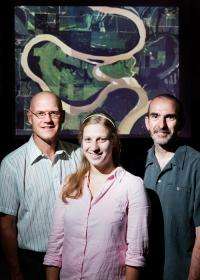
For University of Illinois river researchers, new insight into river cutoffs was a case of being in the right place at the right time.
Geography professor Bruce Rhoads and geology professor Jim Best were conducting research where the Wabash River meets the Ohio River in the summer of 2008 when they heard about a new channel that had just formed, cutting off a bend in the winding Wabash just upstream from the confluence. That serendipity gave the researchers a rare view of a dynamic, little-understood river process that changed the local landscape and deposited so much sediment into the river system that it closed the Ohio River.
"It was fortunate to be there right when it was beginning to happen, because these are hard-to-predict, unusual events, particularly on large rivers," Rhoads said.
While cutoffs are common in meandering rivers, or rivers that wander across their floodplains, the conditions surrounding cutoff events are poorly understood. Most cutoffs are discovered long after they first develop. The Illinois team's quick response to the 2008 Wabash cutoff, and witnessing of a second cutoff in the same bend a year later, allowed them to monitor the huge amounts of sediment the cutoffs released into the river. The researchers published their findings in the journal Nature Geoscience.
"Cutoffs occur in just about every meandering river on the face of the earth," said Jessica Zinger, a graduate student and lead author of the paper. "Although it's unusual to capture one like this, they are ubiquitous events, so it's important to understand what happens when these cutoffs occur, why they occur when they do, and how they evolve after they occur."
The two cutoffs, both 1 kilometer long, delivered about 6 million tons of sediment from the floodplain into the river – equivalent to 6.4 percent of the total annual sediment load of the entire Mississippi River basin (which the Wabash contributes to) – in a matter of days. It would take nearly 250 years of bank erosion to displace the same amount of sediment along the bend, had the cutoff not occurred. Such sediment pulses, as they are known, are more often associated with mountain rivers, rather than the relatively level landscape of rural Illinois.
"The first kilometer-long channel was cut in eight days, which is a phenomenal rate of erosion," Best said. "There were banks collapsing, sediment moving; it's probably one of the most dynamic river environments you'll ever see, and you don't expect that in lowland, flat-grade rivers."
The researchers found that, after each cutoff, the majority of the sediment was deposited locally. In particular, a large percentage of the sediment accumulated where the Wabash joins the Ohio River. The new layer of sediment, up to 7 meters thick, raised the bed of the Ohio River and required dredging so that barges could continue to use the river.
The Wabash River study demonstrated that cutoffs can have large, immediate effects on sediment transport and deposition in a river – processes not accounted for in current models of meandering rivers.
"If we look at river systems and their role in the landscape, one of their most fundamental roles from a geoscience perspective is that they transport sediment from the land surfaces to ocean basins," Rhoads said. "What has not been recognized is that these cutoff events can actually deliver large amounts of sediment to the river very rapidly. Then, the question is, since cutoffs are ubiquitous along a lot of meandering rivers, could this be something that we have not recognized fully as a major sediment delivery mechanism for all meandering rivers?"
The researchers plan to continue monitoring the cutoff and the areas just upstream and downstream to document how the cutoffs contribute to the river's evolution. They anticipate that the river will abandon the bend and the first cutoff as more water is directed through the second cutoff, a more direct route for the river to flow. The abandoned bend will become a new wetland area, shaping the local ecology. The researchers will continue to measure and model changes in flow velocity, sediment transport and morphology in the river as the cutoff channel widens, providing valuable insight into cutoff effects and perhaps contributing to a model that could predict where such sediment pulses could occur.
"Our study brings attention to a whole range of elements – the basic science, the local effects, the ecological effects, the commercial effects – all from this one mechanism of channel change," s said. "A lot of the meandering models that are out there treat cutoffs very schematically and they don't deal with the processes that are occurring once a cutoff develops. I think that our work could really make people rethink that aspect of modeling the long-term evolution of meander bends."
More information: The paper, "Extreme Sediment Pulses Generated by Bend Cutoffs Along a Large Meandering River," is available online at www.nature.com/ngeo/journal/va … t/full/ngeo1260.html
Provided by University of Illinois at Urbana-Champaign


