British adventurer returns from global eco-bus trip
September 9, 2011

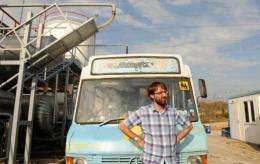
Eco-adventurer Andy Pag stands by his truck in Istanbul

Enlarge

Eco-adventurer Andy Pag stands by his truck after refuelling it with vegetable oil in Istanbul in 2009. Pag arrived back in Britain on Friday after driving round the world in a battered old "biotruck" rescued from a junkyard and powered by used cooking oil.

An eco-adventurer arrived back in Britain on Friday after driving round the world in a battered old "biotruck" rescued from a junkyard and powered by used cooking oil.

Andy Pag, 36, scavenged oil from fryers to clock up more than 18,000 miles (29,000 kilometres) travelling through 25 countries in an environmentally-friendly way.

He set off in September 2009 and his adventures included a spell banged up in an Indian jail and falling in love with journalist Christina Ammon, who joined him for the rest of the trip.

Pag, from Croydon in south London, salvaged the 22-year-old school minibus from a scrap yard and used reclaimed materials to transform it into a home on wheels.

The clapped-out vehicle's diesel engine was converted to run on waste , stored in a 1,200-litre tank under the bed. It has a 500-watt solar panel on the roof.

Pag and Ammon made it back to the port of Dover on England's southeast tip.

"It was an experiment to see if we could recycle our way around the world. I'm as surprised as anyone that we got around the world without putting any fossil fuel in the tank," said Pag.

"The random acts of kindness have given us an overwhelming faith in how great humankind is."
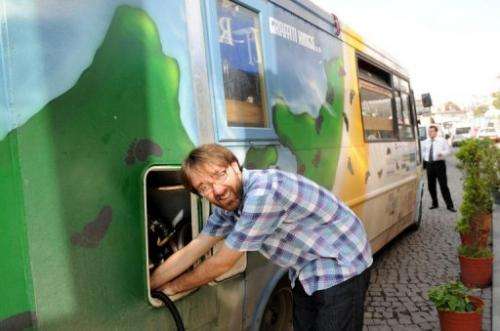
Eco-adventurer Andy Pag re-fuels his truck with vegetable oil from a Turkish restaurant in Istanbul
Enlarge

Eco-adventurer Andy Pag re-fuels his truck with vegetable oil from a Turkish restaurant in Istanbul in 2009. Pag arrived back in Britain on Friday after driving around the world in a battered old "biotruck" rescued from a junkyard and powered by used cooking oil.

The couple travelled through parts of Pakistan where militants often attack road convoys.

However, the worst moment came after Pag was arrested on suspicion of terrorism-related offences in India for illegally using a satellite telephone.

"Even when I was locked up in prison, I came across a lot of good people. We would play cricket together and read papers. By rights it was pretty unpleasant but I met some nice people," he said.

"Fortunately, I was only in prison for seven days but it cost thousands in legal fees and set us back six months waiting for it to come to court."

While driving through Indonesia, a year into his trip, he was joined by US freelancer Ammon, who wanted to write about Pag's journey.

Romance blossomed and she stayed with him for the rest of the adventure and the pair are still together.

"The breakdowns were the best bit," she said.

"That's when we met the most interesting, friendly people and had the unique sort of adventures which you can't have travelling any other way."

Pag previously drove from Britain to Timbuktu in Mali in a truck fuelled by cocoa butter extracted from waste chocolate.

(c) 2011 AFP


Rank not rated yet
Relevant PhysicsForums posts

More news stories

Browser wars flare in mobile space

The browser wars are heating up again, but this time the fight is for dominance of the mobile Internet.

Technology / Software

created 6 hours ago | popularity 5 / 5 (1) | comments 2

Probability of contamination from severe nuclear reactor accidents is higher than expected: study

Catastrophic nuclear accidents such as the core meltdowns in Chernobyl and Fukushima are more likely to happen than previously assumed. Based on the operating hours of all civil nuclear reactors and the number ...

Technology / Energy & Green Tech

created May 22, 2012 | popularity 3.6 / 5 (22) | comments 56 | with audio podcast

SpotterRF debuts Radar Backpack Kit (w/ Video)

(Phys.org) -- SpotterRF has announced a special radar backpack kit designed to enhance situational awareness for soldiers on the ground. The company says its special radar is designed for warfighters as part ...

Technology / Hi Tech & Innovation

created May 26, 2012 | popularity 5 / 5 (5) | comments 13 | with audio podcast report

HyperSolar shows dirty water no barrier to power world

(Phys.org) -- The Santa Barbara, California, company, HyperSolar, is set to transparently share the ups and downs of its research experiences toward the company’s ultimate vision, successfully producing ...

Technology / Energy & Green Tech

created May 24, 2012 | popularity 4.8 / 5 (16) | comments 17 | with audio podcast report

Tesla to launch electric sedan in US on June 22

Tesla Motors said Tuesday it would begin deliveries of "the world's first premium electric sedan" on June 22, slightly ahead of schedule.

Technology / Energy & Green Tech

created May 22, 2012 | popularity 4.5 / 5 (11) | comments 18


Nvidia trumpets Tegra 3 phone design wins for 2012

(Phys.org) -- Nvidia’s competitive war paint has a name, Tegra 3. On the heels of Nvidia announcements about lowering costs of its Tegra 3 processors and Nvidia-enabled tablets running Android Ice Cream ...

Scientist: Evolution debate will soon be history

(AP) -- Richard Leakey predicts skepticism over evolution will soon be history. Not that the avowed atheist has any doubts himself.

Dell tablet leak: 10.1-inch display, two-battery choice

(Phys.org) -- Headline after headline talks about vendors’ tablets in the wings as likely number-one contenders for the iPad. Such claims have justifiably been taken with a grain of salt, considering ...

Keep food safety in mind this memorial day weekend

(HealthDay) -- Picnics, parades and cookouts are as much a part of Memorial Day weekend as tributes to the United States' war veterans.

Social welfare cuts ultimately come with heavy price, researchers say

(Phys.org) -- Slashing government funding for Medicaid, food stamps and other programs that serve the poor – while politically popular with some lawmakers and many conservatives – may do more harm ...

Is a classical electrodynamics law incompatible with special relativity?

(Phys.org) -- The laws of classical electromagnetism that were developed in the 19th century are the same laws that scientists use today. They include Maxwell’s four equations along with the Lorentz la ...