Aboriginal Australians were the first explorers: Genome study rewrites the history books
September 22, 2011

Aboriginal Australians were the first explorers: Genome study rewrites the history books

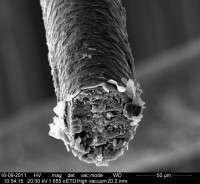
An electron microscope photograph of the hair sample

An international team of researchers has for the first time sequenced the genome of a man who was an Aboriginal Australian. They have shown that modern day Aboriginal Australians are the direct descendents of the first people who arrived on the continent some 50,000 years ago and that those ancestors left Africa earlier than their European and Asian counterparts. The work is published this evening (22 September 2011) in the journal Science.

Although there is good that shows humans in Australia around 50,000 years ago, this genome study re-writes the story of their journey there. The study provides good evidence that Aboriginal Australians are descendents of the earliest modern explorers, leaving Africa around 24,000 years before their Asian and European counterparts. This is contrary to the previous and most widely accepted theory that all modern humans derive from a single out-of-Africa migration wave into Europe, Asia, and Australia.

This video is not supported by your browser at this time.

Watch interview with Professor Eske Willerslev who headed an international study that has pieced together the human genome from an Aboriginal Australian. The results, now to be published in the international journal Science, reinterpret the prehistory of our species. Credit: Voice: Sheena Lauersen. Illustration: Science/AAAS, Sofia Olsen. Stills: Mikal Schlosser, Timothy P. Topper. Camera: Kristoffer Aabo, Henrik Prętorius. Production: Henrik Prętorius.

Professor Eske Willerslev from the University of Copenhagen, who led the study, said "While the ancestors of Europeans and Asians were sitting somewhere in Africa or the Middle East, yet to explore their world further, the ancestors of Aboriginal Australians spread rapidly; the first modern humans traversing unknown territory in Asia and finally crossing the sea into Australia. It was a truly amazing journey that must have demanded exceptional survival skills and bravery."

Dr Francois Balloux, MRC Centre for Outbreak, Analysis and Modelling, Imperial College London, led the UK team, he said "Thanks to tremendous progress in it is much easier to compare genomes of individual people, including those from geographically distinct populations. And by doing this you can learn a lot about when and via what route they came to be where they are today. In this way, the science of genomics makes a unique contribution to our understanding of when and how humans colonised the world."

The study derived from a lock of hair donated to a British anthropologist by an Aboriginal man from the Goldfields region of Western Australia in the early 20th century. One hundred years later, researchers have isolated from this same hair, using it to explore the genetics of the first Australians and to provide insights into how humans first dispersed across the globe.

By sequencing the genome, which was shown to have no genetic input from modern European Australians, the researchers demonstrated that Aboriginal descend directly from an early human expansion into Asia that took place some 70,000 years ago, at least 24,000 years before the population movements that gave rise to present-day Europeans and Asians.

This research is presented with the full endorsement of the Goldfields Land and Sea Council, the organization that represents the Aboriginal traditional owners for the region.

Professor Douglas Kell, Chief Executive, BBSRC said "In a new era of rapid sequencing, one of the most powerful approaches to understanding human biology will be to make comparisons between the genomes of multiple individuals – so-called population genomics. One of the options is to do this according to geography and so learn about, for example, early human migration or the localised evolution of health and disease."

Provided by Biotechnology and Biological Sciences Research Council search and more info website

4.9 /5 (11 votes)  

Rank 4.9 /5 (11 votes)
Relevant PhysicsForums posts

More news stories

Scientist: Evolution debate will soon be history

(AP) -- Richard Leakey predicts skepticism over evolution will soon be history. Not that the avowed atheist has any doubts himself.

Biology / Evolution

created 17 hours ago | popularity 3.3 / 5 (17) | comments 54

More plant species responding to global warming than previously thought

(Phys.org) -- Far more wild plant species may be responding to global warming than previous large-scale estimates have suggested.

Biology / Ecology

created May 22, 2012 | popularity 4.6 / 5 (14) | comments 18 | with audio podcast

Thousands of shellfish found dead in Peru

Thousands of crustaceans were found dead off the coast of Lima following the mystery mass death of dolphins and pelicans, the Peruvian Navy said Friday.

Biology / Ecology

created May 26, 2012 | popularity 4.8 / 5 (4) | comments 7

For monogamous sparrows, it doesn't pay to stray (but they do it anyway)

It's quite common for a female song sparrow to stray from her breeding partner and mate with the male next door, but a new study shows that sleeping around can be costly.

Biology / Plants & Animals

created May 22, 2012 | popularity 5 / 5 (2) | comments 7 | with audio podcast

Study uncovers secret to speedy burrowing by razor clams

(Phys.org) -- If you look at a razor burrowing clam sitting in a bucket, you’d never guess that it could burrow itself down into the soil, much less do it with any speed. Razor clams look like fat straws, ...

Biology / Plants & Animals

created May 25, 2012 | popularity 1 / 5 (1) | comments 3 | with audio podcast report


Browser wars flare in mobile space

The browser wars are heating up again, but this time the fight is for dominance of the mobile Internet.

Nvidia trumpets Tegra 3 phone design wins for 2012

(Phys.org) -- Nvidia’s competitive war paint has a name, Tegra 3. On the heels of Nvidia announcements about lowering costs of its Tegra 3 processors and Nvidia-enabled tablets running Android Ice Cream ...

Dell tablet leak: 10.1-inch display, two-battery choice

(Phys.org) -- Headline after headline talks about vendors’ tablets in the wings as likely number-one contenders for the iPad. Such claims have justifiably been taken with a grain of salt, considering ...

Keep food safety in mind this memorial day weekend

(HealthDay) -- Picnics, parades and cookouts are as much a part of Memorial Day weekend as tributes to the United States' war veterans.

Social welfare cuts ultimately come with heavy price, researchers say

(Phys.org) -- Slashing government funding for Medicaid, food stamps and other programs that serve the poor – while politically popular with some lawmakers and many conservatives – may do more harm ...

Is a classical electrodynamics law incompatible with special relativity?

(Phys.org) -- The laws of classical electromagnetism that were developed in the 19th century are the same laws that scientists use today. They include Maxwell’s four equations along with the Lorentz la ...