Weather, snow models help arctic Canada's inuit people
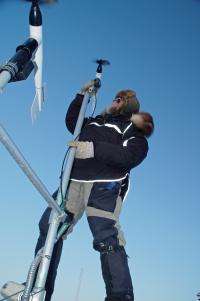
A Colorado State University atmospheric scientist is helping the physically isolated Inuit people on Canada’s Baffin Island with a groundbreaking weather model that quickly identifies and predicts dangerous snow and wind conditions.
The model, developed by Glen Liston, a senior research scientist in CSU’s renowned Cooperative Institute for Research in the Atmosphere, is part of a larger National Science Foundation project to examine the effects of climate change on human populations. Liston and his research team have installed three weather stations on the island to measure such things as snow depth and wind speed in real time and – through Liston’s modeling – account for blowing snow as well as future conditions.
The island, west of Greenland on the extreme northeastern edge of Canada, gets daily incoming flights that carry supplies, but the Inuit population relies largely on the land and sea – including whale and seal hunting – for survival, said Liston, who has visited the island four times in the past two years. Average annual temperature on the island is about 17 degrees Fahrenheit.
Liston is one of the rare scientists at CIRA who works with computer models in the office as well as travels to make observations in the field. He’s no stranger to Arctic environments: In his 28 years as a researcher, he has spent more than 500 days sleeping on snow and more than five years in the field.
“We’re trying to relate the physical observed climate system to the observations the Inuit make,” Liston said. “A goal of this project is to talk to people about what influences their decisions and to develop tools associated with those decision-making processes.
“People want weather forecasts that keep them safe or that have economic benefit,” Liston said. “Just like the floods in the Midwest now or the increase in tornadoes, the snow melting earlier or the sea ice or the winds coming from a different direction influences these guys. If things happen that make it more unsafe, it’s no different than if things happen in the Lower 48 that make us unsafe. It’s really human/weather interactions, but just in a different environment where the interactions are a little different.”
Liston is part of a four-person NSF team led by Shari Gearheard, an Arctic geographer and research scientist at the University of Colorado National Snow and Ice Data Center, who lives on the island. Also participating in the study is Kelly Elder, former CSU professor who is now a snow hydrologist for the U.S. Forest Service in Fort Collins.
Liston’s unique model transfers conditions that might be occurring over a very large area into more localized measurements of every 10 to 100 meters - what Liston calls “real-world, human-relevant spatial distributions.”
To use an analogy, “It doesn’t matter what it’s like two miles away from a tornado,” Liston said. “What matters is what’s happening right underneath it.”
Liston’s models have been used in Colorado, Wyoming, Idaho, Oregon, Alaska, Arctic Canada, Siberia, Japan, Tibet, Chile, Germany, Austria, Svalbard, Norway, Greenland and Antarctica as part of a wide variety of snow and weather studies.
In Canada, the NSF team has spent the past two years meeting with key Inuit leaders, particularly elders who lived in igloos and skin shelters before a change in Canadian law brought them to the individual hamlets they now live in.
“They’ve said the frequency of offshore wind has changed over the last 30 years. The snow melts two or three weeks earlier than it used to, and it starts accumulating and freezing a week or two later in the fall,” Liston said. “That affects the hunting and fishing they can do. There’s an economic cost to that change in seasons – the dog-team sledding and snowmobile traveling season is shorter, and the boating season is longer. It costs more to run a boat than a snowmobile because boats burn more fuel to go the same distance.”
But Liston said he has learned that safety, not comfort, largely determines decisions made in the community.
“There are all kinds of social decisions that affect how they interact with the environment that make the whole thing very complicated,” he said. “It’s hard to have a model that says if it’s this cold or this windy, this is how they’re going to behave. What the Inuit really care about is whether the weather conditions make traveling and hunting unsafe for themselves and their families.”
Provided by Colorado State University


