Spotting weaknesses in solid wood
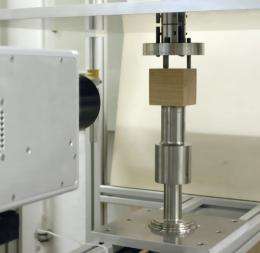
The ultrasound agitator causes the wood to vibrate, which generates frictional heat wherever there are cracks. A thermal imaging camera shows these defects up. (© Fraunhofer WKI)
Is there a hairline crack in the oak table? Was the window frame glued badly? Ultrasound thermography can reliably identify material defects during the production of wooden items. This allows rejects to be caught quickly and eliminated, and faulty goods to be repaired in good time.
People who buy an expensive solid wooden table or wardrobe want to be certain that their new piece of furniture is absolutely faultless. Pianos whether upright or grand can only produce an opulent tone if their soundboard, bridge and keyboard are made of high-quality materials. And wood that is free of imperfections is also essential in house building and window construction: load-bearing wooden beams need to be of the highest quality, as even the smallest crack can cause them to fail.
Research scientists from the Fraunhofer Institute for Wood Research, Wilhelm-Klauditz-Institut, WKI in Braunschweig are able to pinpoint defects in wood that cannot be seen with the naked eye. Using high-power ultrasound thermography they can detect longitudinal and transverse cracks, gluing errors, delaminations and black knots. To do this they vibrate the wooden item using a sonotrode, or ultrasound agitator, at a frequency of 20 kHz in other words, 20,000 times a second. Where there are defects, the different parts of the material rub against each other and produce heat. This heat at the defects extremities is picked up by a thermal imaging camera connected to a monitor; in the case of hairline cracks, frictional heat can be seen along the length of the crack as well. High-power ultrasound thermography even allows the researchers to probe beneath the surface to uncover dowels that have not been glued and defects hidden under coatings something that todays much less reliable testing methods, such as mechanical materials testing or electrical measuring, are simply not able to do.
We can spot the imperfections in raw timber. That is crucial for rejecting defective wood before time and money have been invested in processing it, says physicist Peter Meinlschmidt at the WKI. Whether the wood in question is oak, walnut or beech is not important, and neither is the condition of the wood ; defects in damp parts show up on the thermal imaging camera too. The depth to which the wood can be analyzed depends on its thermal conductivity, but up to 20 millimeters are possible. Our process is especially suited for finding defects in high-quality solid wooden parts and window frame squares and to detect badly glued joints. Its a non-destructive testing method. Applying the ultrasound agitator does leave small pressure marks though but these arent an issue when youre dealing with raw timber, explains Meinlschmidt. The researchers have even managed to use high-energy ultrasound thermography to detect cracks in ceramics and glass. In laboratory tests, they were able to pinpoint defects in ceramic floor tiles and in glass mouthwash bottles. In ceramics and glass we can spot defects that are up to 30 centimeters away from the sonotrode, says the research scientist. A demonstrator of the ultrasound generator with thermal imaging camera has already been built.
Provided by
Fraunhofer-Gesellschaft
-
From lemons to lemonade: Reaction uses carbon dioxide to make carbon-based semiconductor,
32 comments
-
Thioridazine kills cancer stem cells in human while avoiding toxic side-effects of conventional cancer treatments,
3 comments
-
SpaceX private rocket blasts off for space station (Update),
42 comments
-
Climate scientists say they have solved riddle of rising sea,
31 comments
-
SpaceX capsule has 'new car' smell, astronauts say (Update),
2 comments
-
Need a rigid insulation material???
15 hours ago
-
magnets or EMF in car bumpers to protect from fender bender
May 26, 2012
-
length of wire in a coil of known dimensions?
May 25, 2012
-
India Engineering Powerhouse
May 25, 2012
-
electromagnet core dereference between hard and soft iron
May 25, 2012
-
Measuring water pressure in an open tank
May 24, 2012
- More from Physics Forums - General Engineering
More news stories
Browser wars flare in mobile space
The browser wars are heating up again, but this time the fight is for dominance of the mobile Internet.
8 hours ago |
5 / 5 (1) |
3
Probability of contamination from severe nuclear reactor accidents is higher than expected: study
Catastrophic nuclear accidents such as the core meltdowns in Chernobyl and Fukushima are more likely to happen than previously assumed. Based on the operating hours of all civil nuclear reactors and the number ...
Technology / Energy & Green Tech
May 22, 2012 |
3.6 / 5 (22) |
56
|
SpotterRF debuts Radar Backpack Kit (w/ Video)
(Phys.org) -- SpotterRF has announced a special radar backpack kit designed to enhance situational awareness for soldiers on the ground. The company says its special radar is designed for warfighters as part ...
HyperSolar shows dirty water no barrier to power world
(Phys.org) -- The Santa Barbara, California, company, HyperSolar, is set to transparently share the ups and downs of its research experiences toward the companys ultimate vision, successfully producing ...
Tesla to launch electric sedan in US on June 22
Tesla Motors said Tuesday it would begin deliveries of "the world's first premium electric sedan" on June 22, slightly ahead of schedule.
Technology / Energy & Green Tech
May 22, 2012 |
4.5 / 5 (12) |
18
Change in developmental timing was crucial in the evolutionary shift from dinosaurs to birds: study
At first glance, it's hard to see how a common house sparrow and a Tyrannosaurus Rex might have anything in common. After all, one is a bird that weighs less than an ounce, and the other is a dinosaur that ...
Computer model used to pinpoint prime materials for efficient carbon capture
When power plants begin capturing their carbon emissions to reduce greenhouse gases and to most in the electric power industry, it's a question of when, not if it will be an expensive undertaking.
'Unzipped' carbon nanotubes could help energize fuel cells, batteries
Multi-walled carbon nanotubes riddled with defects and impurities on the outside could replace some of the expensive platinum catalysts used in fuel cells and metal-air batteries, according to scientists at ...
T cells 'hunt' parasites like animal predators seek prey, study shows
By pairing an intimate knowledge of immune-system function with a deep understanding of statistical physics, a cross-disciplinary team at the University of Pennsylvania has arrived at a surprising finding: T cells use a movement ...
Manufacturing genes to attack flu virus
An international research team has manufactured a new protein that can combat deadly flu epidemics.
Yale study concludes public apathy over climate change unrelated to science literacy
Are members of the public divided about climate change because they don't understand the science behind it? If Americans knew more basic science and were more proficient in technical reasoning, would public consensus match ...