Transparent electronics from graphene-based electrodes (w/ Video)
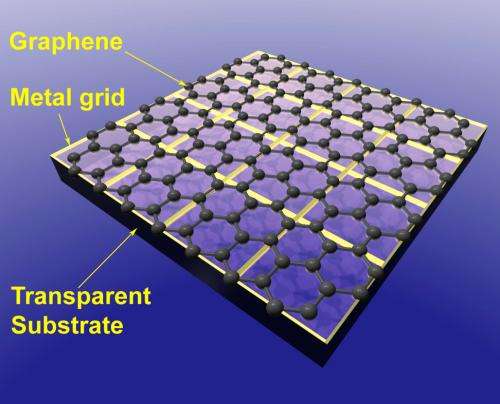
A hybrid material that combines a fine aluminum mesh with a single-atom-thick layer of graphene outperforms materials common to current touch screens and solar cells. The transparent, flexible electrodes were developed in the lab of Rice University chemist James Tour. (Credit: Yu Zhu/Rice University)
Flexible, transparent electronics are closer to reality with the creation of graphene-based electrodes at Rice University.
The lab of Rice chemist James Tour lab has created thin films that could revolutionize touch-screen displays, solar panels and LED lighting. The research was reported in the online edition of ACS Nano.
Flexible, see-through video screens may be the "killer app" that finally puts graphene -- the highly touted single-atom-thick form of carbon -- into the commercial spotlight once and for all, Tour said. Combined with other flexible, transparent electronic components being developed at Rice and elsewhere, the breakthrough could lead to computers that wrap around the wrist and solar cells that wrap around just about anything.
The lab's hybrid graphene film is a strong candidate to replace indium tin oxide (ITO), a commercial product widely used as a transparent, conductive coating. It's the essential element in virtually all flat-panel displays, including touch screens on smart phones and iPads, and is part of organic light-emitting diodes (OLEDs) and solar cells.
This video is not supported by your browser at this time.
ITO works well in all of these applications, but has several disadvantages. The element indium is increasingly rare and expensive. It's also brittle, which heightens the risk of a screen cracking when a smart phone is dropped and further rules ITO out as the basis for flexible displays.The Tour Lab's thin film combines a single-layer sheet of highly conductive graphene with a fine grid of metal nanowire. The researchers claim the material easily outperforms ITO and other competing materials, with better transparency and lower resistance to electric current.
"Many people are working on ITO replacements, especially as it relates to flexible substrates," said Tour, Rice's T.T. and W.F. Chao Chair in Chemistry as well as a professor of mechanical engineering and materials science and of computer science. "Other labs have looked at using pure graphene. It might work theoretically, but when you put it on a substrate, it doesn't have high enough conductivity at a high enough transparency. It has to be assisted in some way."
Conversely, said postdoctoral researcher Yu Zhu, lead author of the new paper, fine metal meshes show good conductivity, but gaps in the nanowires to keep them transparent make them unsuitable as stand-alone components in conductive electrodes.
But combining the materials works superbly, Zhu said. The metal grid strengthens the graphene, and the graphene fills all the empty spaces between the grid. The researchers found a grid of five-micron nanowires made of inexpensive, lightweight aluminum did not detract from the material's transparency.
"Five-micron grid lines are about a 10th the size of a human hair, and a human hair is hard to see," Tour said.
Tour said metal grids could be easily produced on a flexible substrate via standard techniques, including roll-to-roll and ink-jet printing. Techniques for making large sheets of graphene are also improving rapidly, he said; commercial labs have already developed a roll-to-roll graphene production technique.
"This material is ready to scale right now," he said.
The flexibility is almost a bonus, Zhu said, due to the potential savings of using carbon and aluminum instead of expensive ITO. "Right now, ITO is the only commercial electrode we have, but it's brittle," he said. "Our transparent electrode has better conductivity than ITO and it's flexible. I think flexible electronics will benefit a lot."
In tests, he found the hybrid film's conductivity decreases by 20 to 30 percent with the initial 50 bends, but after that, the material stabilizes. "There were no significant variations up to 500 bending cycles," Zhu said. More rigorous bending test will be left to commercial users, he said.
"I don't know how many times a person would roll up a computer," Tour added. "Maybe 1,000 times? Ten thousand times? It's hard to see how it would wear out in the lifetime you would normally keep a device."
The film also proved environmentally stable. When the research paper was submitted in late 2010, test films had been exposed to the environment in the lab for six months without deterioration. After a year, they remain so.
"Now that we know it works fine on flexible substrates, this brings the efficacy of graphene a step up to its potential utility," Tour said.
More information: ACS Nano, Article ASAP DOI: 10.1021/nn201696g
Provided by
Rice University
-
From lemons to lemonade: Reaction uses carbon dioxide to make carbon-based semiconductor,
32 comments
-
Thioridazine kills cancer stem cells in human while avoiding toxic side-effects of conventional cancer treatments,
3 comments
-
SpaceX private rocket blasts off for space station (Update),
42 comments
-
Climate scientists say they have solved riddle of rising sea,
31 comments
-
SpaceX capsule has 'new car' smell, astronauts say (Update),
2 comments
-
microstructure of titanium
21 hours ago
-
Steam in My Espresso Machine
May 26, 2012
-
Density question
May 24, 2012
-
Mass transport originating from a point source at a solid gas interface
May 22, 2012
-
Ammonia dispersion in Air
May 22, 2012
-
Multi Choice Help
May 21, 2012
- More from Physics Forums - Materials & Chemical Engineering
More news stories
'Unzipped' carbon nanotubes could help energize fuel cells, batteries
Multi-walled carbon nanotubes riddled with defects and impurities on the outside could replace some of the expensive platinum catalysts used in fuel cells and metal-air batteries, according to scientists at ...
Nanotechnology / Nanomaterials
7 minutes ago |
not rated yet |
0
|
In nanorod crystal growth, nanoparticles seen as artificial atoms
In the growth of crystals, do nanoparticles act as "artificial atoms" forming molecular-type building blocks that can assemble into complex structures? This is the contention of a major but controversial theory ...
May 24, 2012 |
4.8 / 5 (6) |
0
|
First direct observation of oriented attachment in nanocrystal growth
Berkeley Lab researchers have reported the first direct observation of nanoparticles undergoing oriented attachment, the critical step in biomineralization and the growth of nanocrystals. A better understanding ...
May 24, 2012 |
4.7 / 5 (3) |
0
|
Dopant gives graphene solar cells highest efficiency yet
(Phys.org) -- By taking advantage of graphenes favorable electrical and optical properties, and then adding an organic dopant, researchers have achieved the highest power conversion efficiency yet for ...
Synthetic nano-waste does not disappear
(Phys.org) -- Tiny particles of cerium oxide do not burn or change in the heat of a waste incineration plant. They remain intact on combustion residues or in the incineration system, as a new study by Swiss ...
Nanotechnology / Bio & Medicine
May 25, 2012 |
5 / 5 (2) |
1
|
Change in developmental timing was crucial in the evolutionary shift from dinosaurs to birds: study
At first glance, it's hard to see how a common house sparrow and a Tyrannosaurus Rex might have anything in common. After all, one is a bird that weighs less than an ounce, and the other is a dinosaur that ...
Computer model used to pinpoint prime materials for efficient carbon capture
When power plants begin capturing their carbon emissions to reduce greenhouse gases and to most in the electric power industry, it's a question of when, not if it will be an expensive undertaking.
T cells 'hunt' parasites like animal predators seek prey, study shows
By pairing an intimate knowledge of immune-system function with a deep understanding of statistical physics, a cross-disciplinary team at the University of Pennsylvania has arrived at a surprising finding: T cells use a movement ...
Manufacturing genes to attack flu virus
An international research team has manufactured a new protein that can combat deadly flu epidemics.
Yale study concludes public apathy over climate change unrelated to science literacy
Are members of the public divided about climate change because they don't understand the science behind it? If Americans knew more basic science and were more proficient in technical reasoning, would public consensus match ...
Same gene that stunts infants' growth also makes them grow too big: research
UCLA geneticists have identified the mutation responsible for IMAGe* syndrome, a rare disorder that stunts infants' growth. The twist? The mutation occurs on the same gene that causes Beckwith-Wiedemann syndrome, which makes ...
Aug 02, 2011
Rank: not rated yet
I envisage playing Zombie or Alien invasion games around the house/street/pub with some mates. Networked mobile gaming devices attached to the glasses with stereo cameras for the gaming system to interpret 3D surroundings. Identifying surfaces to project AR images onto. Detecting other 'users' and projecting AR avatars onto their person. Watching films on the cieling in bed.. the possibilities are endless and the technology is here!