New tool may yield smaller, faster optoelectronics
The steady improvement in speed and power of modern electronics may soon hit the brakes unless new ways are found to pack more structures into microscopic spaces. Unfortunately, engineers are already approaching the limit of what light—the choice tool for "tweezing" tiny features—can achieve. But there may be a way of reaching beyond this so-called "diffraction limit" by precisely steering, in real time, a curve-shaped beam of weird "virtual particles" known as surface plasmons.
This technique, described in the Optical Society's (OSA) journal Optics Letters, opens the possibility of even smaller, faster communications systems and optoelectronic devices. Examples of optoelectronic devices used today include photodiodes such as solar cells, integrated optical circuits used in communications, and charged coupled imaging devices at the heart of cell phone cameras and receivers on the world's most advanced telescopes. This method also may yield new, important tools for research in chemistry, biology, and medicine.
The key to this innovation is the ability—for the first time—to actively manipulate a blended stream of light and plasma, known as a plasmonic Airy beam. The beam, owing to the laws of electromagnetism, travels, not in a straight line like the beams of light to which we are accustomed, but rather in an arc. "It's an odd thing for sure, as light is supposed to travel in a straight line," says Peng Zhang a member of the research team with the National Science Foundation (NSF) Nanoscale Science and Engineering Center of the University of California, Berkeley and Department of Physics and Astronomy at San Francisco State University (SFSU). "That's why people are so crazy about these kinds of interesting beams."
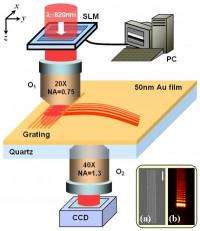
As the beam first strikes a metal surface (typically at an irregular feature called a grating structure), it stirs up small waves of electrons at the metal-insulator interface. These waves, which can be thought of as "virtual particles" known as surface plasmon polaritons (SPPs), then follow the curved trajectory of the Airy beams (see Fig. 1). And, just as ocean waves move objects on the surface of the water, the SPPs can be directed to manipulate ultrafine-scale features on the surface of a metal.
SPPs are already essential elements in the design and manufacture of optoelectronic devices. The reason they're so critical is that they can affect extremely small-scale objects, smaller than the diffraction limit, or half of the wavelength of light used to create SPPs.
The current systems, however, have a significant drawback: they required fixed, permanent nanostructures to direct the SPPs. This lack of flexibility severely limits their uses in nano-system design and manufacture. But by being able to manipulate the Airy beam, and therefore the SPPs, in real time, the new design gives scientists on-the-fly control (see Fig. 2).
"We have demonstrated a new way of routing the flow of surface plasmons without any guiding structures," says Xiang Zhang, who led this research and is the director of the NSF Nanoscale Science and Engineering Center at Berkeley and a faculty scientist with the Materials Sciences Division of the Lawrence Berkeley National Laboratory.
The lack of guiding structures, according to Xiang Zhang, is the critical innovation in their design. Currently, to manipulate surface plasmons over two-dimensional metal surfaces, different elements such as waveguides, lenses, beam splitters, and reflectors need to be created. This is done by either structuring metal surfaces (fabricating some permanent nanostructures) or placing insulators on metals. These permanent guiding structures cannot be reconfigured; once the structure is fabricated it cannot be changed in real time.
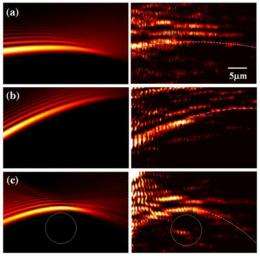
By using computer-controlled optics, however, the research team has developed a way to steer and manipulate the beams, precisely directing their trajectories to specific spots on an optical surface and adjusting them as needed. Due to their unique arc-shaped paths, the beams have the added ability to bypass surface roughness and defects, or even vault over obstacles.
"These on-the-fly adjustments are extremely desirable," says Zhigang Chen, a principal investigator with the Department of Physics and Astronomy at SFSU. "They enable reconfigurable optical interconnections in ultra-compact integrated photonic circuits, which are at the core of many high-speed computing technologies. They also would enable on-chip nanoparticle manipulations for chemical, medical, or biological research purposes."
The Airy beams used to direct the flow of plasmons also remain coherent, not fanning out or distorting as they travel along their curved trajectories, much in the same way that laser light remains coherent even after traveling great distances.
To create the Airy beams, the researchers used a laser beam and modulated its phase, or wave front, with a spatial light modulator (a device similar to a miniature liquid crystal display) controlled by a personal computer. By continuously changing the specially designed patterns in the computer, they were able to dynamically control the trajectories of the beam in real time.
"These results point out a new direction for dynamically routing surface energies without any permanent guiding structures," says Peng Zhang, "which could inspire researchers from different areas to develop new technologies or tools for a variety of applications." For example, in nano-photonics, researchers may design practical reconfigurable plasmonic devices for ultra-compact integrated photonic circuits. In biology and chemistry, researchers may establish new tools for dynamically manipulating nanoparticles or molecules, and improving the performance of sensors.
"The ultrafine wavelength nature of surface plasmons makes them a promising tool for future nanolithography or nanoimaging applications," says research team member Sheng Wang, also of the NSF Nanoscale Science and Engineering Center. "Now, with the dynamic tunable plasmonic Airy beams, researchers may also shed new light on ultrahigh resolution bioimaging. For example, by bypassing obstacles and directly shining a beam on a target sample, background noise can be greatly reduced, which would enable more accurate imaging."
"This method may also encourage researchers in other fields to manipulate the surface waves in other low-dimensional systems, including graphenes, topological insulators, and magnetic thin films," says fellow team member Yongmin Liu of the NSF Nanoscale Science and Engineering Center.
More information: The paper, titled "Plasmonic Airy beams with dynamically controlled trajectories," was authored by Peng Zhang, Sheng Wang, Yongmin Liu, Xiaobo Yin, Changgui Lu, Zhigang Chen, and Xiang Zhang. It appears in the Aug. 15 issue of Optics Letters (vol. 36, issue 16, pp. 3191-3193). www.opticsinfobase.org/ol/abst … fm?uri=ol-36-16-3191
Provided by Optical Society of America


