Researchers theorize that neutrons may be squished into cubes in neutron stars
August 18, 2011 by Bob Yirka
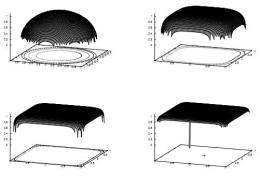
Trial wavefunction that interpolates between sphere, and cube. Image: arXiv:1108.1859v1 [nucl-th]
(PhysOrg.com) -- Neutrons, those particles that reside here on Earth inside the nucleus of atoms, along with protons, collectively called nucleons, are thought to exist in the far reaches of the universe inside of so-named neutron stars, which are the remnants of stars that have exploded. In a paper published on the preprint server arXiv, Spanish physicists Felipe Llanes-Estrada, and Gaspar Moreno Navarro, suggest that the densities in the cores of certain sizes of such neutron stars might be so great as to squash the neutrons down from their normal spherical shape, into cubes.
The key is in the size of the neutron star, the researchers say; too big and theyd collapse down to black holes. Too small and they'd simply exist as run of the mill neutron stars. Since the tipping point is believed to be such stars that are of twice the density as the sun, the discovery of a neutron star last year, PSR J1614-2230 (the largest ever found) with a solar masses of 1.97 seems to fit the bill as its about as dense as a neutron star can get without collapsing. The researchers speculate that in order to achieve such a density, the neutrons at its core would have to facilitate a means of having the same number of neutrons in a smaller space. And because cubes are more efficient, they theorize that those neutrons closet to the core, would be the ones squished down to cube shapes.
Llanes-Estrada likens it to a stack of oranges sitting on a grocers shelf. Normally spherical they begin to flatten as more and more are piled on top. If the same amount of weight (gravity) were applied in all directions, the oranges would flatten from both above and below, but also on all sides as well.
In their natural state, as spheres, neutrons have a packing density of about 74%; collapsing them down to cubes, creating a sort of crystal lattice such as happens when diamonds from carbon in the Earth, could possibly bring that number up to nearly 100%.
Not everyone agrees with the results of the duos paper, some even suggesting that the huge density numbers could come about as the result of the blurring of lines between individual neutrons; but the two researchers seem undaunted, suggesting that pushing boundaries, is all a part of science.
More information: Cubic neutrons, arXiv:1108.1859v1 [nucl-th] http://arxiv.org/abs/1108.1859
Abstract
The neutron is largely spherical and incompressible in atomic nuclei. These two properties are however challenged in the extreme pressure environment of a neutron star. Our variational computation within the Cornell model of Coulomb gauge QCD shows that the neutron (and also the Delta-3/2 baryon) can adopt cubic symmetry at an energy cost of about 150 MeV. Balancing this with the free energy gained by tighter neutron packing, we expose the possible softening of the equation of state of neutron matter.
via Arxiv Blog
© 2011 PhysOrg.com
-
From lemons to lemonade: Reaction uses carbon dioxide to make carbon-based semiconductor,
32 comments
-
Thioridazine kills cancer stem cells in human while avoiding toxic side-effects of conventional cancer treatments,
3 comments
-
SpaceX private rocket blasts off for space station (Update),
42 comments
-
Climate scientists say they have solved riddle of rising sea,
31 comments
-
SpaceX capsule has 'new car' smell, astronauts say (Update),
2 comments
-
Water flow question
2 hours ago
-
[Drift velocity] Factors affecting velocity
5 hours ago
-
does cold gasoline have less energy
5 hours ago
-
distribution of molecules throughout the atmosphere
7 hours ago
-
The Global Positioning System !
8 hours ago
-
A Question relating Power
9 hours ago
- More from Physics Forums - General Physics
More news stories
Is a classical electrodynamics law incompatible with special relativity?
(Phys.org) -- The laws of classical electromagnetism that were developed in the 19th century are the same laws that scientists use today. They include Maxwell’s four equations along with the Lorentz la ...
Landmark calculation clears the way to answering how matter is formed
(Phys.org) -- An international collaboration of scientists, including Thomas Blum, associate professor of physics, is reporting in landmark detail the decay process of a subatomic particle called a kaon ...
May 25, 2012 |
4.3 / 5 (22) |
50
|
Lying in wait for WIMPs: Researchers seek to dramatically increase sensitivity of Large Underground Xenon detector
Although it's invisible, dark matter accounts for at least 80 percent of the matter in the universe. No one knows what it is, but most scientists would bet on weakly interacting massive particles, or WIMPs.
May 23, 2012 |
4 / 5 (7) |
15
|
Hawaii lab turns laser-powered bubbles into microrobots
(Phys.org) -- A team of scientists from the University of Hawaii are working on microrobots created from bubbles of air in a saline solution. The bubbles take on their title of robots as a laser ...
Sound increases the efficiency of boiling
Scientists at the Georgia Institute of Technology achieved a 17-percent increase in boiling efficiency by using an acoustic field to enhance heat transfer. The acoustic field does this by efficiently removing vapor bubbles ...
May 24, 2012 |
5 / 5 (2) |
2
Change in developmental timing was crucial in the evolutionary shift from dinosaurs to birds: study
At first glance, it's hard to see how a common house sparrow and a Tyrannosaurus Rex might have anything in common. After all, one is a bird that weighs less than an ounce, and the other is a dinosaur that ...
Computer model used to pinpoint prime materials for efficient carbon capture
When power plants begin capturing their carbon emissions to reduce greenhouse gases and to most in the electric power industry, it's a question of when, not if it will be an expensive undertaking.
'Unzipped' carbon nanotubes could help energize fuel cells, batteries
Multi-walled carbon nanotubes riddled with defects and impurities on the outside could replace some of the expensive platinum catalysts used in fuel cells and metal-air batteries, according to scientists at ...
T cells 'hunt' parasites like animal predators seek prey, study shows
By pairing an intimate knowledge of immune-system function with a deep understanding of statistical physics, a cross-disciplinary team at the University of Pennsylvania has arrived at a surprising finding: T cells use a movement ...
Manufacturing genes to attack flu virus
An international research team has manufactured a new protein that can combat deadly flu epidemics.
Yale study concludes public apathy over climate change unrelated to science literacy
Are members of the public divided about climate change because they don't understand the science behind it? If Americans knew more basic science and were more proficient in technical reasoning, would public consensus match ...
Aug 18, 2011
Rank: 3.7 / 5 (3)
http://en.wikiped..._crystal
It means, when the neutrons are squeezed enough, their short distance repulsive lepton charge applies in similar way, like at the case of long distance electromagnetic charge of free electrons. It's not rocket science, despite it appears so at the first look.
Aug 18, 2011
Rank: 5 / 5 (6)
Aug 18, 2011
Rank: 3.2 / 5 (5)
I presume, we could study such a geometry experimentally with electrons or tiny charged nanoparticles, attracted to surface of insulators with strong external electrostatic field.
Aug 18, 2011
Rank: 5 / 5 (1)
Likening this to the 'orange pile' is no good. That pile only has one direction of gravitational force..
Aug 18, 2011
Rank: 4.7 / 5 (3)
For some reason, this story reminded me of something here on Earth:
http://www.snopes...elon.asp
(square watermelons)
Aug 18, 2011
Rank: 3 / 5 (2)
http://arxiv.org/abs/1106.4548
http://xxx.lanl.g.../0506053
http://mathworld....ing.html
Aug 18, 2011
Rank: 4.3 / 5 (9)
Gawad, I'm surprised you missed "Too small and they'd simply exist as run of the mill neutron stars."
Correction - too small and they would exist as run of the mill white dwarfs.
What happened to Oliver. This paper has relevant information on the sun's neutron core.
@shockr - the orange pile metaphor is perfectly fine. the neutrons pack in like a pyramid made of oranges. In fact, I think they over explained it. Let me lay it out simply for your reading comprehension skills. They are basically saying that the neutrons crystallize into a cubic type crystal.
Aug 18, 2011
Rank: 5 / 5 (2)
Aug 18, 2011
Rank: 5 / 5 (4)
Also, I couldn't really make out if Bob was trying to situate these special case "squaring the neutrons" neutron stars between black holes and white dwarfs or between black holes (supposedly JUST above the mass limit for these special neutron stars) and "regular" neutron stars with round neutrons. It seems to me that Mr. Yirka usually manages to be a little more clear!
Aug 18, 2011
Rank: 5 / 5 (7)
Aug 18, 2011
Rank: not rated yet
You're right, I didn't think about that. Maybe it was unclear instead of incorrect.
Aug 18, 2011
Rank: not rated yet
Aug 18, 2011
Rank: 1 / 5 (1)
You're both wrong.
The author is saying that a NS of 1.4sols isn't massive, or dense, enough to pack its neutrons in the manner described.
Just sayin'
Aug 18, 2011
Rank: 5 / 5 (3)
Isn't that what Gawad is saying in the statement you quoted??
Aug 18, 2011
Rank: 5 / 5 (3)
Aug 18, 2011
Rank: not rated yet
Aug 18, 2011
Rank: 5 / 5 (1)
It's OK, Guy, he's just being Shootist. Shootin' from the hip, BANG, BANG!
Some day he'll figure out either that twice the density of the Sun doesn't quiiiite match the density of any neutron star, or that doubling the Sun's *density* won't do Jack S*it as far as its mass. Or better yet, he'll pull those two ideas together and conclude that "twice the density as the sun" and "need to be twice the mass of the sun to be dense enough" aren't equivalent statements. And, yes, we all figured out what Bob was trying to say there anyway.
Aug 18, 2011
Rank: 5 / 5 (2)
Aug 18, 2011
Rank: 5 / 5 (1)
Aug 18, 2011
Rank: 5 / 5 (1)
Aug 19, 2011
Rank: 5 / 5 (1)
Yes, such an object would have high gravity, but it's not actually about the gravity. It's about the pressure being generated by all the many particles being closely packed around each other in a VERY confined space and pushing against each other (density). This density being high enough to here generate this famous cube. The gravity field being generated will still be omnidirectional, but the shape of the field will follow the shape of the object as long as it is still separate. However, as all these objects and fields are in such close proximity, we get a collective field that is by extension, the field of gravity of the (collective) entity we call a neutron star.
Aug 19, 2011
Rank: 5 / 5 (2)
Aug 19, 2011
Rank: 3 / 5 (2)
At 2D, not 3D...
Aug 19, 2011
Rank: 5 / 5 (1)
I can appreciate that under pressure the neutrons may crystallise into such a lattice form. But surely there are still neutrons on the periphery that are not under such pressure and thus still mould around to form the sphere I'd expect from the gravity well. Is this still the case? I can't image anything having naturally flat sides. Surely some particles would adhere to the flat sides and make it non-uniform in that respect?
Aug 19, 2011
Rank: 1 / 5 (1)
I think he means 3D. Wouldn't that be a Octadecagon with 18 sides? I think that shape packs perfectly.
Aug 22, 2011
Rank: 5 / 5 (1)
Aren't the apical angles wrong for that? Octadecagons are too like a sphere for close packing.
Aug 22, 2011
Rank: 5 / 5 (1)
http://en.wikiped...oneycomb
The cubic honeycomb is the most space efficient because it's externally smooth (no outer layer graininess), when packed into a box.
But, I don't know if it's any more efficient than several other polyhedron shapes, when packed into a sphere.
http://en.wikiped...eometry)
But I suppose the outer layers might exhibit "smoothing" (to conform to the sphere's 2D boundary). Therefore, a variety of shapes seem just as likely.
Aug 22, 2011
Rank: 3 / 5 (1)
Aug 22, 2011
Rank: not rated yet
Exactly what I first thought. It seams logical that spheres would deform easier (read more likely) into something closer to spherical shape while utilizing the gaps.
If there is a reason for the neutrons to be aligned into cubical crystal lattice before they start to change their shape, yet the author has omitted to point this out.
Aug 22, 2011
Rank: not rated yet
I generally agree, but the word simplifies the principle. I doubt the lay audience would easily understand the principle of "tessellation." I think the references I provided clear up any subsequent misunderstandings.
What I wonder is how much resistance to compression the neutrons may have. I definitely think it's likely harder to squeeze a sphere into a cube than a truncated octahedra, or some other semi-spherical polyhedron, as the corners of the cube are significantly extruded away from the center of mass/energy.
Aug 23, 2011
Rank: 1 / 5 (1)
You have deduced correctly, the outer particles would be under less pressure, therefore there would be correspondingly less 'deformity'. This is because the direction of the pressure is inwards, towards the centre and is greatest there. So, the further out from the centre the particle, the less it is being deformed. It is NOT a case of a couple of rounder ones sticking to a group of square ones. We are talking about a VERY large collection of VERY small (but uniform-sized) particles and that each deform gradually less and less, as we travel towards the outer parts. If you want a kind of a lineal analogy, maybe think of stacking a whole pile of loose fluffy cushions on top of each other. The top layer will still be loose and fluffy. As you go down the layers, each will be a little more flattened by the pressure being generated by the ones above. The direction of force is straight down, at a right angle to the floor. To take this to a 2D picture representative of a sphere..cont
Aug 23, 2011
Rank: 1 / 5 (1)
cut down the middle, take your floor and roll it into a tight circle. The cushions are stuck together above and below, so that they don't fall off. The lines of force STILL point at right angles to the tangent of the corresponding point on the floor. And the operation of the force has not changed. The only difference is that the lines now meet at a central point. I tend to be somewhat pictorial (to be as clear as possible) when I try to explain things and I rather suspect that the picture I have painted is somewhat simplistic for you. I'm not trying to imply anything nasty, but I daresay that there are some on this site for whom this is what it takes. I prefer to hope that at least somebody has actually gained some genuine insight from this, however minor. As I would hope that others would do for me, when I don't get it right.
Cheers.
Aug 23, 2011
Rank: not rated yet