Could tadpole weaponry be used against cane toads?
August 31, 2011 By Sunanda Creagh, The Conversation
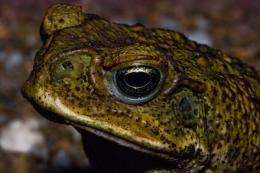
Cane toads are ruthless survivors and even stoop to poisoning competing egg clutches. Credit: Flickr/rob's lensonlife
A chemical produced naturally by cane toad tadpoles may one day be used to help control the invasive species, according to new research published today.
Cane toads are native to South America but have overrun Northern Australia since being introduced in 1935.
Efforts to control the outbreak have been stymied by the toads impressive rate of reproduction; the warty amphibians lay up to 30,000 eggs at a time, crowding out native frogs, which produce only 3000 eggs per clutch.
However, a new ARC-funded study by scientists from the University of Sydney found that cane toad tadpoles produce a chemical that poisons competing cane toad tadpole eggs. They hope the chemical may one day be used in the battle against the invasive species.
A toad is another toads worst enemy. If you are a toad tadpole, you really love to get rid of the opposition by killing any eggs as soon as they are laid, said Rick Shine, Professor in Evolutionary Biology at University of Sydney and co-author of the study.
What we discovered is that toad tadpoles have a very cunning chemical which has the effect of really substantially disturbing the development of eggs laid in the same pond.
The chemical, which the researchers are yet to isolate, identify or name, is emitted by tadpoles and causes competing cane toad eggs from another clutch to develop into tiny toads unlikely to survive.
Its chemical warfare in the pond, said Professor Shine.
The chemical has already likely helped control the cane toad population to some extent in nature, meaning Australias cane toad problem could have been a lot worse.
If the chemical can be isolated, produced commercially and tested to ensure it doesnt also poison native species, it may one day be used to stop cane toad eggs developing into adults.
The researchers have published a paper on the study in the journal Biology Letters.
Associate Professor Mike Tyler, a cane toad expert from the University of Adelaides Department of Ecology and Evolutionary Biology, said the research was interesting but that it was no silver bullet.
Its not Gods answer to a bad problem, he said.
Even if the chemical could be identified and produced in large quantities, it may not be enough to stop cane toads, said Associate Professor Tyler, who was not involved in the study.
Its a fascinating bit if work but certainly of no consequence in terms of biological control, he said. The cane toad occupies 1.5 million square kilometres. No chemical will have any impact whatsoever on that scale.
This story is published courtesy of the The Conversation (under Creative Commons-Attribution/No derivatives).
Provided by The Conversation Media Group
-
From lemons to lemonade: Reaction uses carbon dioxide to make carbon-based semiconductor,
32 comments
-
Thioridazine kills cancer stem cells in human while avoiding toxic side-effects of conventional cancer treatments,
3 comments
-
SpaceX private rocket blasts off for space station (Update),
42 comments
-
Climate scientists say they have solved riddle of rising sea,
31 comments
-
SpaceX capsule has 'new car' smell, astronauts say (Update),
2 comments
-
What would stain as translucent on light-coloured fabric?
19 hours ago
-
How do I identify different bacteria on culture plates?
May 26, 2012
-
Why Do Dogs do Strange things...
May 25, 2012
-
What does exophillic and endophillic mean in terms of mosquito and their control?
May 24, 2012
-
Semen stains glows under black lights (uv light)?
May 23, 2012
-
Question on Human Chromosome 2
May 23, 2012
- More from Physics Forums - Biology
More news stories
Manufacturing genes to attack flu virus
An international research team has manufactured a new protein that can combat deadly flu epidemics.
4 minutes ago |
not rated yet |
0
|
Scientist: Evolution debate will soon be history
(AP) -- Richard Leakey predicts skepticism over evolution will soon be history. Not that the avowed atheist has any doubts himself.
18 hours ago |
3.3 / 5 (18) |
63
More plant species responding to global warming than previously thought
(Phys.org) -- Far more wild plant species may be responding to global warming than previous large-scale estimates have suggested.
May 22, 2012 |
4.6 / 5 (14) |
18
|
Thousands of shellfish found dead in Peru
Thousands of crustaceans were found dead off the coast of Lima following the mystery mass death of dolphins and pelicans, the Peruvian Navy said Friday.
May 26, 2012 |
4.8 / 5 (4) |
7
For monogamous sparrows, it doesn't pay to stray (but they do it anyway)
It's quite common for a female song sparrow to stray from her breeding partner and mate with the male next door, but a new study shows that sleeping around can be costly.
May 22, 2012 |
5 / 5 (2) |
7
|
Change in developmental timing was crucial in the evolutionary shift from dinosaurs to birds: study
At first glance, it's hard to see how a common house sparrow and a Tyrannosaurus Rex might have anything in common. After all, one is a bird that weighs less than an ounce, and the other is a dinosaur that ...
Computer model used to pinpoint prime materials for efficient carbon capture
When power plants begin capturing their carbon emissions to reduce greenhouse gases and to most in the electric power industry, it's a question of when, not if it will be an expensive undertaking.
'Unzipped' carbon nanotubes could help energize fuel cells, batteries
Multi-walled carbon nanotubes riddled with defects and impurities on the outside could replace some of the expensive platinum catalysts used in fuel cells and metal-air batteries, according to scientists at ...
T cells 'hunt' parasites like animal predators seek prey, study shows
By pairing an intimate knowledge of immune-system function with a deep understanding of statistical physics, a cross-disciplinary team at the University of Pennsylvania has arrived at a surprising finding: T cells use a movement ...
Yale study concludes public apathy over climate change unrelated to science literacy
Are members of the public divided about climate change because they don't understand the science behind it? If Americans knew more basic science and were more proficient in technical reasoning, would public consensus match ...
Same gene that stunts infants' growth also makes them grow too big: research
UCLA geneticists have identified the mutation responsible for IMAGe* syndrome, a rare disorder that stunts infants' growth. The twist? The mutation occurs on the same gene that causes Beckwith-Wiedemann syndrome, which makes ...