Sony uses Augmented Reality to guide TV buyers
Aug 29, 2011 by Nancy Owano weblog
Sony uses Augmented Reality to guide TV buyers

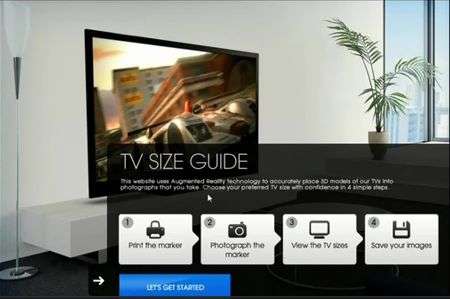
(PhysOrg.com) -- Sony UK is using Augmented Reality technology in a new online tool to help consumers decide which Sony television size will be best for their walls or tables. For those in a palatial home where you don’t want the TV to look lost, or for those in a shoebox room where every bit of space counts, the tool is intended to be the accurate guide. It is designed to let you see exactly how the set would look in situ before you buy.

The website instructs you to download and print out a marker. You place this marker where you want your TV to go. You can choose a flat surface or on a wall. You photograph it. Then you upload the image to Sony’s and it will automatically pick up the marker, work out the scale and position for your TV. You can choose different size TVs to appear on top of the marker to find the one that satisfies you.

As justification for the tool’s usefulness, Tim Schwarz, Sony Europe online content manager, said all that one could rely on in the past to make the right TV buying decision was a tape measure and guesswork.

This video is not supported by your browser at this time.

For Sony, the AR tool might also induce customers toward buying bigger TVs than the customers had assumed practical. He said people don’t often realize that TVs take up a lot less space than they used to, so you can go larger.

Sony’s AR tool might not only please consumers but help its weak television sales. According to Bloomberg, Sony had to cut its profit forecast earlier this year due to a slump in TV sales as demand has waned in the US and Europe. The entire industry has been coping with poor sales, low prices, and tough competition amongst rivals.

Use of the tool requires a computer, printer, A4 paper and digital camera. Sony recommends a ruler to check the scale of the printout.

Viewer comments regarding the new tool have been mixed.

There have been strong signs of approval from viewers who like the fun of it all and welcome the ability to see what a new Sony TV would look like on their walls or tables, replacing guesswork with certitude. Other comments have not been as kind.

How about a tape measure and a brain.
Shilly pretend holograms.

Nonetheless, Sony joins many vendors who are showing interest in how might help their marketing efforts. Augmented Reality overlays computer graphics on the real world, like your open palm showing a phonepad, or that wall of yours showing a TV. In other words, the technology brings an augmented layer of information into your real-world environment. A report from Juniper Research earlier this year found that an increasing number of retailers and mobile vendors are investing in mobile Augmented Reality applications.

Explore further: Inventor creates Card Beams with 3D printer

More information: www.sony.co.uk/article/tv-size-guide

Related Stories

Sony Flat-Screen TVs to Be Powered by PlayStation 2 Chip

Aug 11, 2004

According Nikkei Net, Sony will use the PlayStation 2's CPU chip in a flat-screen TV. Sony plans to take advantage of the PS2 chip's CG capabilities to improve the TV's image-processing capacity and to create a high ...

Warner Bros., Sony offer more 3-D Blu-ray movies

Sep 17, 2010

(AP) -- Warner Bros. says it will release six 3-D movies on Blu-ray ahead of the holidays, while Sony Pictures announced one more. That alleviates concerns that studios have tied up too many movies in exclusive release deals ...

Sony optimistic on 3-D TVs, in-house display

Nov 26, 2009

(AP) -- A third to a half of the Sony Corp. TV sets sold annually will be packed with 3-D features by the year ending March 2013, a senior executive said Thursday.

Sony, Panasonic, Samsung in 3D glasses deal

Aug 09, 2011

Japan's Sony and Panasonic and South Korea's Samsung Electronics said Tuesday they will jointly develop new standards for glasses used to watch 3D images on television, computer and movie screens.

Recommended for you

Inventor creates Card Beams with 3D printer

May 23, 2013

What are card beams, you may ask? They are the building toy that allows you to build gravity-defying houses of cards with the help of friction, gravity, and two types of beams - the cap and the connector.

With high-tech guns, users could disable remotely

May 21, 2013

A high-tech startup is wading into the gun control debate with a cellphone controller that would allow gun owners to know when their weapon is being moved—and disable it remotely.

Game system castAR debuts at Maker Faire

May 21, 2013

(Phys.org) —Two tech talents, formerly employees at video game publisher Valve, have been working on their own vision in the form of game-ready glasses. Their company, Technical Illusions, will seek to ...

China police billions spell profit opportunity

May 19, 2013

Mannequins in riot gear, armoured cars and drones line a police equipment and "anti-terrorism technology" trade fair in Beijing as vendors seek to profit from China's huge internal security budget.

User comments : 0

More news stories

Drones may violate international law

(Phys.org) —As President Obama gives a speech on national security—including defending U.S. use of drones to combat terrorism—Leila Sadat, JD, international law expert and professor of law at Washington University in ...

Google eyes emerging markets networks

Google has become deeply involved in a series of projects to build and operate wireless networks in emerging markets including sub-Saharan Africa and Southeast Asia, a report said Friday.

Facial-recognition technology proves its mettle

(Phys.org) —In a study that evaluated some of the latest in automatic facial recognition technology, researchers at Michigan State University were able to quickly identify one of the Boston Marathon bombing ...

The long road to the 2000-watt society

The vision of a society in which each inhabitant of the earth manages to consume only 2000 watts has already been around for 15 years. During this time, there has been a steady increase in environmental awareness ...

Galaxies fed by funnels of fuel

(Phys.org) —Computer simulations of galaxies growing over billions of years have revealed a likely scenario for how they feed: a cosmic version of swirly straws.