Shells slim down with CO2
Aug 09, 2011

Marine algae that turn carbon dissolved in seawater into shell will produce thinner and thinner shells as carbon dioxide levels increase.

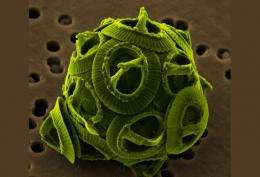
The algae, called coccolithophores, have floated in our oceans for over 200 million years Hoovering up carbon and turning it into coccoliths - overlapping plates of .

Predicting how these algae, an important part of the carbon cycle, will react to rising has always been a puzzle. Now a team including Ros Rickaby from Oxford University’s Department of Earth Sciences, has found strong evidence that as CO2 concentration in seawater increases so calcification decreases and coccolith mass declines.

The findings, reported in a recent Nature paper, suggest that entire communities of marine organisms, such as coral, are threatened by rising CO2 and ocean acidification.

The new evidence comes from studies of half a million coccoliths from hundreds of seawater samples and ancient marine sediments cores taken from all over the world.

The research shows much greater variations in coccolith mass than previous lab-based studies, as, in the ocean, rising CO2 causes populations of algae to favour smaller, lightly calcified species over heavily calcified ones.

Further work is now needed to understand how the algae will respond to the changing marine environment and what impact a rise in thinner-shelled species will have on our oceans and the planet.

Explore further: NOAA predicts possible record-setting deadzone for Gulf of Mexico

More information: Nature 476, 80–83 (04 August 2011) doi:10.1038/nature10295

Related Stories

CO2 makes life difficult for algae

May 10, 2011

The acidification of the world's oceans could have major consequences for the marine environment. New research shows that coccoliths, which are an important part of the marine environment, dissolve when seawater acidifies.

Microbes on the menu

Jul 28, 2010

The functioning of marine ecosystems depends on the size and flavor of microbes at the base of the food chain. Changes to the Earth's atmosphere might rearrange that microscopic menu. Microbes that currently ...

Recommended for you

Singapore fumes after pollution hits 16-year high

14 hours ago

Singaporeans rolled back military training, kept cough-stricken children indoors and considered wearing protective masks to work Tuesday after a smoky haze triggered by forest fires in neighboring Indonesia ...

Heavy rains can strip away mobile soil nutrients

16 hours ago

(Phys.org) —Heavy spring rains in portions of the state have probably increased yield potentials but may also be increasing nutrient losses of nitrogen, sulfur and chloride. In addition, water-logged soils and cool temperatures ...

Egypt, Ethiopia in further talks over Nile dam

17 hours ago

Ethiopia and Egypt have agreed to hold further talks on the impact of an Ethiopian dam to quell tensions between the two countries, the foreign ministers of both nations said Tuesday.

User comments : 0

More news stories

3D printing tiny batteries

(Phys.org) —3D printing can now be used to print lithium-ion microbatteries the size of a grain of sand. The printed microbatteries could supply electricity to tiny devices in fields from medicine to communications, ...