Sexually extravagant male birds age more rapidly, but try to hide it
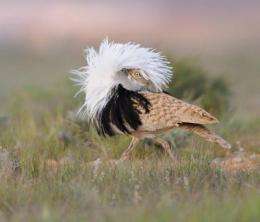
This photo is of a male Houbara bustard. Credit: Yves Hingrat
For male houbara bustards sexual extravagance is the key to attracting mates in some of the world's harshest desert environments. However, new research in Ecology Letters reveals that males who perform the most extravagant sexual displays will suffer from premature biological aging and will pass their reproductive prime years earlier than their less ostentatious rivals.
Houbara bustards, Chlamydotis undulata, are found across the deserts of the Southern Hemisphere, from the Persian Gulf to the Gobi Desert, and for six months of the year the males spend their days in elaborate sexual displays aiming to charm passing females.
Research has demonstrated that the 'showiest' of these males produce the highest quality sperm when they mate.
However, new research reveals that this effort takes its toll. Extravagant males were found to pass their reproductive prime much sooner than their more subdued rivals and they began to produce 'burnt-out', smaller ejaculates, containing high numbers of dead and abnormal sperm.
"This is the bird equivalent of the posers who strut their stuff in bars and nightclubs every weekend," said lead author Dr Brian Preston from the University of Burgundy, France. "If the bustard is anything to go by, these same guys will be reaching for their toupees sooner than they'd like."
Dr Preston's team found that despite burning out, showy males continued their energetic sexual displays at near maximum levels.
"Male houbara bustards may help to explain how senescence, or biological aging, has evolved," concluded Preston. "Senescence is the deterioration that occurs with advancing age, yet the reason why an organism should senesce has been an evolutionary puzzle, as natural selection would be expected to 'weed-out' the genes responsible for these age-related declines."
"The bustard shows that an over-abundance of early reproductive effort comes at the cost of physiological declines later in life. This early versus late life trade-off can help explain why senescence occurs, and reveals the potential significance of sexual selection in explaining rates of aging."
Provided by
Wiley
-
From lemons to lemonade: Reaction uses carbon dioxide to make carbon-based semiconductor,
32 comments
-
Thioridazine kills cancer stem cells in human while avoiding toxic side-effects of conventional cancer treatments,
3 comments
-
SpaceX private rocket blasts off for space station (Update),
42 comments
-
Climate scientists say they have solved riddle of rising sea,
31 comments
-
SpaceX capsule has 'new car' smell, astronauts say (Update),
2 comments
-
What would stain as translucent on light-coloured fabric?
19 hours ago
-
How do I identify different bacteria on culture plates?
May 26, 2012
-
Why Do Dogs do Strange things...
May 25, 2012
-
What does exophillic and endophillic mean in terms of mosquito and their control?
May 24, 2012
-
Semen stains glows under black lights (uv light)?
May 23, 2012
-
Question on Human Chromosome 2
May 23, 2012
- More from Physics Forums - Biology
More news stories
Manufacturing genes to attack flu virus
An international research team has manufactured a new protein that can combat deadly flu epidemics.
4 minutes ago |
not rated yet |
0
|
Scientist: Evolution debate will soon be history
(AP) -- Richard Leakey predicts skepticism over evolution will soon be history. Not that the avowed atheist has any doubts himself.
18 hours ago |
3.3 / 5 (18) |
63
More plant species responding to global warming than previously thought
(Phys.org) -- Far more wild plant species may be responding to global warming than previous large-scale estimates have suggested.
May 22, 2012 |
4.6 / 5 (14) |
18
|
Thousands of shellfish found dead in Peru
Thousands of crustaceans were found dead off the coast of Lima following the mystery mass death of dolphins and pelicans, the Peruvian Navy said Friday.
May 26, 2012 |
4.8 / 5 (4) |
7
For monogamous sparrows, it doesn't pay to stray (but they do it anyway)
It's quite common for a female song sparrow to stray from her breeding partner and mate with the male next door, but a new study shows that sleeping around can be costly.
May 22, 2012 |
5 / 5 (2) |
7
|
Change in developmental timing was crucial in the evolutionary shift from dinosaurs to birds: study
At first glance, it's hard to see how a common house sparrow and a Tyrannosaurus Rex might have anything in common. After all, one is a bird that weighs less than an ounce, and the other is a dinosaur that ...
Computer model used to pinpoint prime materials for efficient carbon capture
When power plants begin capturing their carbon emissions to reduce greenhouse gases and to most in the electric power industry, it's a question of when, not if it will be an expensive undertaking.
'Unzipped' carbon nanotubes could help energize fuel cells, batteries
Multi-walled carbon nanotubes riddled with defects and impurities on the outside could replace some of the expensive platinum catalysts used in fuel cells and metal-air batteries, according to scientists at ...
T cells 'hunt' parasites like animal predators seek prey, study shows
By pairing an intimate knowledge of immune-system function with a deep understanding of statistical physics, a cross-disciplinary team at the University of Pennsylvania has arrived at a surprising finding: T cells use a movement ...
Yale study concludes public apathy over climate change unrelated to science literacy
Are members of the public divided about climate change because they don't understand the science behind it? If Americans knew more basic science and were more proficient in technical reasoning, would public consensus match ...
Same gene that stunts infants' growth also makes them grow too big: research
UCLA geneticists have identified the mutation responsible for IMAGe* syndrome, a rare disorder that stunts infants' growth. The twist? The mutation occurs on the same gene that causes Beckwith-Wiedemann syndrome, which makes ...