Severe low temperatures devastate coral reefs in Florida Keys
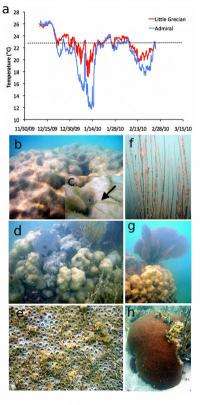
Temperature from an inshore patch (Admiral Reef) and offshore (Little Grecian) reefs. Dotted line is the average winter (January and February) seawater temperature for Admiral Reef from 2007-2009 (panel a). Photos of Admiral Reef taken in February 2010 show Montastraea faveolata skeletons being overgrown by macroalgae (indicated by arrow, panels b, c). Dead M. annularis (panel d). Tissue necrosis and skeleton of M. cavernosa (panel e). Tissue necrosis from a dead octocoral (panel f). Dead M. faveolata colony with visually unharmed Gorgonia ventalina (panel g). Visually unharmed Siderastrea siderea (panel h). Credit: Dustin Kemp/University of Georgia
Athens, Ga. Increased seawater temperatures are known to be a leading cause of the decline of coral reefs all over the world. Now, researchers at the University of Georgia have found that extreme low temperatures affect certain corals in much the same way that high temperatures do, with potentially catastrophic consequences for coral ecosystems. Their findings appear in the early online edition of the journal Global Change Biology.
Lead author Dustin Kemp, a postdoctoral associate in the UGA Odum School of Ecology, said the study was prompted by an abnormal episode of extended cold weather in January and February 2010. Temperatures on inshore reefs in the upper Florida Keys dropped below 12 C (54 F), and remained below 18 C (64 F) for two weeks. Kemp and his colleagues had planned to sample corals at Admiral Reef, an inshore reef off Key Largo, just three weeks after the cold snap. When they arrived, they discovered that the reef, once abundant in hard and soft corals, was essentially dead. "It was the saddest thing I've ever seen," Kemp said. "The large, reef-building corals were gone. Some were estimated to be 200 to 300 years old and had survived other catastrophic events, such as the 1998 El Niño bleaching event. The severe cold water appeared to kill the corals quite rapidly."
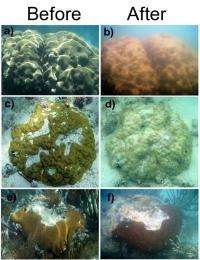
Photographs of coral colonies from Admiral Reef before (panels a, c, e) and after (panels b, d, f) the cold-water anomaly. Photographs were taken in May 2009 (before) and February 2010 (after). Coral species shown are Montastraea faveolata (a, b), Porites astreoides (c, d), and Siderastrea siderea (e, f). “After” photographs of M. faveolata and P. astreoides (panels b, d) show dead colonies, whereas S. siderea (panel f) remained alive. Pigmentation of dead M. faveolata (panel b) is due to overgrowth of the coral skeleton by cyanobacteria and filamentous algae. Credit: Dustin Kemp, University of Georgia
Odum School Professor William Fitt, Kemp's doctoral advisor and one of the paper's co-authors, realized that the team had a unique opportunity. "Nearly 100 years ago, Alfred Mayer described the temperature tolerance of different corals in the Dry Tortugas and found very similar results," Kemp said. "We decided to take the next step and learn how and why the cold temperatures caused the corals to die."The researchers took samples of Siderastrea sidereaone of the few reef-building corals to survivefrom Admiral Reef. They also took samples of three common Florida Keys corals, Montastraea faveolata, Siderastrea sidereaand Porites astreoides from Little Grecian Reef, a nearby offshore reef that had not experienced the temperature anomaly to the extent of Admiral Reef. Kemp explained that Little Grecian Reef is far enough offshore that the cold-water temperatures were likely buffered by the warm waters of the Gulf Stream, which resulted in offshore coral reefs being less severely affected by the cold air mass that was pushed by an unusual weather pattern over much of the U.S. during that two-week period.
Back in the lab, they simulated the temperatures that had been recorded at Admiral Reef during the cold weather event, testing the different corals' physiological responses at 12 C and 16 C (61 F), and then, after the corals' exposure to the cold, returned the temperature to 20 C (68 F). They found that although responses varied depending on the coral species, in general the stress of extended cold temperatures had an effect similar to that of high temperatures.
Kemp explained that corals depend on Symbiodinium, a type of symbiotic algae that lives inside them, for nutrition. Through photosynthesis, the algae produce sugars, which are passed on to the corals. "The cold temperatures inhibited photosynthesis in the algae, leading to a potential net loss of carbon transferred from the algae to the coral," said Kemp. He said that each coral species had its own unique type of Symbiodinium, some of which were better able to tolerate and recover from cold temperatures than others.
All of the corals experienced a significant decrease in photosynthesis at 12 C. Siderastrea siderea and M. faveolata were able to handle the 16 C temperatures, but P. astreoides was not, and did not show signs of recovery once the temperature was returned to 20 C. Siderastrea siderea was the only coral able to recover.
"Corals and their symbiotic algae have a range of stress tolerance," said Kemp. "Some can handle moderate stress, some are highly sensitive, and some are in between. But extreme cold is just one stressor among many." Other threats to coral health include increased seawater temperatures, diseases, ocean acidification, and pollution. "Adding stress from wintertime cold episodes could not only quickly kill corals but also may have long-term effects," he said. "For corals found in the Florida Keys, winter is typically a 'non-stressful' time and corals bulk up on tissue reserves that are important for surviving potentially 'stressful' summertime conditions (i.e. coral bleaching)."
Kemp said that researchers at NOAA attribute the record-breaking cold anomaly to a negative trend in the North Atlantic oscillation, an atmospheric pressure pattern that influences the weather in the northern hemisphere. "They speculate that if the trend continues, these kinds of extreme cold events may become more frequent," he said.
Kemp stressed that the study's findings should not be interpreted to downplay the major role of higher temperatures on corals' decline. "The study shows that warming may not be the only climate-related problem for coral reefs in the future," he said.
Kemp also pointed out that it was not only the corals that were devastated by the cold snap. "The corals provide the framework for the entire reef ecosystem," he said. "The lobster, shrimp, clams, fishall the creatures that depend on the reefwere affected too. The potential consequences for coral ecosystems are extremely alarming."
Provided by
University of Georgia
-
From lemons to lemonade: Reaction uses carbon dioxide to make carbon-based semiconductor,
32 comments
-
Thioridazine kills cancer stem cells in human while avoiding toxic side-effects of conventional cancer treatments,
3 comments
-
SpaceX private rocket blasts off for space station (Update),
42 comments
-
Climate scientists say they have solved riddle of rising sea,
31 comments
-
SpaceX capsule has 'new car' smell, astronauts say (Update),
2 comments
-
Hypothetical desert earth
15 hours ago
-
More human population = greater mass?
May 25, 2012
-
Conversion from aircraft bearing to normal degrees
May 23, 2012
-
Interpretation/Analysis of the Lab results(HEPA filter)
May 22, 2012
-
Has anyone here attended the The Urbino Summer School in Paleoclimatology?
May 22, 2012
-
Earthquakes: Mag 6 N. Italy and Mag 5.6 W. Bulgaria
May 21, 2012
- More from Physics Forums - Earth
More news stories
Yale study concludes public apathy over climate change unrelated to science literacy
Are members of the public divided about climate change because they don't understand the science behind it? If Americans knew more basic science and were more proficient in technical reasoning, would public consensus match ...
2 minutes ago |
not rated yet |
0
|
10 million years needed to recover from mass extinction
It took some 10 million years for Earth to recover from the greatest mass extinction of all time, latest research has revealed.
Space & Earth / Earth Sciences
3 minutes ago |
not rated yet |
0
|
Sophisticated simulations predict future warming
The chances of our planet being hit by a global warming of 3 degrees Celsius by 2050 is as likely as it being hit by an increase of 1.4 degrees, new research shows. Presented in the journal Nature Geoscience, the British study ...
Space & Earth / Earth Sciences
May 22, 2012 |
4.4 / 5 (9) |
51
Aliens don't want to eat us, says former SETI director
Alien life probably isnt interested in having us for dinner, enslaving us or laying eggs in our bellies, according to a recent statement by former SETI director Jill Tarter.
Space & Earth / Space Exploration
May 25, 2012 |
4.4 / 5 (13) |
39
Kyoto Protocol architect 'frustrated' by climate dialogue
UN climate talks are going nowhere, as politicians dither or bicker while the pace of warming dangerously speeds up, one of the architects of the Kyoto Protocol told AFP.
May 23, 2012 |
3.7 / 5 (7) |
39
Change in developmental timing was crucial in the evolutionary shift from dinosaurs to birds: study
At first glance, it's hard to see how a common house sparrow and a Tyrannosaurus Rex might have anything in common. After all, one is a bird that weighs less than an ounce, and the other is a dinosaur that ...
Computer model used to pinpoint prime materials for efficient carbon capture
When power plants begin capturing their carbon emissions to reduce greenhouse gases and to most in the electric power industry, it's a question of when, not if it will be an expensive undertaking.
'Unzipped' carbon nanotubes could help energize fuel cells, batteries
Multi-walled carbon nanotubes riddled with defects and impurities on the outside could replace some of the expensive platinum catalysts used in fuel cells and metal-air batteries, according to scientists at ...
T cells 'hunt' parasites like animal predators seek prey, study shows
By pairing an intimate knowledge of immune-system function with a deep understanding of statistical physics, a cross-disciplinary team at the University of Pennsylvania has arrived at a surprising finding: T cells use a movement ...
Manufacturing genes to attack flu virus
An international research team has manufactured a new protein that can combat deadly flu epidemics.
Same gene that stunts infants' growth also makes them grow too big: research
UCLA geneticists have identified the mutation responsible for IMAGe* syndrome, a rare disorder that stunts infants' growth. The twist? The mutation occurs on the same gene that causes Beckwith-Wiedemann syndrome, which makes ...

Aug 08, 2011
Rank: 3 / 5 (2)
Aug 08, 2011
Rank: 2 / 5 (1)
"Heat" and "temperature" are two different things.
The Heat of Melting of water-ice is so much higher than the specific heat capacity that it is easily possible for huge quantities of ICE in the Arctic circle to MELT, absorbing HEAT from the Sun and environment.
As this Ice becomes WATER at 0c, it mixes with the surrounding oceans, cooling the "Temperature," at least in the short term.
The Heat of Fusion of water-ice is 80 times greater than the specific heat capacity of the same amount of Liquid Water, so melting a big chunk of ice can actually cool 80 times as much sea water by 1C.
If you so happened to have a cold pocket in the ocean, and then have a frontal system move in and sit there with winds out of the North, you can cool water several meters deep, at least locally.
You should check Reynolds SST anomaly.
One giant pocket of water is around 3.5C hotter than normal, and just a few degrees away, another pocket is 2C colder than normal.
Aug 09, 2011
Rank: 5 / 5 (1)
Aug 09, 2011
Rank: 4 / 5 (1)
Obviously, it didn't go extinct.
Corals reproduce similarly to Jellyfish, through a combined "tri-sexual" reproduction system.
During the sexual phase, they release "Polyps" into the ocean water, which are carried away and take roots elsewhere. Then they enter an "asexual phase" in which they make exact clones of themselves as additional polyps which continue to do the same thing.
In the case of Jellyfish, some of them, such as box Jellyfish, actually have polyps which are capable of "searching" for the most favorable environment.
Over time, the corals will move with the ocean currents to areas with more stable temperatures.
In the most extreme cases, humans may need to give them a bit of help and move them "upstream" in some cases.