Scientists find underground river beneath Amazon
August 25, 2011

An overview of an area in the Amazon rain forest

Enlarge

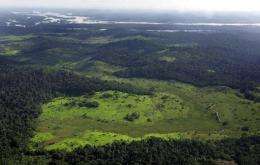
An overview of an area in the Amazon rain forest in northern Brazil, in 2005. Brazilian scientists have discovered an underground river some 4,000 meters (13,000) feet deep, which flows from west to east like the country's famous waterway.

Brazilian scientists have discovered an underground river some 4,000 meters (13,000) feet deep, which flows from west to east like the country's famous waterway.

A statement this week from Brazil's National Observatory named the underground river Hamza and said it represents one of two different draining systems for the large rainforest region.

A team of scientists led by Elizabeth Pimentel came to the conclusion from studying 241 wells drilled by the state oil giant Petrobras in the Amazon region.

Even though the two rivers cover a similar path they have differences. The underground river flows at a far slower pace and empties into the ocean deep underground.

"It is likely that this river is responsible for the low level of in the waters around the mouth of the Amazon," the statement said.

(c) 2011 AFP

4.8 /5 (11 votes)  

Filter


Move the slider to adjust rank threshold, so that you can hide some of the comments.


Display comments: newest first

tadchem
Aug 25, 2011

Rank: 5 / 5 (4)
Given that the water at 4,000 m depth resides in porous rock rather than in open (unobstructed) channels, the appelation 'river' is misleading. A more descriptive name would be 'flowing aquifer.'
tadchem
Aug 25, 2011

Rank: not rated yet
Economically, the presence of such a deep aquifer means there is no intervening caprock - i.e. no gas or oil reservoirs.
TombSyphon2317
Aug 25, 2011

Rank: not rated yet
That fresh water could be worth far more then oil or gas in the future. I think it is a great find.
Shelgeyr
Aug 28, 2011

Rank: not rated yet
@tadchem said:
Economically, the presence of such a deep aquifer means there is no intervening caprock - i.e. no gas or oil reservoirs.


Probably, but not necessarily... elsewhere deposits are being found at absurd depths - well outside the so-called "oil window", and even below the salt layer and supposedly "basement" rock.

So while you're probably right, you're not provably right, and there is at least a solid, if small, chance you're wrong.
Rank 4.8 /5 (11 votes)
Relevant PhysicsForums posts

More news stories

Yale study concludes public apathy over climate change unrelated to science literacy

Are members of the public divided about climate change because they don't understand the science behind it? If Americans knew more basic science and were more proficient in technical reasoning, would public consensus match ...

Space & Earth / Environment

created 2 minutes ago | popularity not rated yet | comments 0 | with audio podcast

10 million years needed to recover from mass extinction

It took some 10 million years for Earth to recover from the greatest mass extinction of all time, latest research has revealed.

Space & Earth / Earth Sciences

created 3 minutes ago | popularity not rated yet | comments 0 | with audio podcast

Sophisticated simulations predict future warming

The chances of our planet being hit by a global warming of 3 degrees Celsius by 2050 is as likely as it being hit by an increase of 1.4 degrees, new research shows. Presented in the journal Nature Geoscience, the British study ...

Space & Earth / Earth Sciences

created May 22, 2012 | popularity 4.4 / 5 (9) | comments 51

Aliens don't want to eat us, says former SETI director

Alien life probably isn’t interested in having us for dinner, enslaving us or laying eggs in our bellies, according to a recent statement by former SETI director Jill Tarter.

Space & Earth / Space Exploration

created May 25, 2012 | popularity 4.4 / 5 (13) | comments 39

Kyoto Protocol architect 'frustrated' by climate dialogue

UN climate talks are going nowhere, as politicians dither or bicker while the pace of warming dangerously speeds up, one of the architects of the Kyoto Protocol told AFP.

Space & Earth / Environment

created May 23, 2012 | popularity 3.7 / 5 (7) | comments 39


Change in developmental timing was crucial in the evolutionary shift from dinosaurs to birds: study

At first glance, it's hard to see how a common house sparrow and a Tyrannosaurus Rex might have anything in common. After all, one is a bird that weighs less than an ounce, and the other is a dinosaur that ...

Computer model used to pinpoint prime materials for efficient carbon capture

When power plants begin capturing their carbon emissions to reduce greenhouse gases – and to most in the electric power industry, it's a question of when, not if – it will be an expensive undertaking.

'Unzipped' carbon nanotubes could help energize fuel cells, batteries

Multi-walled carbon nanotubes riddled with defects and impurities on the outside could replace some of the expensive platinum catalysts used in fuel cells and metal-air batteries, according to scientists at ...

T cells 'hunt' parasites like animal predators seek prey, study shows

By pairing an intimate knowledge of immune-system function with a deep understanding of statistical physics, a cross-disciplinary team at the University of Pennsylvania has arrived at a surprising finding: T cells use a movement ...

Manufacturing genes to attack flu virus

An international research team has manufactured a new protein that can combat deadly flu epidemics.

Same gene that stunts infants' growth also makes them grow too big: research

UCLA geneticists have identified the mutation responsible for IMAGe* syndrome, a rare disorder that stunts infants' growth. The twist? The mutation occurs on the same gene that causes Beckwith-Wiedemann syndrome, which makes ...