Scientists still struggle to identify 9/11 remains
August 26, 2011 by Mariano Andrade

The latest 9/11 victim was identified just this week

Enlarge

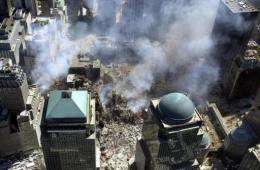
A photo released on 17 September 2001 by the New York City Office of Emergency Management shows smoke rising from the ruins of the World Trade Center in lower Manhattan, New York, on 16 September. In a laboratory in the center of Manhattan scientists continue to struggle to put names to the remains of victims from the September 11, 2001 attacks, some 40 percent of which are still unidentified.

In a laboratory in the center of Manhattan scientists continue to struggle to put names to the remains of victims from the September 11, 2001 attacks, some 40 percent of which are still unidentified.

"It's not a because everybody has a death certificate. It's an ethical-moral decision," said Mechthild Prinz in the department of forensic biology at the city's Chief Medical Examiner office.

The names of the people who died in the explosions, fires and collapse in the Twin Towers on 9/11 are known, but the violence was so extreme that even a decade later it takes painstaking forensic work to match those identities to the human fragments found at the site.

The latest match made was just this week: Ernest James, who was 40 years old. He was the 1,629th victim identified out of 2,753 people killed at the World Trade Center, or 59 percent of the total.

Initially, traditional methods such as dental records, photographs and finger prints were used to identify the bodies and pulled from the rubble. But as the easier batches of remains were dealt with the gruesome task turned into something more akin to serious detective work -- and even that is not enough in many cases.

"We did collect 21,817 remains, so you can imagine obviously that a lot of people were fragmented in many different body parts. And since we haven't identified over a thousand people, some of them really disappeared," said Prinz, 53, who comes from Germany but has been working as a in New York since 1995.

Amid strict security and sanitation conditions, a team of five scientists continues to deal with 6,314 fragments of bones found in the World Trade Center area.

An AFP journalist was shown the work underway through a window in a door before being told to put on gloves and taken into a large room, where robots clean the remains before they are tested for DNA against a databank created by relatives of the deceased.

"I remember a case a few years ago which was a small piece of bone on the roof of the Deutsche Bank building. It was the size of a coin and we were able to identified someone who worked in the towers at that time," recalled Taylor Dickerson, a criminalist in the forensic biology department.

However in most cases the DNA found in the fragments turns out to be just another piece of a person already identified. As a result, the work is painfully slow: less than three dozen people have been identified since 2006.

Sometimes, DNA is found in bone fragments that cannot be matched to anyone in the databank -- either because relatives did not give samples or because the remains belong to an illegal immigrant who happened to be in the area at the time and was never registered.

Prinz said the work, for all its frustrations, is satisfying.

"It definitely was worthwhile to do it, because some of the families are really grateful," he said.

"I guess the biggest thing for me has been just understanding the impact our has on both the families and the community, the forensic community," Dickerson said. "I never expected to do that in my career."

(c) 2011 AFP

Filter


Move the slider to adjust rank threshold, so that you can hide some of the comments.


Display comments: newest first

COCO
Aug 29, 2011

Rank: not rated yet
and how quickly the 19 arab highjackers had their DNA matched within hours - tens years later and we still are ask to digest the NIST fairy tale of events.
Rank 3 /5 (2 votes)
Relevant PhysicsForums posts

More news stories

Change in developmental timing was crucial in the evolutionary shift from dinosaurs to birds: study

At first glance, it's hard to see how a common house sparrow and a Tyrannosaurus Rex might have anything in common. After all, one is a bird that weighs less than an ounce, and the other is a dinosaur that ...

Other Sciences / Archaeology & Fossils

created 5 minutes ago | popularity not rated yet | comments 0 | with audio podcast

Social welfare cuts ultimately come with heavy price, researchers say

(Phys.org) -- Slashing government funding for Medicaid, food stamps and other programs that serve the poor – while politically popular with some lawmakers and many conservatives – may do more harm ...

Other Sciences / Social Sciences

created May 24, 2012 | popularity 4.3 / 5 (16) | comments 147

Ancient Bethlehem seal unearthed in Jerusalem

Israeli archaeologists have discovered a 2,700-year-old seal that bears the inscription "Bethlehem," the Israel Antiquities Authority announced Wednesday, in what experts believe to be the oldest artifact ...

Other Sciences / Archaeology & Fossils

created May 23, 2012 | popularity 3.5 / 5 (14) | comments 23

Oldest Jewish archaeological evidence on the Iberian Peninsula

German archaeologists of the Friedrich Schiller University Jena found one of the oldest archaeological evidence so far of Jewish Culture on the Iberian Peninsula at an excavation site in the south of Portugal, ...

Other Sciences / Archaeology & Fossils

created May 25, 2012 | popularity 4.3 / 5 (4) | comments 12

Dollars and sense: Why are some people morally against tax?

As the U.S. presidential election campaigns heat up, the economic debate is dominated by bailouts, austerity and, inevitably, taxation. Now a new study published in Symbolic Interaction asks why tax is such an important issue ...

Other Sciences / Social Sciences

created May 23, 2012 | popularity 3 / 5 (2) | comments 12


Computer model used to pinpoint prime materials for efficient carbon capture

When power plants begin capturing their carbon emissions to reduce greenhouse gases – and to most in the electric power industry, it's a question of when, not if – it will be an expensive undertaking.

'Unzipped' carbon nanotubes could help energize fuel cells, batteries

Multi-walled carbon nanotubes riddled with defects and impurities on the outside could replace some of the expensive platinum catalysts used in fuel cells and metal-air batteries, according to scientists at ...

T cells 'hunt' parasites like animal predators seek prey, study shows

By pairing an intimate knowledge of immune-system function with a deep understanding of statistical physics, a cross-disciplinary team at the University of Pennsylvania has arrived at a surprising finding: T cells use a movement ...

Manufacturing genes to attack flu virus

An international research team has manufactured a new protein that can combat deadly flu epidemics.

Yale study concludes public apathy over climate change unrelated to science literacy

Are members of the public divided about climate change because they don't understand the science behind it? If Americans knew more basic science and were more proficient in technical reasoning, would public consensus match ...

Same gene that stunts infants' growth also makes them grow too big: research

UCLA geneticists have identified the mutation responsible for IMAGe* syndrome, a rare disorder that stunts infants' growth. The twist? The mutation occurs on the same gene that causes Beckwith-Wiedemann syndrome, which makes ...