Scientist finds rapidly adapting fanged frogs
August 16, 2011 By Matt Terry
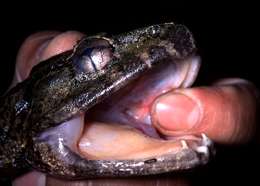
A team led by McMaster biologist Ben Evans has documented the rapid adaptation of new fanged frog species on the island of Sulawesi, Indonesia. Nine of the thirteen types of frogs had not previously been described by science. Credit: Rafe M. Brown.
(PhysOrg.com) -- Scientists led by biologist Ben Evans of McMaster University have documented the rapid adaptation of new fanged frog species on the island of Sulawesi, Indonesia.
The team found 13 species of fanged frog - so named for the bony, tooth-like protrusions in their mouths - on the island, nine of which had not previously been described by science. The frogs all have differing attributes, according to the particular areas they inhabit. Unexpectedly, however, the single island of Sulawesi was found to have the same number of fanged frog species as the entire Philippine archipelago to the north.
"We would expect to find more species on the archipelago because it's so much larger, but that's not the case," said Evans, an associate professor of biology who has been studying the frogs since 2000.
Why such diversity in such a small place? There's less competition on Sulawesi, the researchers say.
Fanged frogs in the Philippines have to compete with another type of frog, Platymantis. Platymantis never made the hop over to Sulawesi, leaving the fanged frogs free to spread out into new habitat niches, to which they eventually adapted, creating new species. The rapid evolution of these frogs - in less than 15 million years - is a striking example of adaptive radiation, a concept Charles Darwin famously recorded in Galapagos finches.
"Darwin found that the finches had evolved changes to the shapes of their beaks, allowing them to access different food sources," said Evans. "With the frogs, we found that they have made a number of adaptations including in body size, amount of webbing in their feet and how they raise their young - all of which matched the demands of their particular ecological niches."
One type of fanged frog has adapted to terrestrial living by laying its eggs on tree leaves, where its young go through the early stages of life completely within a thick, jelly-like egg capsule. Another type has grown to become approximately 10 centimetres in body length (medium-sized fanged frogs are about half that size) to facilitate life in fast-moving water.
"The frogs' adaptations are great examples of 'ecological opportunity', of a species changing its body and life history to better exploit its habitat," said Evans. "Our research on them will help us to better understand the mechanisms of speciation - of how new species arise over time." The work could also affect conservation efforts on Sulawesi.
"Rather than species diversity being evenly distributed across Sulawesi, we found at least seven 'pockets' of diversity on the island with high concentrations of unique species," said Evans. "The knowledge we gain from work like this will hopefully allow officials to prioritize conservation efforts across the island."
In 2009 the Ontario government gave Evans an Early Researcher Award, meant to help up-and-coming researchers build their teams of undergraduate and graduate students, post-doctoral fellows, research assistants, associates and technicians.
The research appears in the American Naturalist.
Provided by
McMaster University
-
From lemons to lemonade: Reaction uses carbon dioxide to make carbon-based semiconductor,
32 comments
-
Thioridazine kills cancer stem cells in human while avoiding toxic side-effects of conventional cancer treatments,
3 comments
-
SpaceX private rocket blasts off for space station (Update),
42 comments
-
Climate scientists say they have solved riddle of rising sea,
31 comments
-
SpaceX capsule has 'new car' smell, astronauts say (Update),
2 comments
-
What would stain as translucent on light-coloured fabric?
19 hours ago
-
How do I identify different bacteria on culture plates?
May 26, 2012
-
Why Do Dogs do Strange things...
May 25, 2012
-
What does exophillic and endophillic mean in terms of mosquito and their control?
May 24, 2012
-
Semen stains glows under black lights (uv light)?
May 23, 2012
-
Question on Human Chromosome 2
May 23, 2012
- More from Physics Forums - Biology
More news stories
Manufacturing genes to attack flu virus
An international research team has manufactured a new protein that can combat deadly flu epidemics.
4 minutes ago |
not rated yet |
0
|
Scientist: Evolution debate will soon be history
(AP) -- Richard Leakey predicts skepticism over evolution will soon be history. Not that the avowed atheist has any doubts himself.
18 hours ago |
3.3 / 5 (18) |
63
More plant species responding to global warming than previously thought
(Phys.org) -- Far more wild plant species may be responding to global warming than previous large-scale estimates have suggested.
May 22, 2012 |
4.6 / 5 (14) |
18
|
Thousands of shellfish found dead in Peru
Thousands of crustaceans were found dead off the coast of Lima following the mystery mass death of dolphins and pelicans, the Peruvian Navy said Friday.
May 26, 2012 |
4.8 / 5 (4) |
7
For monogamous sparrows, it doesn't pay to stray (but they do it anyway)
It's quite common for a female song sparrow to stray from her breeding partner and mate with the male next door, but a new study shows that sleeping around can be costly.
May 22, 2012 |
5 / 5 (2) |
7
|
Change in developmental timing was crucial in the evolutionary shift from dinosaurs to birds: study
At first glance, it's hard to see how a common house sparrow and a Tyrannosaurus Rex might have anything in common. After all, one is a bird that weighs less than an ounce, and the other is a dinosaur that ...
Computer model used to pinpoint prime materials for efficient carbon capture
When power plants begin capturing their carbon emissions to reduce greenhouse gases and to most in the electric power industry, it's a question of when, not if it will be an expensive undertaking.
'Unzipped' carbon nanotubes could help energize fuel cells, batteries
Multi-walled carbon nanotubes riddled with defects and impurities on the outside could replace some of the expensive platinum catalysts used in fuel cells and metal-air batteries, according to scientists at ...
T cells 'hunt' parasites like animal predators seek prey, study shows
By pairing an intimate knowledge of immune-system function with a deep understanding of statistical physics, a cross-disciplinary team at the University of Pennsylvania has arrived at a surprising finding: T cells use a movement ...
Yale study concludes public apathy over climate change unrelated to science literacy
Are members of the public divided about climate change because they don't understand the science behind it? If Americans knew more basic science and were more proficient in technical reasoning, would public consensus match ...
Same gene that stunts infants' growth also makes them grow too big: research
UCLA geneticists have identified the mutation responsible for IMAGe* syndrome, a rare disorder that stunts infants' growth. The twist? The mutation occurs on the same gene that causes Beckwith-Wiedemann syndrome, which makes ...
Aug 16, 2011
Rank: not rated yet
0,o
Aug 16, 2011
Rank: 5 / 5 (2)
Aug 16, 2011
Rank: not rated yet