Scientifically taking the guilt out of guilty pleasures
August 25, 2011

Scientifically taking the guilt out of guilty pleasures

Enlarge

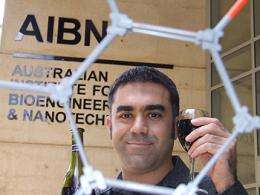
Dr. Aaron Micallef has designed new compounds that mimic the activity of antioxidants found in wine and chocolate.

Red wine and chocolate are part of the working week for Australian Institute for Bioengineering and Nanotechnology researcher Dr. Aaron Micallef.

More specifically, Dr. Micallef has designed and prepared new compounds that mimic the activity of found in wine and chocolate.

He hopes the compounds can promote the body's natural antioxidant defences, neutralise damaging in the body and fight the onset of diseases associated with free radical damage, such as and arthritis.

To mark National Science Week, Dr. Micallef will explain the research as part of a wine and chocolate tasting event at the Queensland Museum at South Bank on August 26.

He will talk about antioxidants, wine and chocolate; their relationship to his AIBN research; and his role as a free radical and associate investigator for the ARC Center of Excellence for Free Radical Chemistry and Biotechnology.

“I want people to realise there are links between chemistry, chemical research, the foods we eat and our health,” Dr. Michallef said.

“Free radicals are implicated in many processes in the body, such as inflammation, ageing and cancer. They can be very damaging, but we are conducting research into how we can use antioxidants to neutralise free radicals and prevent this damage," he said.

“Eating foods rich in antioxidants can help mop up damaging free radicals in the body. It means we are taking the guilt out of pleasures such as and chocolate.

“I have a soft spot for a good glass of red wine and dark chocolate myself, so the research is definitely very appealing.”

Reactive free radicals are believed to be the cause of the accumulated damage in cells that contributes to ageing and degenerative diseases. Antioxidants can protect against this damage, either neutralising the radicals directly or promoting the body's defences.

Dr. Micallef said his synthetic compounds would have potential applications in fighting disease if they were found to mimic the protective properties of the antioxidants found in red wine and chocolate.

Called Radical Wine and Chocolate, the tasting event will be held at the Queensland Museum from 5.30pm on August 26, with three guest speakers and tastings and sales of wines from Ballandean Estate and Sirromet Winery. Chocolates to taste and buy will be from Bittersweet, Mayfield and Ballandean Estate.

Provided by University of Queensland search and more info website


Rank not rated yet
Relevant PhysicsForums posts
  • Gibbs Free Energy Change/Entropy
    created7 hours ago
  • What's the rule to covalent character
    created8 hours ago
  • Schwartz reagent-- NMR/MS/IR
    createdMay 26, 2012
  • High school chemistry EEI
    createdMay 25, 2012
  • oxidation of I- by KMnO4
    createdMay 25, 2012
  • Inversion temp
    createdMay 25, 2012
  • More from Physics Forums - Chemistry

More news stories

Computer model used to pinpoint prime materials for efficient carbon capture

When power plants begin capturing their carbon emissions to reduce greenhouse gases – and to most in the electric power industry, it's a question of when, not if – it will be an expensive undertaking.

Chemistry / Materials Science

created 13 minutes ago | popularity not rated yet | comments 0 | with audio podcast

Scientists develop ultra-sensitive test that detects diseases in their earliest stages

Scientists have developed an ultra-sensitive test that should enable them to detect signs of a disease in its earliest stages, in research published today in the journal Nature Materials.

Chemistry / Analytical Chemistry

created 13 minutes ago | popularity not rated yet | comments 0 | with audio podcast

New CO2-removing catalyst can take the heat

(Phys.org) -- The current method of removing the greenhouse gas carbon dioxide (CO2) from the flues of coal-fired power plants uses so much energy that no one bothers to use it. So says Roger Aines, principal ...

Chemistry / Materials Science

created May 24, 2012 | popularity 5 / 5 (9) | comments 10 | with audio podcast

High-speed method to aid search for solar energy storage catalysts

Eons ago, nature solved the problem of converting solar energy to fuels by inventing the process of photosynthesis.

Chemistry / Materials Science

created May 25, 2012 | popularity 5 / 5 (3) | comments 4 | with audio podcast

Researchers demonstrate possible primitive mechanism of chemical info self-replication

(Phys.org) -- When scientists think about the replication of information in chemistry, they usually have in mind something akin to what happens in living organisms when DNA gets copied: a double-stranded molecule ...

Chemistry / Materials Science

created May 25, 2012 | popularity 5 / 5 (4) | comments 2 | with audio podcast


Change in developmental timing was crucial in the evolutionary shift from dinosaurs to birds: study

At first glance, it's hard to see how a common house sparrow and a Tyrannosaurus Rex might have anything in common. After all, one is a bird that weighs less than an ounce, and the other is a dinosaur that ...

'Unzipped' carbon nanotubes could help energize fuel cells, batteries

Multi-walled carbon nanotubes riddled with defects and impurities on the outside could replace some of the expensive platinum catalysts used in fuel cells and metal-air batteries, according to scientists at ...

T cells 'hunt' parasites like animal predators seek prey, study shows

By pairing an intimate knowledge of immune-system function with a deep understanding of statistical physics, a cross-disciplinary team at the University of Pennsylvania has arrived at a surprising finding: T cells use a movement ...

Manufacturing genes to attack flu virus

An international research team has manufactured a new protein that can combat deadly flu epidemics.

Yale study concludes public apathy over climate change unrelated to science literacy

Are members of the public divided about climate change because they don't understand the science behind it? If Americans knew more basic science and were more proficient in technical reasoning, would public consensus match ...

Same gene that stunts infants' growth also makes them grow too big: research

UCLA geneticists have identified the mutation responsible for IMAGe* syndrome, a rare disorder that stunts infants' growth. The twist? The mutation occurs on the same gene that causes Beckwith-Wiedemann syndrome, which makes ...