Russia 'grounds Soyuz rockets' after space crash
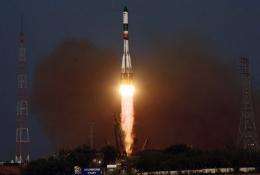
Russia on Thursday grounded its Soyuz rockets after a space ship carrying tonnes of cargo for the International Space Station (ISS) crashed into Siberia shortly after blast-off, officials said.
The failed launch of the unmanned Progress capsule on a Soyuz-U rocket was a spectacular blow for Russia which proudly became the sole nation capable of taking humans to the ISS after the July withdrawal of the US space shuttle.
Emergency services blocked access to the site of the crash in the Altai region of Siberia, state television said, amid fears the space freighter could have dumped highly-toxic fuel in the area.
The Russian space forces said that a launch scheduled this week of a navigation satellite has been postponed until September while an official said all the Soyuz rockets were grounded pending an investigation.
Soyuz rockets are the backbone of the Russian space programme and are notably used to launch the unmanned Progress cargo vehicles as well as the Soyuz manned capsules for the ISS.
"A decision has been taken to halt the launch of Soyuz carrier rockets until the reasons for the accident become clear," an unnamed Russian official told the Interfax news agency.
Space forces commander Lieutenant General Oleg Ostapenko said the Soyuz-2 rocket that was to have launched a Russian GLONASS navigation satellite this week from the Plesetsk cosmodrome was to be removed from the launch pad.
"The launch has been postponed until the first half of September," after the rocket is submitted to a full check, he said, quoted by Russian news agencies.
The next manned flight to the ISS -- currently staffed by a six-person multinational crew -- is scheduled for September and a cargo vessel with new supplies is due to take off in October.
It remains unclear if these flights will be affected.
But Russian space agency Roskosmos removed all reference to future missions from its official website, leaving an ominous-looking black space where the listing is usually found.
Igor Lisov, the space expert of specialised journal Novosti Kosmonavtiki, played down the implications for global space exploration, saying that the grounding was normal practice after an accident.
"The cause of the accident will be established soon. After they have found out and eliminated the causes, the Soyuz will fly again, undoubtedly," he told AFP.
The ISS depends on the Progress deliveries for basic supplies such as food and water but both Russian and US officials took care to dispel suggestions that the accident may prompt an emergency evacuation of the ISS crew.
Roskosmos said in a statement Thursday it was in contact with NASA about "resolving questions" related to supporting the ISS as well as future manned and freight launches.
Prime Minister Vladimir Putin instructed Roskosmos to "radically change the quality control and inspection system it uses" after the disaster, Putin's spokesman Dmitry Peskov told AFP.
Russian news agencies said space officials had also informed ISS commander Andrei Borisenko of the loss of the supply craft and that the team took the news "with understanding."
Local officials said fragments of the craft crashed into Russia's Siberian region of Altai on the border with Mongolia and China -- a remote region of soaring mountains and poorly accessible by road.
"The explosion was so powerful that it shattered windows nearly 100 kilometres (60 miles) away," said the region's Choya district head Alexander Borisov.
Emergency services, hampered by bad weather, have yet to locate the wreckage. There have been no reports of casualties, despite fears people could have been pine-nut picking in the area.
The Interfax news agency quoted a space official as saying that the Progress contained one-and-a-half tonnes of highly toxic fuel but it was unclear how much had burned up on intact and what quantity entered the soil.
The Progress was the fourth failed launch of a capsule or satellite by Russia since December last year when three satellites for its prized new GLONASS system crashed into the Pacific Ocean after launch.
This was followed by the loss of a new military satellite in February while only last week a satellite for Internet and digital television across Russia was lost after being put into the wrong orbit after launch.
That failure led to Roskosmos grounding its Proton-M carrier rockets.
(c) 2011 AFP


