Replication of arsenic life experiment not successful so far
Aug 11, 2011 By Nancy Atkinson
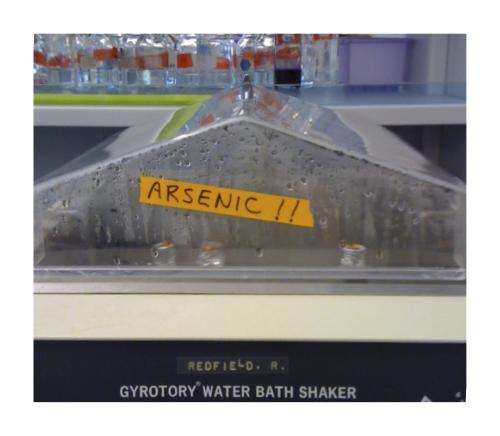
A replication of the arsenic life experiment being done by biologist Rosie Redfield. Credit: Rosie Redfield.

One of the most vocal and ardent critics of the so-called 'arsenic life' experiment which was published in December 2010 was biologist Rosie Redfield from the University of British Columbia in Vancouver. The science paper by NASA astrobiologist Felisa Wolfe-Simon and her team reported that a type of bacteria in Mono Lake in California can live and grow almost entirely on arsenic, a poison, and incorporates it into its DNA. Redfield called the paper “lots of flim-flam, but very little reliable information.” Her opinion was quickly seconded by many other biologists/bloggers.

Redfield has been working on replicating the experiment done by Wolfe-Simon, and doing in her work in front of the world, so to speak. She is detailing her work in an open lab notebook on her blog. So far, she reports that her results contradict Wolfe-Simon et al.’s observations.

To date, Redfield is finding that the , called GFAJ-1, is not living and growing in arsenic, but dying. Redfield says her work refutes that cells from the GFAJ-1 could use arsenic for growth in place of phosphorus, and when arsenic was added to the low-phosphorus medium in which the bacteria was living, the bacteria was killed. Additionally, in other test viles, the growth properties Redfield is finding for GFAJ-1 don’t match those reported by Wolfe-Simon and her team, which claimed that the bacteria could not grow on a low concentration of phosphorus, and that the bacteria could grow on arsenic in the absence of phosphorus.

Redfield’s two major early criticisms of the original paper were that the authors had not ruled out the possibility that the bacteria were feeding on phosphorus contaminating their growth medium; and that the bacterial DNA was not properly purified, so that the arsenic detected might not actually have been in .

An article in Nature reports that other researchers also working on replicating the experiment with GFAJ-1 laud Redfield’s efforts, but say it is too early to conclude that she has debunked the original work.

Additionally, one problem is that Redfield she did not replicate the experiment exactly, as she had to add one nutrient not used by the authors of the original arsenic life paper in order for the bacteria to grow.

This is not the first time scientists have written open notebooks during the replication of controversial findings, but it might be one of the more notable, given the amount of media attention the life paper received.

Redfield is also hoping that her work will highlight the benefits of open notebook-type research.

You can read Redfield’s blog about her work at this link.

Explore further: New DNA cattle test beefs up dairy and meat quality

add to favorites email to friend print save as pdf

Related Stories

Critics raise doubts on NASA's arsenic bacteria

Dec 09, 2010

(PhysOrg.com) -- NASA’s announcement last week that bacteria had been discovered that appeared to replace phosphorus with arsenic and thrive even in the most poisonous environments, has now come under ...

NASA's arsenic life-form scientist answers critics

Dec 16, 2010

The NASA-funded scientist whose discovery of a bacterium that thrives on arsenic prompted an avalanche of criticism responded Thursday with a statement answering questions about her research. ...

NASA's arsenic-eating life form gets a second look

Dec 15, 2010

Soon after NASA-funded researchers announced this month they had found a new life form that thrives on arsenic, critics took to the blogosphere with skeptical views and downright insults. ...

Searching for Alien Life, on Earth

Oct 05, 2009

If you spend an afternoon walking along the muddy shore of Mono Lake, with the eastern flank of the Sierra Nevada mountains looming majestically in the background, you’ll no doubt discover, as others have ...

LU researcher: NASA's ET hype does disservice to science

Dec 13, 2010

NASA researchers recently unveiled a major discovery -- the first identified microorganism on Earth able to thrive using toxic arsenic rather than phosphorus, which forms the DNA-backbone of all other living things. But now, s ...

Recommended for you

New DNA cattle test beefs up dairy and meat quality

6 minutes ago

(Phys.org) —A genomics technique developed at Cornell to improve corn can now be used to improve the quality of milk and meat, according to research published online May 17 in the journal PLOS ONE.

Strawberry fields forever and fungus-free

13 minutes ago

(Phys.org) —Strawberries are one of the most economically important berry crops in the world, and a high value export crop for the Australian horticultural industry.For the first time, researchers at The ...

'Whodunnit' of Irish potato famine solved

May 21, 2013

An international team of scientists reveals that a unique strain of potato blight they call HERB-1 triggered the Irish potato famine of the mid-19th century.

Engineered microbes grow in the dark

May 20, 2013

Scientists at the University of California, Davis have engineered a strain of photosynthetic cyanobacteria to grow without the need for light. They report their findings today at the 113th General Meeting of the American ...

User comments : 1

Adjust slider to filter visible comments by rank

Display comments: newest first

alanborky
not rated yet Aug 12, 2011
"one problem is that Redfield she did not replicate the experiment exactly, as she had to add one nutrient not used by the authors of the original arsenic life paper in order for the bacteria to grow."

Talk about your flim-flam!

First replicate the original experiment: if you can't, use that to discredit it - but DON'T CLAIM AN EXPERIMENT WITH DIFFERENT PARAMETERS DISCREDITS ANOTHER EXPERIMENT YOU CLEARLY SET OUT TO DISCREDIT FROM THE BEGINNING, (rather than scientifically and open mindedly set out to test the veracity of)!

I can see a new 'reality' TV show emerging out of this growing trend of scientific priesthoods setting out to smear each others reputations instead of their actual work: SCIENCE WARS, (on the lines of Robot Wars).

More news stories

Coral reefs 'ruled by earthquakes and volcanoes'

(Phys.org) —Titanic forces in the Earth's crust explain why the abundance and richness of corals varies dramatically across the vast expanse of the Indian and Pacific Oceans, a world-first study from the ...

Coccoliths thrive despite ocean acidification

Ocean acidification is damaging some marine species while others thrive, say scientists. An international team studied the effect of ocean acidification on plankton in the North Sea over the past forty years, ...

Strawberry fields forever and fungus-free

(Phys.org) —Strawberries are one of the most economically important berry crops in the world, and a high value export crop for the Australian horticultural industry.For the first time, researchers at The ...

Single-cell sequencing

When studying any kind of population—people or cells—averaging is a useful, if flawed, form of measurement. According to the US Census Bureau, the average American household size in 2010 was 2.59. Of ...

Theorists weigh in on where to hunt dark matter

(Phys.org) —Now that it looks like the hunt for the Higgs boson is over, particles of dark matter are at the top of the physics "Most Wanted" list. Dozens of experiments have been searching for them, but ...