Reforestation practices may be lagging behind climate change
August 24, 2011 By Bev Betkowski
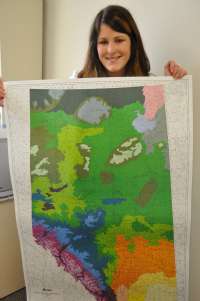
Laura Gray holds up a map of Alberta's tree habitats.
A University of Alberta study is sounding a warning about forestry practices in North America, claiming that climate change is already rendering established planting guidelines obsolete.
Weve found that trees are already lagging in adaptation to climate change and are not performing as they should, said Laura Gray, a PhD student in the Department of Renewable Resources. We need to change the way we manage our forests today if we want to maximize production.
Grays findings were based on two studies she conducted for her thesis, exploring planting guidelines in the forest-rich regions of western North America, including parts of Alberta, British Columbia, Montana, South Dakota and Wyoming, seeking ways to adapt to climate change that is leaving forests less productive or vulnerable to disease and pests like the Mountain Pine Beetle.
The related findings are published in the latest issues of the scientific journals Public Library of Science and Ecological Applications.
Using computer models, Gray and her colleagues analyzed the landscape of western North America, attempting to find optimal climate habitat for tree species under observed warming trends and under future climate change scenarios. Based on that data, changes could be made to what type of tree seed is planted where.
Currently, legislated forestry practices dictate that seed for reforestation cannot be transferred from designated zones where seed has been collected, but, said Gray, climate change is altering tree habitat so that the existing zones may not be the best places for current and future reforestation efforts.
A lot of forest management strategies are based on data we have from the 1960s and 1970s, but the climate has definitely changed since then, said Gray. Her research has revealed that aspen treesused for oriented strandboard and pulpare already climactically mismatched for their current seed zones. In turn, that has led to much less forest productivity over the last decade, Gray said. Its already happening, and we are behind the times.
We know the climate is changing and we are trying to determine where we can pick up seed and move it, so that trees are more closely matched to their optimal environments, creating better productivity over their lifetime.
The studies recommend that various tree seeds be planted in multiple zones that show a close climatic match for the future. In many cases, we have found that those locations range well beyond the current seed zones.
The research also showed that trees suited to warm and dry climatessuch as southern Alberta and some areas of the United Stateswill likely be the best choices for the forests of tomorrow. Trees best adapted to those conditions are going to be really useful in the future, Gray said.
And while the trend in forestry is to look ahead 80 to 100 years, Grays research recommends against that, suggesting instead that projections can realistically only stretch to 2020 or so. The adaptation strategies are limited to the short-term horizon, because it is difficult to really predict the climate beyond that time. A better strategy is to focus on seeds that are climate-matched for 10 years from now.
Gray has made several presentations on her findings to the forestry industry, and said while the research represents a significant departure from contemporary forest management practices, changes are necessary.
We really are suggesting a change to the way things are managed today, and while this research cant fix the problem of climate change, we can certainly make suggestions on how to mitigate impacts for the forestry sector.
Provided by
University of Alberta
-
From lemons to lemonade: Reaction uses carbon dioxide to make carbon-based semiconductor,
32 comments
-
Thioridazine kills cancer stem cells in human while avoiding toxic side-effects of conventional cancer treatments,
3 comments
-
SpaceX private rocket blasts off for space station (Update),
42 comments
-
Climate scientists say they have solved riddle of rising sea,
31 comments
-
SpaceX capsule has 'new car' smell, astronauts say (Update),
2 comments
-
Hypothetical desert earth
15 hours ago
-
More human population = greater mass?
May 25, 2012
-
Conversion from aircraft bearing to normal degrees
May 23, 2012
-
Interpretation/Analysis of the Lab results(HEPA filter)
May 22, 2012
-
Has anyone here attended the The Urbino Summer School in Paleoclimatology?
May 22, 2012
-
Earthquakes: Mag 6 N. Italy and Mag 5.6 W. Bulgaria
May 21, 2012
- More from Physics Forums - Earth
More news stories
Yale study concludes public apathy over climate change unrelated to science literacy
Are members of the public divided about climate change because they don't understand the science behind it? If Americans knew more basic science and were more proficient in technical reasoning, would public consensus match ...
2 minutes ago |
not rated yet |
0
|
10 million years needed to recover from mass extinction
It took some 10 million years for Earth to recover from the greatest mass extinction of all time, latest research has revealed.
Space & Earth / Earth Sciences
3 minutes ago |
not rated yet |
0
|
Sophisticated simulations predict future warming
The chances of our planet being hit by a global warming of 3 degrees Celsius by 2050 is as likely as it being hit by an increase of 1.4 degrees, new research shows. Presented in the journal Nature Geoscience, the British study ...
Space & Earth / Earth Sciences
May 22, 2012 |
4.4 / 5 (9) |
51
Aliens don't want to eat us, says former SETI director
Alien life probably isnt interested in having us for dinner, enslaving us or laying eggs in our bellies, according to a recent statement by former SETI director Jill Tarter.
Space & Earth / Space Exploration
May 25, 2012 |
4.4 / 5 (13) |
39
Kyoto Protocol architect 'frustrated' by climate dialogue
UN climate talks are going nowhere, as politicians dither or bicker while the pace of warming dangerously speeds up, one of the architects of the Kyoto Protocol told AFP.
May 23, 2012 |
3.7 / 5 (7) |
39
Change in developmental timing was crucial in the evolutionary shift from dinosaurs to birds: study
At first glance, it's hard to see how a common house sparrow and a Tyrannosaurus Rex might have anything in common. After all, one is a bird that weighs less than an ounce, and the other is a dinosaur that ...
Computer model used to pinpoint prime materials for efficient carbon capture
When power plants begin capturing their carbon emissions to reduce greenhouse gases and to most in the electric power industry, it's a question of when, not if it will be an expensive undertaking.
'Unzipped' carbon nanotubes could help energize fuel cells, batteries
Multi-walled carbon nanotubes riddled with defects and impurities on the outside could replace some of the expensive platinum catalysts used in fuel cells and metal-air batteries, according to scientists at ...
T cells 'hunt' parasites like animal predators seek prey, study shows
By pairing an intimate knowledge of immune-system function with a deep understanding of statistical physics, a cross-disciplinary team at the University of Pennsylvania has arrived at a surprising finding: T cells use a movement ...
Manufacturing genes to attack flu virus
An international research team has manufactured a new protein that can combat deadly flu epidemics.
Same gene that stunts infants' growth also makes them grow too big: research
UCLA geneticists have identified the mutation responsible for IMAGe* syndrome, a rare disorder that stunts infants' growth. The twist? The mutation occurs on the same gene that causes Beckwith-Wiedemann syndrome, which makes ...
Aug 24, 2011
Rank: 1 / 5 (1)
Palm oil; the new cash crop for Alberta? Sorry, I couldn't restrain myself.