Raptor usurpers in neighboring habitats reshape the conventional wisdom
When we make plans that will change a natural environment — whether it's building a new shopping mall or planting a new forest — surveyors dutifully assess the environmental risks to plant and animal life in the region. But what's environmentally good for one area may be an environmental disaster for an adjacent one, a Tel Aviv University researcher cautions.
When displaced by these projects, indigenous species migrate to neighboring habitats, says Guilad Friedemann, a PhD student at TAU's Department of Zoology in the George S. Wise Faculty of Life Sciences. This has a significant impact on the species and resources that were already there. With a new species moving in and demanding its share of existing space and food, competition becomes fierce.
Based on a study of two raptor species in the Judean Foothills, the long-legged buzzard and the short-toed eagle, Friedemann has determined that human interference in natural habitats has a reach beyond the specific region under assessment. Pursued under the supervision of TAU's Prof. Yossi Leshem and Prof. Ido Izhaki from the University of Haifa, and in collaboration with the KKL-JNF, Smolar – Vinnikov Foundation, NPA and Kfar Etzion Field School, this ongoing research has been published in the journal Biological Conservation.
A turf war revealed by GPS
When a species is forced from its habitat, it has to go somewhere — and that has an effect on neighboring environments. The long-legged buzzard had always made its home in the open spaces of the Judean Mountains, explains Friedemann, using the mountain cliffs for nesting and hunting. But because environmentalists have been planting a new forest in the area in a process known as "afforestation," the buzzard needed to migrate elsewhere. They now make their nests in the trees of the Judean Foothills, threatening the nesting ground and food source of the short-toed eagle, its established inhabitants.
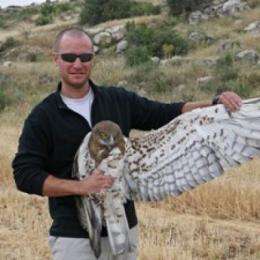
Through extensive field research, including the placement of advanced GPS systems on the adult nesting birds, Friedemann and his fellow researchers tracked the movements of both species throughout breeding season by tagging four buzzards and three eagles. They found 31 buzzard nests and 60 eagle nests in the Judean Foothills. The researchers continue to examine each nest twice a season, tracking the growth of new chicks and analyzing food remains to determine the extent of competition for food sources between the two raptor species.
The results, say Friedemann, will indicate that the buzzards have started to muscle in on the eagles' habitat — taking over their nests and diminishing the common food supply of snakes, lizards and rodents. "Every time you have strong competition between two species, one is more successful," he explains. "There is a negative impact on the weaker species."
The next step, says Friedemann, is to extend research done with the GPS transmitters, and to assess the rising levels of aggression in both buzzards and eagles, which arise from the heightened competition for food and space. By playing recorded bird calls near nesting sites of the opposite species, the researchers can measure how aggressive the response becomes.
Living side-by-side
In this case, afforestation, usually considered a positive contribution to the sustainability of our environment, was the cause of habitat destruction. This should serve as a cautionary lesson for any project that serves to alter the natural environment, the researchers conclude.
"There needs to be a broader consideration not just of the directly affected area, but of neighboring areas as well — especially if there is a species that will be forced to abandon the original area and seek out a new place to live," Friedemann says. In this instance, harm might have been avoided by setting aside a track of open space where the buzzards could continue to nest and hunt, a conclusion that would have broad implications for landscape planning and policy.
We must take more responsibility for the assessment of neighboring habitats, Friedemann cautions, because what helps one environment might harm the next.
Provided by Tel Aviv University


