After raids, artifact dealers slowly regain trust
(AP) -- It's been two years since swarms of federal agents burst into nearly two dozen homes scattered throughout the archeologically rich Southwest, looking to take down what they believed was a criminal element robbing Native American grave sites and illicitly selling or trading pieces of the nation's heritage.
Prosecutors are nearly done working their way through the list of defendants charged following those raids, having negotiated plea agreements with most that have resulted in nothing more than probation.
But for legitimate dealers and collectors of Indian artifacts, the sting in the rugged Four Corners region - where the boundaries of Utah, Arizona, New Mexico and Colorado meet - is as fresh today as when the raids happened that summer day in 2009.
Since then, they've been struggling to rebuild their reputations and to dispel the "fantasy" that they are part of a black market dealing in rare, pricey bits of American history - an illusory underground network which, they argue, doesn't exist at all.
"There's not that much crime in this business. It's a very tiny fringe element," said Dace Hyatt, a restoration expert from Show Low, Ariz., who has served as an expert in some of the cases stemming from the raids.
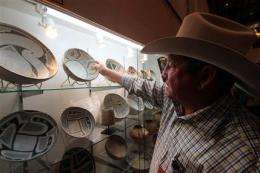
Hyatt and fellow members of the Antique Tribal Art Dealers Association organized a discussion on the raids this week during the Whitehawk Antique Show, the nation's largest and longest-running Indian artifacts show.
The concerns raised during the meeting echoed what dealers and collectors first brought up a year ago: that the federal government should not have relied on undercover informant Ted Gardiner to make their case.
This time Hyatt was armed with federal court documents that he obtained while working on the cases as part of an effort to determine the market value of some of the items that Gardiner had purchased with government funds as part of the sting operation. The value was key in determining whether the defendants would be charged with federal felonies, rather than misdemeanors.
In one case, Gardiner paid $2,800 for four stones that looked like nothing more than skipping rocks. At best, Hyatt said, the stones could have fetched $100 on the open market.
The FBI evidence list referred to the stones as three prayer sticks and a mountain lion fetish. After seeing photographs, the dealers and collectors in the audience let out a roar of laughter at the suggestion.
The markup for the 25 items that Hyatt reviewed averaged more than 700 percent, he said.
"To me, it's a cut and dry case where the government was clearly inducing felony charges with an erroneous value system," he said. "I know that's a pretty hard statement to make when you're dealing with the FBI and the BLM.
"The facts don't lie and when you're on the right side of truth, it gives you an element of confidence and these are irrefutable facts," he said, referring to what the market is willing to bear for arrowhead collections, pendants, shell necklaces and other artifacts.
Hyatt and others said people were harassed and the case was blown out of proportion.
"Three prayer sticks? A mountain lion fetish? These are just a few rocks," he said. "People started to take their lives and that's the tragedy of it."
The FBI, the Bureau of Land Management and other agencies involved in the raids are standin g behind their investigation, but they have declined to comment since a civil lawsuit is pending and a handful of defendants have yet to get their day in court.
"We're not trying to dodge the issue," David Kice, an FBI special agent in Santa Fe who is assigned to the agency's art theft team, said during one of this week's meetings. "You may have noticed that federal government folks can't talk about ongoing cases, we simply can't."
All 24 of the government's cases hinged on the work of Gardiner, an artifacts dealer who secretly recorded more than $335,000 in purchases over two years from people later accused of digging, collecting, selling or trafficking in artifacts taken from federal and tribal lands.
In March 2010, three weeks before the 52-year-old Gardiner was scheduled to testify, he committed suicide at his home near Salt Lake City.
Jim Owens, a retired attorney and avid collector from Albuquerque, said the idea of a black market was perpetuated by Gardiner himself.
"All of this was a figment of Ted Gardiner attempting to get a salary and selling the FBI and the BLM a bill of goods. There's no other way to say it. He lied."
Gardiner was known to have suffered through substance abuse and mental health issues, but his son, Dustin, told The Associated Press his father believed he was doing what was right by agreeing to be an informant.
"His whole motivation was wanting to protect and preserve that history," Dustin Gardiner said in a telephone interview. He added that those who continue to take aim at his father are "apologists for nothing but an illegal black market."
Aside from the debate over whether a black market exists, a fight is brewing over who is in the best position to act as caretakers for the millions of fragments of history that are floating through the market and sitting on museum shelves or in government warehouses.
No matter whom you talk to, from dealers and collectors to federal agencies, museum directors and archaeologists, they all share intentions for preserving and protecting artifacts.
How that's accomplished and who has the final say is what's causing all the consternation.
Dealers and collectors say they should have a role because they have a passion for the objects, from appreciating them for their simple artistic beauty to researching the history embedded in layers of organic paint or strands of woven yucca.
"Human nature tells me if I buy something, I'm going to take care of it," Owens said. "But more importantly than that, when it comes to people that collect, we have a passion for these articles and we're going to take care of them a heck of a lot better than what reports show the government is doing."
Many at the meetings said they were frustrated. They had hoped federal officials would provide them with a better understandin g of what happened in 2009 and why.
Some also criticized Kice for wanting the Indian artifacts market to "dry up."
"The legal trade creates a market for the illegal trade and creates a market for looted art," Kice said. "Personally, for me it makes it difficult, much more difficult for me to do my job and find those who are trafficking in looted artifacts, illegal artifacts."
The problem is that many artifacts were excavated decades and even centuries ago before Congress enacted laws protecting archaeological sites and cultural property, said Kate Fitz Gibbon, a Santa Fe attorney and ATADA board member. Those items shouldn't be treated as contraband just because they come without an archaeological record, she said.
She suggested to the federal officials and dealers that they appreciate what previous generations did to open the public's eyes to "the beauty and the meaning and the message" of different cultures.
"Let's hope some of the younger generation will continue and will want to be the traders and collectors and scholars of tomorrow," she said, "and let's acknowledge that as valuable as archaeology is, it's not the only way of looking at this art."
©2011 The Associated Press. All rights reserved. This material may not be published, broadcast, rewritten or redistributed.


