Organic photovoltaics: Solar cells of the future?

August 16, 2011 By Safatul Islam
"With our burgeoning energy demands, we need to start utilizing the sun's precious gift - it's the greatest source of energy we have. And we need to do this in a sustainable manner for the long term," said Safatul Islam, a UA sophomore studying chemical engineering and mathematics who is conducting research with a team in the College of Optical Sciences
Undergraduate researcher Safatul Islam is a member of a team in the College of Optical Sciences investigating organic photovoltaics, which can lead to improved electronics.
As the summer dwindles down, many people eagerly welcome the decline of long sunny days. But for others, this period of shorter days signals the end of the sun's longest duration of generously giving energy to this region of the world.
Safatul Islam, a University of Arizona sophomore studying chemical engineering and mathematics, is working with researchers to develop better ways to harness the sun's power for human use.
This summer, Islam has been working under UA College of Optical Sciences professor Robert Norwood and his solar team.
The team is investigating different ways to improve a special category of solar cells organic photovoltaics, or OPVs.
Unlike typical solar cells composed of semiconductors like silicon, these cells utilize carbon-based polymers that are able to separate charges to produce a current directly from the sun's energy.
Still a relatively new field of study, OPVs show promise because of their immense variability and the fact that they are less costly and more resourceful, said Islam, a UA Honors College student.
"OPVs may never reach the conversion efficiency of their crystalline counterparts," said Islam, as part of the research team, who works closely with Byron Cocilovo, a doctoral student of optical sciences.
"But the best thing is that they don't need to," Islam said. "Since they are so much cheaper to make and the sun provides so much energy, a target of 10 percent efficiency will hopefully make them viable in the market."
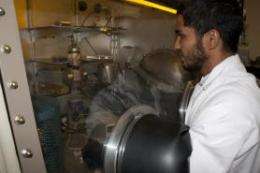
Safatul Islam spent the summer fabricating solar cells for his investigation. Credit: Byron Cocolivo
Translation: Out of the light that hits the cell, only 10 percent needs to be converted to usable electricity. However, there is still work that needs to be done to get to that point.OPV cells are unstable and improving the chemical layer responsible for charge separation is hardly trivial, Islam said.
His research project has been aimed at building cells in a nitrogen-rich environment, then exposing them to the atmosphere and investigating the degradation of the cells.
In an ambient air environment, the electrodes of the cell oxidize and the polymer layers degrade, so the cells don't last longer than a few days, Islam said. "But we're exploring ways to impede the degradation, either by changing the structure or experimenting with the chemical encapsulation layers."
After spending the summer fabricating cells and working to improve the methods of testing them, Islam said he and other members of his team are optimistic that organic PV cells will reach a point when they will be commercially viable.
"There are lots of things to play with," he said. "Whether it's modifying the structure to allow the organic solar cell to trap more light or degrade slower, or understanding the chemical makeup to use more effective polymer combinations, the possible ways to improve the cell are endless."
Provided by
University of Arizona
-
From lemons to lemonade: Reaction uses carbon dioxide to make carbon-based semiconductor,
32 comments
-
Thioridazine kills cancer stem cells in human while avoiding toxic side-effects of conventional cancer treatments,
3 comments
-
SpaceX private rocket blasts off for space station (Update),
42 comments
-
Climate scientists say they have solved riddle of rising sea,
31 comments
-
SpaceX capsule has 'new car' smell, astronauts say (Update),
2 comments
-
Need a rigid insulation material???
14 hours ago
-
magnets or EMF in car bumpers to protect from fender bender
May 26, 2012
-
length of wire in a coil of known dimensions?
May 25, 2012
-
India Engineering Powerhouse
May 25, 2012
-
electromagnet core dereference between hard and soft iron
May 25, 2012
-
Measuring water pressure in an open tank
May 24, 2012
- More from Physics Forums - General Engineering
More news stories
Browser wars flare in mobile space
The browser wars are heating up again, but this time the fight is for dominance of the mobile Internet.
7 hours ago |
5 / 5 (1) |
3
Probability of contamination from severe nuclear reactor accidents is higher than expected: study
Catastrophic nuclear accidents such as the core meltdowns in Chernobyl and Fukushima are more likely to happen than previously assumed. Based on the operating hours of all civil nuclear reactors and the number ...
Technology / Energy & Green Tech
May 22, 2012 |
3.6 / 5 (22) |
56
|
SpotterRF debuts Radar Backpack Kit (w/ Video)
(Phys.org) -- SpotterRF has announced a special radar backpack kit designed to enhance situational awareness for soldiers on the ground. The company says its special radar is designed for warfighters as part ...
HyperSolar shows dirty water no barrier to power world
(Phys.org) -- The Santa Barbara, California, company, HyperSolar, is set to transparently share the ups and downs of its research experiences toward the companys ultimate vision, successfully producing ...
Tesla to launch electric sedan in US on June 22
Tesla Motors said Tuesday it would begin deliveries of "the world's first premium electric sedan" on June 22, slightly ahead of schedule.
Technology / Energy & Green Tech
May 22, 2012 |
4.5 / 5 (12) |
18
Change in developmental timing was crucial in the evolutionary shift from dinosaurs to birds: study
At first glance, it's hard to see how a common house sparrow and a Tyrannosaurus Rex might have anything in common. After all, one is a bird that weighs less than an ounce, and the other is a dinosaur that ...
Computer model used to pinpoint prime materials for efficient carbon capture
When power plants begin capturing their carbon emissions to reduce greenhouse gases and to most in the electric power industry, it's a question of when, not if it will be an expensive undertaking.
'Unzipped' carbon nanotubes could help energize fuel cells, batteries
Multi-walled carbon nanotubes riddled with defects and impurities on the outside could replace some of the expensive platinum catalysts used in fuel cells and metal-air batteries, according to scientists at ...
T cells 'hunt' parasites like animal predators seek prey, study shows
By pairing an intimate knowledge of immune-system function with a deep understanding of statistical physics, a cross-disciplinary team at the University of Pennsylvania has arrived at a surprising finding: T cells use a movement ...
Manufacturing genes to attack flu virus
An international research team has manufactured a new protein that can combat deadly flu epidemics.
Yale study concludes public apathy over climate change unrelated to science literacy
Are members of the public divided about climate change because they don't understand the science behind it? If Americans knew more basic science and were more proficient in technical reasoning, would public consensus match ...
