Better 'photon loops' may be key to computer and physics advances
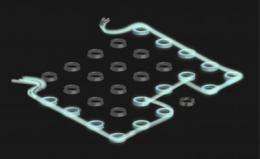
Artist's rendering of the proposed JQI fault-tolerant photon delay device for a future photon-based microchip. The devices ordinarily have a single row of resonators; using multiple rows like this provides alternative pathways for the photons to travel around any physical defects. Credit: JQI
Surprisingly, transmitting information-rich photons thousands of miles through fiber-optic cable is far easier than reliably sending them just a few nanometers through a computer circuit. However, it may soon be possible to steer these particles of light accurately through microchips because of research performed at the Joint Quantum Institute of the National Institute of Standards and Technology (NIST) and the University of Maryland, together with Harvard University.
The scientists behind the effort say the work not only may lead to more efficient information processors on our desktops, but also could offer a way to explore a particularly strange effect of the quantum world known as the quantum Hall effect in which electrons can interfere with themselves as they travel in a magnetic field. The corresponding physics is rich enough that its investigation has already resulted in three Nobel Prizes, but many intriguing theoretical predictions about it have yet to be observed.
The advent of optical fibers a few decades ago made it possible for dozens of independent phone conversations to travel long distances along a single glass cable by, essentially, assigning each conversation to a different color-each narrow strand of glass carrying dramatic amounts of information with little interference.
Ironically, while it is easy to send photons far across a town or across the ocean, scientists have a harder time directing them to precise locations across short distances-say, a few hundred nanometers-and this makes it difficult to employ photons as information carriers inside computer chips.
"We run into problems when trying to use photons in microcircuits because of slight defects in the materials chips are made from," says Jacob Taylor, a theoretical physicist at NIST and JQI. "Defects crop up a lot, and they deflect photons in ways that mess up the signal."
These defects are particularly problematic when they occur in photon delay devices, which slow the photons down to store them briefly until the chip needs the information they contain. Delay devices are usually constructed from a single row of tiny resonators, so a defect among them can ruin the information in the photon stream. But the research team perceived that using multiple rows of resonators would build alternate pathways into the delay devices, allowing the photons to find their way around defects easily.
As delay devices are a vital part of computer circuits, the alternate-pathway technique may help overcome obstacles blocking the development of photon-based chips, which are still a dream of computer manufacturers. While that application would be exciting, lead author Mohammad Hafezi says the prospect of investigating the quantum Hall effect with the same technology also has great scientific appeal.
"The photons in these devices exhibit the same type of interference as electrons subjected to the quantum Hall effect," says Hafezi, a research associate at JQI. "We hope these devices will allow us to sidestep some of the problems with observing the physics directly, instead allowing us to explore them by analogy."
More information: M. Hafezi, E.A. Demler, M.D. Lukin and J.M. Taylor. Robust optical delay lines with topological protection. Nature Physics, Aug. 21, 2011, DOI: 10.1038/NPHYS2063
Provided by
National Institute of Standards and Technology
-
From lemons to lemonade: Reaction uses carbon dioxide to make carbon-based semiconductor,
32 comments
-
Thioridazine kills cancer stem cells in human while avoiding toxic side-effects of conventional cancer treatments,
3 comments
-
SpaceX private rocket blasts off for space station (Update),
42 comments
-
Climate scientists say they have solved riddle of rising sea,
31 comments
-
SpaceX capsule has 'new car' smell, astronauts say (Update),
2 comments
-
Water flow question
2 hours ago
-
[Drift velocity] Factors affecting velocity
5 hours ago
-
does cold gasoline have less energy
5 hours ago
-
distribution of molecules throughout the atmosphere
7 hours ago
-
The Global Positioning System !
8 hours ago
-
A Question relating Power
9 hours ago
- More from Physics Forums - General Physics
More news stories
Is a classical electrodynamics law incompatible with special relativity?
(Phys.org) -- The laws of classical electromagnetism that were developed in the 19th century are the same laws that scientists use today. They include Maxwell’s four equations along with the Lorentz la ...
Landmark calculation clears the way to answering how matter is formed
(Phys.org) -- An international collaboration of scientists, including Thomas Blum, associate professor of physics, is reporting in landmark detail the decay process of a subatomic particle called a kaon ...
May 25, 2012 |
4.3 / 5 (22) |
50
|
Lying in wait for WIMPs: Researchers seek to dramatically increase sensitivity of Large Underground Xenon detector
Although it's invisible, dark matter accounts for at least 80 percent of the matter in the universe. No one knows what it is, but most scientists would bet on weakly interacting massive particles, or WIMPs.
May 23, 2012 |
4 / 5 (7) |
15
|
Hawaii lab turns laser-powered bubbles into microrobots
(Phys.org) -- A team of scientists from the University of Hawaii are working on microrobots created from bubbles of air in a saline solution. The bubbles take on their title of robots as a laser ...
Sound increases the efficiency of boiling
Scientists at the Georgia Institute of Technology achieved a 17-percent increase in boiling efficiency by using an acoustic field to enhance heat transfer. The acoustic field does this by efficiently removing vapor bubbles ...
May 24, 2012 |
5 / 5 (2) |
2
Change in developmental timing was crucial in the evolutionary shift from dinosaurs to birds: study
At first glance, it's hard to see how a common house sparrow and a Tyrannosaurus Rex might have anything in common. After all, one is a bird that weighs less than an ounce, and the other is a dinosaur that ...
Computer model used to pinpoint prime materials for efficient carbon capture
When power plants begin capturing their carbon emissions to reduce greenhouse gases and to most in the electric power industry, it's a question of when, not if it will be an expensive undertaking.
'Unzipped' carbon nanotubes could help energize fuel cells, batteries
Multi-walled carbon nanotubes riddled with defects and impurities on the outside could replace some of the expensive platinum catalysts used in fuel cells and metal-air batteries, according to scientists at ...
T cells 'hunt' parasites like animal predators seek prey, study shows
By pairing an intimate knowledge of immune-system function with a deep understanding of statistical physics, a cross-disciplinary team at the University of Pennsylvania has arrived at a surprising finding: T cells use a movement ...
Manufacturing genes to attack flu virus
An international research team has manufactured a new protein that can combat deadly flu epidemics.
Yale study concludes public apathy over climate change unrelated to science literacy
Are members of the public divided about climate change because they don't understand the science behind it? If Americans knew more basic science and were more proficient in technical reasoning, would public consensus match ...
Aug 23, 2011
Rank: not rated yet
Wave Division Multiplexing, or the method of using multiple colors on the same fiber, is distinctly different from Time Division Multiplexing, which is Bell Labs' invention for sending 23 phone conversations and the signaling data down 1 single pair of copper wires.
Combining this "T-1" time slicing with other advances in digital logic, allows for a vast amount of data on just 1 single wavelength/color of laser light down a fiber. To the tune of a few gigabits.
That's tens of thousands of phone calls. One color.
Multiplex more colors, you exponentially increase the capacity.
Make faster electronics, increase the capacity without using more laser colors.