Peru researchers make rare ancient insect find
Aug 10, 2011
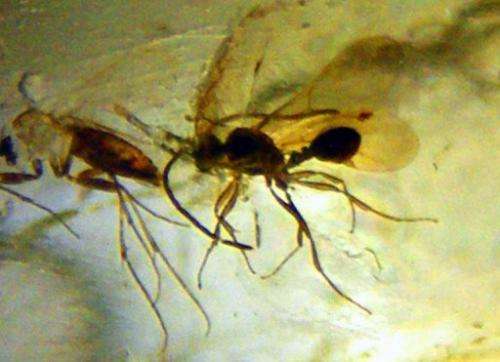
Detailed fossilized insect remains preserved in amber for over 23 million years
A picture released in Lima by the Peruvian Paleontological Meyer-Hönningen Museum of Chiclayo in northern Peru, shows detailed fossilized insect remains preserved in amber for over 23 million years, found in an excavation in the Santiago river basin, in the Amazon region (which borders Ecuador).

Researchers in Peru said Tuesday they have discovered the remains of ancient insects and sunflower seeds trapped inside amber dating from the Miocene epoch, some 23 million years ago.

The rare find was made in the remote mountainous jungle region near Peru's northern border with Ecuador, Klaus Honninger told AFP.

"These are very important, because the insects and sunflower seeds confirm the type of climate that existed during the Miocene period," Honninger said in a telephone interview from the northern city of Chiclayo.

The paleontologists discovered "hundreds of pieces of amber up to 12 centimeters (five inches) large containing several types of insects," Honninger said.

The insects trapped in the amber -- fossilized tree resin -- are extremely well preserved and include ancient beetles, barklice, flies and spiders.

Honninger, director of the Chiclayo-based Meyer-Honninger Paleontology Museum, said that the experts discovered "an unknown species of arachnid" with a head like a dog and legs four times longer than the body.

The discovery was made in April in the Santiago River area of northern Peru.

Extreme climate change from the Miocene epoch (23 to five million years ago) was likely the reason the became extinct, Honninger said.

The same team of researchers announced in January it had discovered a fossilized squid from the Cretaceous era (145 to 65 million years ago) some 3,700 meters (12,100 feet) above sea level in the Maranon River Valley, also in far northern Peru.

Explore further: King Richard III found in 'untidy lozenge-shaped grave'

add to favorites email to friend print save as pdf

Related Stories

Fossil of Cretaceous-era squid found in Peru

Jan 20, 2011

Paleontologists said Thursday they discovered the 85-million-year-old fossil of a previously unknown squid species from the Cretaceous era in the high jungle region of northeastern Peru.

Japanese help uncover ancient Peru remains

Sep 10, 2009

A joint Japanese-Peruvian archeological mission has uncovered the remains of a pre-Incan woman sacrificed more than 2,000 years ago in the Andean nation, experts told local media Wednesday.

Unexpected amber find rewrites botanical history

Oct 02, 2009

(PhysOrg.com) -- An unexpected discovery made by Macquarie University PhD student Sargent Bray about the origin and nature of chemical compounds contained in ancient amber has changed our understanding of ...

Recommended for you

Submerged structure stumps Israeli archaeologists

May 23, 2013

The massive circular structure appears to be an archaeologists dream: a recently discovered antiquity that could reveal secrets of ancient life in the Middle East and is just waiting to be excavated.

User comments : 0

More news stories

Challenging the public's view of gender and science

According to She Figures 2012, which analyses gender equality in research, in 2010 women accounted for only 10 % of university rectors in Europe and 15.5 % were heads of institutions of the higher education ...

Galaxies fed by funnels of fuel

(Phys.org) —Computer simulations of galaxies growing over billions of years have revealed a likely scenario for how they feed: a cosmic version of swirly straws.

Google eyes emerging markets networks

Google has become deeply involved in a series of projects to build and operate wireless networks in emerging markets including sub-Saharan Africa and Southeast Asia, a report said Friday.