Oocytes: Going with the flow
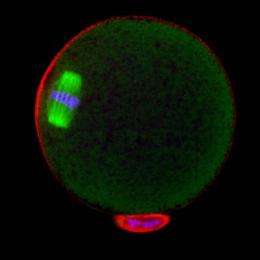
Most cells rely on structural tethers to position chromosomes in preparation for cell division. Not so oocytes. Instead, a powerful intracellular stream pushes chromosomes far-off the center in preparation for the highly asymmetric cell division that completes oocyte maturation upon fertilization of the egg, report researchers at the Stowers Institute for Medical Research.
Their findings illustrate how oocytes repurposed a dynamic cellular mechanism capable of generating considerable intracellular forces and widely used by migrating cells to propel them forward, to set the stage for asymmetric cell division —the kind of cell divisions that generate two different daughter cells. It might also lead to improvements in the selection criteria used to choose the most promising oocytes for in-vitro fertilization.
As a mammalian egg develops, it undergoes two highly asymmetric cell divisions, known as meiosis I and II. During each of these divisions, the cytoplasm divides unequally, giving rise to a large egg and two polar bodies that are much smaller than the developing oocyte. To achieve this uneven distribution of the cytoplasm, the meiotic spindle—the structure that separates the chromosomes into daughter cells—has to be positioned close to the so-called cortical cap, the region where the polar body will form.
"Conventional thinking predicted some sort of physical tether that moors the meiotic spindle at the cortical cap," says Rong Li, Ph.D., Stowers investigator and senior author of the study published in the August 28, 2011, advance online edition of Nature Cell Biology. "It came quite as a surprise that, instead, a continuous intracellular flow pushes the spindle into the correct position and keeps it there."
Earlier studies had ruled out microtubules, which help position the spindle during mitotic cell divisions, as potential tethers while older studies had hinted at actin as a possible candidate. Actin, one of the most abundant protein in animal cells, forms dynamic filament networks that play a crucial role in many cellular processes, including cell migration, intracellular transport.
To find out whether and how actin might play a role in the position of the meiotic spindle, postdoctoral researcher and first author Kexi Yi, Ph.D., incubated mouse oocytes with several known inhibitors of the actin cytoskeleton. "Within minutes of applying CK-666, a brand new and very specific inhibitor, the spindle drifted away from the cortical cap towards the center of the oocyte."
CK-666 inhibits the Arp2/3 complex, a major regulator of the actin cytoskeleton that is known to play a role in cell locomotion and membrane trafficking. It binds to existing actin filaments and initiates the growth of new "branch" filaments. Further experiments revealed that myosin-II contractility, better known for producing muscle contractions, pushes the spindle away from the cortical cap when the Arp2/3 complex is inhibited.
Previous work by Li and her team had shown that meiotic chromosomes, when positioned close to the cortex of an oocyte in meiosis II, induces the formation of a cortical actin cap by propagating the regulatory signal from the Ran protein. When Yi tested the effect of intercepting the Ran signal, they found that Ran also regulates Arp2/3 localization and by extension, spindle position.
Yi then turned to high-resolution time-lapse confocal microscopy and spatiotemporal correlation spectroscopy (STICS), in collaboration with Stowers imaging experts, Jay Unruh, Ph.D., and Brian Slaughter, Ph.D., both co-authors on the paper, to track the dynamics of the cytoplasmic actin network in oocytes labeled with a live F-actin probe.
"STICS analysis showed that the actin flow originates at the cortical cap and continues down along both sides of the lateral cortex before it converges near the center of the oocyte and reverses direction toward the spindle," says Yi. When he treated the oocytes with jasplakinolide, an actin filament-stabilizing drug, actin flow in the cells' interior almost immediately ceased.
"The actin flow drives cytoplasmic streaming away from the cortical cap region along the cell periphery. When it arrives at the opposite pole of the oocyte, it circulates back in a pattern similar to that of the actin flow toward the spindle," says Li. A theoretical analysis by physicist and co-author Boris Rubinstein, Ph.D., a research advisor at the Stowers Institute, found that the observed cytoplasmic streaming generates pressure on the spindle and pushes it towards the cortex.
In many vertebrate species including mammals, oocytes may arrest in meiosis II for hours or even days awaiting fertilization. "During this time the asymmetric spindle position must be stably maintained," explains Li. "Maintaining spindle position under an active force could prevent slow and random drift of spindle position or orientation if the meiotic arrest is prolonged."
Loss of asymmetric positioning of the meiosis II spindle is a known cause of impaired reproductive potential in aging females and spindle position is used as a clinical index to evaluate the quality of oocytes arrested in meiosis II for in-vitro fertilization.
Provided by Stowers Institute for Medical Research


