Oklahoma, Texas set heat records in July
August 9, 2011 By RANDOLPH E. SCHMID , AP Science Writer

Oklahoma, Texas set heat records in July (AP)

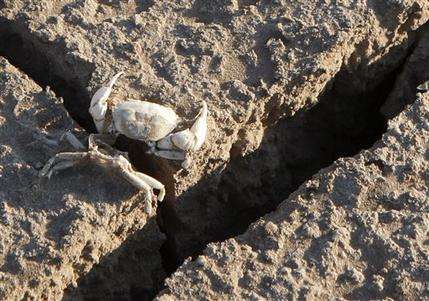
EDS: RE-TRANSMISSION OF TXTG116 FOR ALTERNATE CROP In this Sunday Aug. 7, 2011 photo, the skeletal remains of a fresh water crab is seen on the cracked, dry bed of Lake E.V. Spence in Robert Lee, Texas. The drought that has turned Texas and parts of the Plains into a parched moonscape of cracked earth could persist into next year, prolonging the misery of farmers and ranchers who have endured a dry spell that is now expected to be the state's worst since the 1950s. (AP Photo/Tony Gutierrez)

(AP) -- Sweltering may have reached a new record last month, as Oklahoma racked up the country's highest monthly average temperature ever.

That's the highest , for any month, for any state, associate Oklahoma state climatologist Gary McManus said.

According to automated weather recording instruments, the state's average for July was 89.1 degrees. That tops an average of 88.1 set in July 1954, McManus said.

The on Monday reported that last month was the fourth hottest July on record for the U.S. and that Texas and Oklahoma had their warmest months on record.

"We've been beating temperature records left and right, from the 1930s Dust Bowl drought and the 1950s drought," said McManus, who admitted that's not the kind of record you put on a Chamber of Commerce promotion.

And it's not like Oklahoma is alone in this.

Nationwide, in the past 30 days 3,709 high temperature records have been set or tied.

And, worse, there have been 7,410 records for overnight warmth broken or tied, meaning less chance to recover from the sweltering daytime readings.

"This has been a devastating year," director Jack Hayes said. " are on the rise in the United States," he noted, including records for heat, tornadoes, floods and fires, and with the bulk of still remaining.

Waco, Texas, tied its record for the most consecutive days of 105 degrees or more at six (Aug. 1-6). The previous were Aug. 31-Sept. 5, 2000, and Aug. 9-14 1969.

And Dallas-Fort Worth is on pace to establish a new record for consecutive 100-degree days. It's currently at 38 days, from July 2 to Aug. 8. The record is 42 set June 23-Aug. 3, 1980.

The July average for Texas was 87.1 degrees.

The current is typical of U.S. heat waves in the past decade and is consistent with the increasing warm summer nighttime extremes observed across much of the country since the late 20th century, NOAA reported.

Other findings included:

- Forty-one of the lower 48 states had above-normal, much-above-normal or a record warmest July.

- The South climate region - Arkansas, Kansas, Louisiana, Mississippi, Oklahoma and Texas - had its warmest single calendar month for any climate region on record. The average temperature of 86.1 degrees bested the previous all-time record of 85.9 set in July 1980 in the South climate region.

- Dallas exceeded 100 degrees on 30 of the 31 days in July.

- Reagan National Airport in Washington, D.C., had its warmest single calendar month on record, with an average temperature of 84.5 degrees, breaking the previous record of 83.1 degrees set in July 2010 and July 1993.

©2011 The Associated Press. All rights reserved. This material may not be published, broadcast, rewritten or redistributed.

4.2 /5 (11 votes)  

Filter


Move the slider to adjust rank threshold, so that you can hide some of the comments.


Display comments: newest first

Parsec
Aug 09, 2011

Rank: 3.2 / 5 (11)
I wonder how many times that the deniers have to say that the mounting evidence of climate change don't demonstrate any evidence of AGW before it begins to leak into their little brains that they might, just possibly be wrong.

Data will tell in the end, the only question remaining is how loud it has to shout before its heard.
Vendicar_Decarian
Aug 10, 2011

Rank: 2.6 / 5 (10)
God is turning Denier country into a desert.

I love poetic justice.

...

And ice cream.
omatumr
Aug 10, 2011

Rank: 1.9 / 5 (9)
The National Oceanic and Atmospheric Administration on Monday reported that last month was the fourth hottest July on record for the U.S. and that Texas and Oklahoma had their warmest months on record.


Great story.

But the reporting seems biased for a public-funded research agency.

Surely there are record heat and cold spots someplace on the globe every day.

But selective reporting on those spots, even with scary pictures like these, are not the reason NOAA receives public tax funds. The public deserves honest science reports from NOAA and all other public funded research organizations.

With kind regards,
Oliver K. Manuel
Former NASA Principal
Investigator for Apollo
omatumr
Aug 10, 2011

Rank: 1.4 / 5 (7)
An explanation from NOAA scientists would be appreciated.
omatumr
Aug 10, 2011

Rank: 4 / 5 (10)
Are NOAA scientists aware of this report on the reason for heat wave?

www.theonion.com/...t,21088/
Ethelred
Aug 10, 2011

Rank: 3.7 / 5 (3)
Oliver posted a JOKE.

Will wonders never cease?

Ethelred
omatumr
Aug 11, 2011

Rank: 2 / 5 (8)
The real joke is the claim that Earth's climate is insulated from well-known changes in Earth's heat source - the Sun.
barakn
Aug 11, 2011

Rank: 4.2 / 5 (5)
Who claimed that? Oh, no one, you're lying about it. There has been extensive study of solar variability and climate, and there is widespread agreement that there is some degree of correlation.
Ethelred
Aug 11, 2011

Rank: 1 / 5 (2)
Oliver posted TWO jokes. Of course one was a lie so that isn't anything new. BUT since lying is for life and death and good jokes it would be OK.

Except its a stupid joke.

Ethelred
ryggesogn2
Aug 11, 2011

Rank: 2.8 / 5 (9)
When winters set local low temperature records, it not an indication of the failure of AGW, but localized high temperature records prove AGW?

ryggesogn2
Aug 11, 2011

Rank: 2.8 / 5 (9)
"Oklahoma recorded its coldest temperature in state history on Thursday morning and records fell in cities in Missouri and Texas as a deep freeze gripped most of the nation.

Nowata, Oklahoma in the northeast part of the state recorded 31 degrees below zero Fahrenheit. The previous lowest temperature in state history in Oklahoma was 27 degrees below zero in 1930 and 1905, said Gary McManus, associate state climatologist with the Oklahoma Climatological Survey.

The cold came on top of two major snow falls, one Tuesday night, which brought up to 20 inches of snow in parts of the state, and one during last week's blizzard, which brought 8 to 20 inches."
http://www.reuter...20110210
That was six months ago.
ryggesogn2
Aug 11, 2011

Rank: 2.4 / 5 (8)
"The Dallas-Fort Worth areas streak of 100-degree days is over just two shy of the record set in 1980."
http://dfw.cbsloc...nto-80s/
What? No record broken?
omatumr
Aug 11, 2011

Rank: 1.6 / 5 (7)
These five videos show how consensus opinions and government propaganda have replaced science over the last 50 years:

1. Science vs. Propaganda (1961)

www.youtube.com/w...ld5PR4ts

2. Origin of the Solar System (1975)

www.youtube.com/w...e_Qk-q7M

3. The Iron Sun (1983)

www.youtube.com/w...QSSHIe6k

4. Neutron Repulsion (2001)

www.youtube.com/w...yLYSiPO0

5. Global Warming Scam (2011)

www.youtube.com/w...IFmZpFco
Vendicar_Decarian
Aug 12, 2011

Rank: 2.5 / 5 (8)
Sorry Tard boy.. No one has claimed such a thing. You are assuming what you wish to believe. And that is why you are and will always remain... A tard.

"The real joke is the claim that Earth's climate is insulated from well-known changes in Earth's heat source the Sun." - Omatard
Vendicar_Decarian
Aug 12, 2011

Rank: 2.5 / 5 (8)
You mean it was cold? In winter? In Oklahoma?

Astonishing Omatard... Absolutely Astonishing.

No doubt your theorized Iron neutron star at the center of the sun was the cause.

"Oklahoma recorded its coldest temperature in state history on Thursday morning and records fell in cities in Missouri and Texas as a deep freeze gripped most of the nation... That was 6 months ago." - OmaTard

Meanwhile Texas is continuing to become a desert, as predicted by the high resolution climate models.

ubavontuba
Aug 13, 2011

Rank: 3.7 / 5 (3)
Meanwhile Texas is continuing to become a desert, as predicted by the high resolution climate models.
This is ridiculous. Folks were saying the same things about Australia and the Sahel (Southern Sahara) just a few short years ago. Periodic drought is normal. Even the article we're commenting in states Texas saw an even worse drought in the 1950's (ostensibly before AGW). And, who can forget the Great Dust Bowl of the 1930's?

AGW'ers always cry foul when folks complain that it's cold and wet, yet they themselves shout out from the rooftops when it's hot and dry. Can you say: "hypocrite"

more...
ubavontuba
Aug 13, 2011

Rank: 3 / 5 (2)
"The long-term precipitation trend in Texas is upward, but the climate models project a downward trend under global warming.

Climate model projections of increased drought severity across Texas are based on a combination of decreased rainfall, increased evaporation, and possibly changes in weather patterns. Since theres not at present any evidence of decreasing precipitation, the present drought notwithstanding, total rainfall changes are unattributable at this point."

- John Nielsen-Gammon, the state climatologist and atmospheric scientist at Texas A&M University.

http://blog.chron...warming/

Techno1
Aug 14, 2011

Rank: 5 / 5 (1)
ubavontuba:

It's very hard to model and difficult to understand what the world would be like decades out.

Increases in global average temperature should increase the total amount of convection globally by roughly 7% PER 1F increase in temperature.

However, modeling exactly where extreme droughts or extreme precipitation will occur depends on seasonal and daily fluctuations, and also getting all the "cards" stacked just right.

You would expect more local or regional extremes during a strong El Nino or strong La Nina than in a neutral year, for example.

And just to show something, put THIS on the "Past week" setting:

http://mapcenter..../us.html

During the winter, it was admittedly more cold records than hot, but it was usually around 2 to 5 to one.

I have watech this all summer, and the ration of hot vs cold records has been as high as in the 30's for an entire week, and for this past week it was 14 to 1.
Techno1
Aug 14, 2011

Rank: 5 / 5 (1)
Also, even in the middle of extreme heat records, we find extreme precipitation.

Many, many of the rainfall records are 150%, 200%, even 300% or more of the previous daily rainfall record...even in a location adjacent to or co-located with a record daytime high or high minimum on the same day, or within plus or minus 24 hours.

So the fact that many locations break a hot record on the same day, or the day after an extreme precipitation event is simply ridiculous in the scheme of ordinary climate.

http://igloo.atmo...;sy=2011

Look at this. That shows the September Minimum for ice extent for 1979 and compared to August 11 of this year. This year already has FAR less extent than the september minimum of 1979, and the QUALITY of the ice this year is down by at least 30% or more. The extent with at least 70% Ice is down to around 1/4th or 1/5th of it's 1979 coverage.
Techno1
Aug 14, 2011

Rank: 5 / 5 (1)
The extent of THIRTY PERCENT ice is actually ALREADY less than the extent of SEVENTY PERCENT ice was in the September minimum of 1979...

Considering the Heat of Fusion is EIGHTY times greater than the specific heat capacity of water, this means the planet is absolutely hotter than it has ever been since records began.

Also, change the dates to February 11, which is near the maximums, and compare the WINTER ice packs for the years.

The 2011 sea ice is missing a 70 to 100% ice sheet the size of Alaska just off the eastern coast of Russia alone, another one north east of Norway and Finland, another one near Denmark, and ANOTHER ONE near Newfoundland and ANOTHER one between Iceland and Greenland...

The 2011 Northern hemisphere winter might have broken a few local minimums in the U.S., but globally, it was one of the hottest winters on record, and that's even counting the fact Europe was blocked out from the Sun 2 winters in a row by volcanisms during winter...
Techno1
Aug 14, 2011

Rank: 5 / 5 (1)
If not for the volcanism from Iceland putting so much ash up in the air, there probably would't have been as much ice near Europe as we actually saw.

Now that wasn't pinatubo or anything, but it was persistent ash cover for weeks, and may have given a "tiny" bit of a "reset" on the ice and CO2 levels...

http://en.wikiped..._effects

Observations...show increased carbon dioxide absorption...following the eruption.... carbon dioxide decreased by a total of 2.40 ppm. The thirty year mean for the same months is 1.66 ppm with a standard deviation of 0.52ppm. The probability of a chance result is less than 8%


Either way, it's is likely that since CO2 uptake increased, one way or another, that there would have been LESS ice this year during both winter and summer had the iceland volcanoes not erupted.

Next winter and summer is likely to be much warmer in Northern Hemisphere..
Techno1
Aug 14, 2011

Rank: not rated yet
And above, I should correct myself, the volcanism occured in spring and early summer, but I remember speculating that it might be big enough to cause some sort of negative feedback.

turns out, the CO2 sampling shows it did in fact cause a slight negative feedback in CO2 rise, which might not be much compared to the Keeling Curve, but was statistically significant.
Techno1
Aug 14, 2011

Rank: not rated yet
September 15, 2007 vs August 12, 2011

http://igloo.atmo...;sy=2011

Notice, almost all of the 70% or greater ice (pink and purple) is already gone this year.

This is comparing, by my judgement, probably the september 2007 minimum vs August 12 2011, two days ago.

If this keeps up, there will be no 70% or greater ice at all on this year's minimum, and this year's 50% to70% ice extent will be no bigger than 2007's extent of 70% or greater ice...

Since the data is behind, and since the melting is likely to push the minimum back another day or two, we are looking at probably as much as 34 to 37 more days before the data(two days behind) shows this year's minimum...

I have a terrible feeling that the rate of loss of ICE VOLUME is way worse than anyone has realized, and has been terribly masked by the undo focus on the 15% ice extent...

The 70% ice extent is where most of the albedo enhancement is...
ubavontuba
Aug 14, 2011

Rank: 1 / 5 (1)
It's very hard to model and difficult to understand what the world would be like decades out.

...However, modeling exactly where extreme droughts or extreme precipitation will occur depends on seasonal and daily fluctuations, and also getting all the "cards" stacked just right.
Models can be tested simply by putting in historic data and running them forward to today, and comparing the results with reality. The models generally fail to predict the current climate, miserably.

This is comparing, by my judgement, probably the september 2007 minimum vs August 12 2011, two days ago.
Let's compare apples and apples, shall we?

http://igloo.atmo...;sy=2011

And, there's little long term data to compare with. Was 2007 a 50 year low? ...a 100 year low? We simply don't know. Was it even a globally significant event? Probably not.
PinkElephant
Aug 14, 2011

Rank: 5 / 5 (1)
The models generally fail to predict the current climate, miserably.
Yeah, after all it's not like stuff like this has been out there for years already:

http://www.grida....pm-4.htm

http://www.earthi...-05.html
Techno1
Aug 14, 2011

Rank: 5 / 5 (1)
UBa:

2007 is the lowest the ice has EVER been since the Medieval Warm period....or was the lowest...

http://nsidc.org/...icenews/

July was briefly lower in 15% extend for 2011, but the 15% has gotten a bit above the 2007 curve again, however, this is misleading.

The 2011 70% or greater extents is practically disappeared, and the 15% extent is currently only barely more than 2007.

This is easily explained as the thicker ice breaks up a bit and spreads out, but overall, the volume is much lower than it ever has been...

Overall, the VOLUME is probably down 20% or more just since 2007.

The reason we know is the Northwest passage was impassible or near-impassable suicide mission throughout all of the age of exploration and colonial period history up to ice breakers.

Models might make mistakes, but the satellite data isn't lying.

The ice is melted way more than I ever realized, and this year is going to easily be the worst ever so far, if the trend continues.
jlantrip
Aug 14, 2011

Rank: 5 / 5 (1)
When winters set local low temperature records, it not an indication of the failure of AGW, but localized high temperature records prove AGW?


The weather is liken to a pendulum, as more energy is injected into the system the pendulum is swung wider, colder temperatures are a part of the prediction of global warming.
ubavontuba
Aug 15, 2011

Rank: 1 / 5 (2)
2007 is the lowest the ice has EVER been since the Medieval Warm period
This is an unsubstantiated claim. You're going to need to provide some good references for this. The reference you gave only goes back to 1979.

The reason we know is the Northwest passage was impassible or near-impassable suicide mission throughout all of the age of exploration and colonial period history up to ice breakers.
Wrong. From 1903 to 1906 the Northwest Passage was successfully sailed by Roald Amundsen and a six-man crew. Whereas your own reference states "the Northwest Passage is still choked with ice."

Models might make mistakes, but the satellite data isn't lying.
Right, and my apples and apples comparison clearly shows a wider extent today, than in 2007.

...this year is going to easily be the worst ever so far,
Doubtful. And, you still haven't established a relevant reason to be concerned.

gmurphy
Aug 15, 2011

Rank: 3 / 5 (2)
@ubavontuba. what you so tactfully neglect to mention is that the Amundsen expedition only succeeded because they used a shallow draught ship which allowed them to go right up to the coast and even then, they got locked into the ice and were trapped in a natural harbour at King William's Island for 2 years. http://en.wikiped...pedition

Not exactly on par with the ocean-going cargo behemoths which traverse the Northwest Passage with ease these days, eh?
ubavontuba
Aug 15, 2011

Rank: 2 / 5 (1)
Not exactly on par with the ocean-going cargo behemoths which traverse the Northwest Passage with ease these days, eh?
This is ridiculous. What are you talking about? The Northwest passage is generally not traversable, even today. Didn't you read Techno1's reference wherein it states the Northwest Passage is currently choked with ice? And, the first deep draft ships to make it through went in 1957 (ostensibly before AGW) and the first commercial ship went through in 1969 (again, ostensibly before AGW).

And, an opening of the Northwest Passage would be an economic benefit (even if the opening lasts only a few brief weeks of the year). So, where's the problem?

Vendicar_Decarian
Aug 18, 2011

Rank: 1.3 / 5 (3)
The image below clearly shows that the North West Passage is not "clogged with ice".

The denialist is lying again.

http://arctic.atm....000.png

"the Northwest Passage is currently choked with ice?" - ubavonTard

ubavontuba
Aug 18, 2011

Rank: not rated yet
@Venditard Detardian
The image below clearly shows that the North West Passage is not "clogged with ice".
What, so now you're suggesting Techno1's, National Snow and Ice Data Center website is lying? Maybe you think there's a conspiracy to keep ships out of the passage?

Satellite images don't show all the sea ice. Here's what the Northwest Passage really looks like:

http://www.npr.or...waterway

Rank 4.2 /5 (11 votes)
Relevant PhysicsForums posts

More news stories

Yale study concludes public apathy over climate change unrelated to science literacy

Are members of the public divided about climate change because they don't understand the science behind it? If Americans knew more basic science and were more proficient in technical reasoning, would public consensus match ...

Space & Earth / Environment

created 1 hour ago | popularity not rated yet | comments 4 | with audio podcast

10 million years needed to recover from mass extinction

It took some 10 million years for Earth to recover from the greatest mass extinction of all time, latest research has revealed.

Space & Earth / Earth Sciences

created 1 hour ago | popularity not rated yet | comments 1 | with audio podcast

Sophisticated simulations predict future warming

The chances of our planet being hit by a global warming of 3 degrees Celsius by 2050 is as likely as it being hit by an increase of 1.4 degrees, new research shows. Presented in the journal Nature Geoscience, the British study ...

Space & Earth / Earth Sciences

created May 22, 2012 | popularity 4.4 / 5 (9) | comments 51

Aliens don't want to eat us, says former SETI director

Alien life probably isn’t interested in having us for dinner, enslaving us or laying eggs in our bellies, according to a recent statement by former SETI director Jill Tarter.

Space & Earth / Space Exploration

created May 25, 2012 | popularity 4.4 / 5 (13) | comments 39

Kyoto Protocol architect 'frustrated' by climate dialogue

UN climate talks are going nowhere, as politicians dither or bicker while the pace of warming dangerously speeds up, one of the architects of the Kyoto Protocol told AFP.

Space & Earth / Environment

created May 23, 2012 | popularity 3.7 / 5 (7) | comments 39


Computer model used to pinpoint prime materials for efficient carbon capture

When power plants begin capturing their carbon emissions to reduce greenhouse gases – and to most in the electric power industry, it's a question of when, not if – it will be an expensive undertaking.

'Unzipped' carbon nanotubes could help energize fuel cells, batteries

Multi-walled carbon nanotubes riddled with defects and impurities on the outside could replace some of the expensive platinum catalysts used in fuel cells and metal-air batteries, according to scientists at ...

T cells 'hunt' parasites like animal predators seek prey, study shows

By pairing an intimate knowledge of immune-system function with a deep understanding of statistical physics, a cross-disciplinary team at the University of Pennsylvania has arrived at a surprising finding: T cells use a movement ...

Same gene that stunts infants' growth also makes them grow too big: research

UCLA geneticists have identified the mutation responsible for IMAGe* syndrome, a rare disorder that stunts infants' growth. The twist? The mutation occurs on the same gene that causes Beckwith-Wiedemann syndrome, which makes ...

Change in developmental timing was crucial in the evolutionary shift from dinosaurs to birds: study

At first glance, it's hard to see how a common house sparrow and a Tyrannosaurus Rex might have anything in common. After all, one is a bird that weighs less than an ounce, and the other is a dinosaur that ...

Scientists develop ultra-sensitive test that detects diseases in their earliest stages

Scientists have developed an ultra-sensitive test that should enable them to detect signs of a disease in its earliest stages, in research published today in the journal Nature Materials.