Ocean Observatories Initiative streams live video of undersea volcano
August 26, 2011

Ocean Observatories Initiative streams live video of undersea volcano

Enlarge

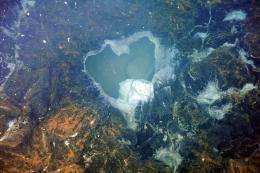
This image looks into the subsurface at Axial Seamount and shows a "snowblower" vent, a collapsed lobate lava flow about 1 meter (3 feet) across with white materials (bacterial mats and biofilm materials that coat the surfaces) thriving in nutrient-rich waters that are slightly above ambient (2 degrees C) temperature. White, dense accumulations of filamentous bacteria surround the snowblower. Credit: Canadian Scientific Submersible Facility and the University of Washington

Last spring, a volcano erupted 425 kilometers (about 265 miles) off the Oregon coast and far below the surface, at Axial Seamount. No one was aware for months.

Now, the National Science Foundation's (NSF) Ocean Observatories Initiative (OOI) will survey the site and stream live video of the volcano. It's the first live video since the volcano spewed massive amounts of lava on April 6.

When NSF-funded Oregon State University geologist William Chadwick first discovered evidence of the April eruption on Axial in late July, he immediately communicated the information to a team of University of Washington (UW) scientists and engineers currently on an OOI expedition very near the recent eruption.

The team, aboard the Thomas G. Thompson, is conducting site surveys for the deployment of a sensor infrastructure that's part of OOI.

Surveying this site is just one example of the ways in which OOI will revolutionize the way oceanography is conducted. UW oceanographers John Delaney and Deborah Kelley are leading the expedition, known as VISIONS '11.

The submarine volcano is one of OOI's primary study sites. OOI, a multi-scale ocean observing system, will deploy sensors in the ocean and provide a networked system that will allow open access to data from the air-sea interface through the to the seafloor.

Scientists and engineers have been putting the finishing touches on the construction design phase of the cabled ocean observing system that forms a backbone of OOI.

This major component of the OOI program, with the formal name of the Regional Scale Nodes, is located off the Oregon and Washington coasts.

The Axial eruption has offered a rare opportunity to use this next-generation ocean-observing technology in innovative ways.

Investigating the seamount and its environs will allow the best decisions to be made on how to construct a long-term observatory at such active seafloor sites.

The crew on the Thompson is now using a host of modern seagoing research tools to examine the Axial site.

Their activities are focused in the short-term on using and producing new maps of the volcanic changes that have taken place since the eruption.

In another portion of the region off Oregon, other members of the OOI team on board the cable-laying ship TE Subcom Dependable are deploying and burying electro-optical cable as part of the current OOI installation activity.

"OOI is transforming our ability to study the global ocean," says Delaney. "We're fitting the Juan de Fuca Plate [off Oregon and Washington] and overlying with myriad sensor arrays connected to a fiber optic-electrical network. This infrastructure will allow scientists to track changes taking place on a 24/7/365 basis for many decades."

Axial Seamount appears to be quiet at the moment, but viewers will see images of "frozen" eruptions with cooling lava flows blanketing the seafloor.

"We are excited to be working at Axial so soon after the latest eruption," said Kelley. "Using a remotely operated vehicle equipped with a high-definition underwater video camera, we are able to conduct surveys that will help determine the extent and amount of new lava flows, and assess the life forms that are already beginning to re-appear at the site."

It's a preview of the kinds of information OOI will enable researchers to collect.

OOI deployments will be on coastal, regional and global scales. OOI's planned operational timeframe is 25 years.

The data will be available to the public, educators and researchers, making oceanography possible for citizens and scholars who might never go to sea.

Sustained, time-series data provided by OOI will enable researchers to study complex, interlinked physical, chemical, biological and geological processes operating throughout the global ocean--processes such as those happening at Axial Seamount.

Provided by National Science Foundation search and more info website


Rank 5 /5 (1 vote)
Relevant PhysicsForums posts

More news stories

Yale study concludes public apathy over climate change unrelated to science literacy

Are members of the public divided about climate change because they don't understand the science behind it? If Americans knew more basic science and were more proficient in technical reasoning, would public consensus match ...

Space & Earth / Environment

created 1 hour ago | popularity not rated yet | comments 4 | with audio podcast

10 million years needed to recover from mass extinction

It took some 10 million years for Earth to recover from the greatest mass extinction of all time, latest research has revealed.

Space & Earth / Earth Sciences

created 1 hour ago | popularity not rated yet | comments 1 | with audio podcast

Sophisticated simulations predict future warming

The chances of our planet being hit by a global warming of 3 degrees Celsius by 2050 is as likely as it being hit by an increase of 1.4 degrees, new research shows. Presented in the journal Nature Geoscience, the British study ...

Space & Earth / Earth Sciences

created May 22, 2012 | popularity 4.4 / 5 (9) | comments 51

Aliens don't want to eat us, says former SETI director

Alien life probably isn’t interested in having us for dinner, enslaving us or laying eggs in our bellies, according to a recent statement by former SETI director Jill Tarter.

Space & Earth / Space Exploration

created May 25, 2012 | popularity 4.4 / 5 (13) | comments 39

Kyoto Protocol architect 'frustrated' by climate dialogue

UN climate talks are going nowhere, as politicians dither or bicker while the pace of warming dangerously speeds up, one of the architects of the Kyoto Protocol told AFP.

Space & Earth / Environment

created May 23, 2012 | popularity 3.7 / 5 (7) | comments 39


Computer model used to pinpoint prime materials for efficient carbon capture

When power plants begin capturing their carbon emissions to reduce greenhouse gases – and to most in the electric power industry, it's a question of when, not if – it will be an expensive undertaking.

'Unzipped' carbon nanotubes could help energize fuel cells, batteries

Multi-walled carbon nanotubes riddled with defects and impurities on the outside could replace some of the expensive platinum catalysts used in fuel cells and metal-air batteries, according to scientists at ...

T cells 'hunt' parasites like animal predators seek prey, study shows

By pairing an intimate knowledge of immune-system function with a deep understanding of statistical physics, a cross-disciplinary team at the University of Pennsylvania has arrived at a surprising finding: T cells use a movement ...

Same gene that stunts infants' growth also makes them grow too big: research

UCLA geneticists have identified the mutation responsible for IMAGe* syndrome, a rare disorder that stunts infants' growth. The twist? The mutation occurs on the same gene that causes Beckwith-Wiedemann syndrome, which makes ...

Change in developmental timing was crucial in the evolutionary shift from dinosaurs to birds: study

At first glance, it's hard to see how a common house sparrow and a Tyrannosaurus Rex might have anything in common. After all, one is a bird that weighs less than an ounce, and the other is a dinosaur that ...

Scientists develop ultra-sensitive test that detects diseases in their earliest stages

Scientists have developed an ultra-sensitive test that should enable them to detect signs of a disease in its earliest stages, in research published today in the journal Nature Materials.