A noctilucent masterpiece
August 9, 2011 By Jason Major

A noctilucent masterpiece

Enlarge

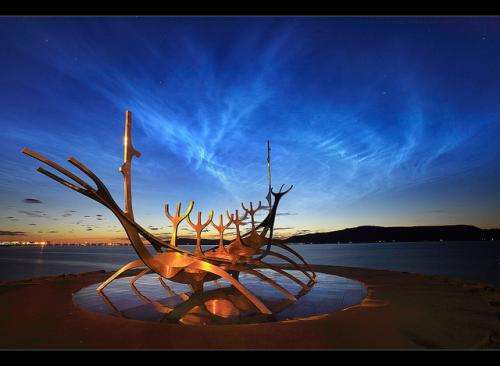
Noctilucent clouds over Reykjavíc. © Örvar Atli Þorgeirsson. Credit: Örvar Atli Þorgeirsson

Night-shining “noctilucent” clouds create a magical glow in the night skies over Reykjavíc, Iceland in this beautiful photo by Örvar Atli Þorgeirsson, taken on August 6. In the foreground is “The Sun Voyager” (Sólfar), an iconic steel sculpture located on the city waterfront representing a Viking ship.

Örvar did not set out to photograph this rare atmospheric phenomenon but had instead intended to shoot aurora triggered by recent solar outbursts.

“The forecast on the 6th of August was predicting extreme aurora activity,” Örvar says in his Flickr description. “Even though it was very early August and the would not get fully dark I went out as the aurora can be seen in deep twilight conditions. I saw the aurora for 1 – 2 minutes that night. I did not get a good picture of it though. Instead we witnessed this even rarer phenomenon called noctilucent clouds.”

Noctilucent clouds are extremely high-level clouds made located in the mesosphere, around 76 to 85 kilometers (47 to 53 miles) high… nearly at the very edge of space. (Most commercial airplanes fly between 6 and 7 miles high.) They are high enough to reflect sunlight coming from beyond the horizon long after night has fallen over the land below. They usually appear as a wispy web of blue, white, purple and orange tendrils stretched across the sky.

“These clouds where extremely beautiful to look at and reminded me of the but where much more stationary and had this beautiful blue color.” –  Örvar Atli Þorgeirsson

Noctilucent clouds are mainly visible at latitudes between 50º – 70º north and south during the months of June and July. This means Reykjavíc, located right in the middle, can get great views. (Of course it helps to have a talented photographer like Örvar to capture them so nicely!)

Oddly enough noctilucent clouds are a relatively recent phenomenon, only having been recorded for about 120 years. They have been connected with space shuttle passages through the upper atmosphere, and it’s even been suggested that they may be associated with the 1908 Tunguska impact.

Read more about noctilucent here.

Source: Universe Today


Rank 5 /5 (3 votes)
Relevant PhysicsForums posts

More news stories

Yale study concludes public apathy over climate change unrelated to science literacy

Are members of the public divided about climate change because they don't understand the science behind it? If Americans knew more basic science and were more proficient in technical reasoning, would public consensus match ...

Space & Earth / Environment

created 1 hour ago | popularity not rated yet | comments 4 | with audio podcast

10 million years needed to recover from mass extinction

It took some 10 million years for Earth to recover from the greatest mass extinction of all time, latest research has revealed.

Space & Earth / Earth Sciences

created 1 hour ago | popularity not rated yet | comments 1 | with audio podcast

Sophisticated simulations predict future warming

The chances of our planet being hit by a global warming of 3 degrees Celsius by 2050 is as likely as it being hit by an increase of 1.4 degrees, new research shows. Presented in the journal Nature Geoscience, the British study ...

Space & Earth / Earth Sciences

created May 22, 2012 | popularity 4.4 / 5 (9) | comments 51

Aliens don't want to eat us, says former SETI director

Alien life probably isn’t interested in having us for dinner, enslaving us or laying eggs in our bellies, according to a recent statement by former SETI director Jill Tarter.

Space & Earth / Space Exploration

created May 25, 2012 | popularity 4.4 / 5 (13) | comments 39

Kyoto Protocol architect 'frustrated' by climate dialogue

UN climate talks are going nowhere, as politicians dither or bicker while the pace of warming dangerously speeds up, one of the architects of the Kyoto Protocol told AFP.

Space & Earth / Environment

created May 23, 2012 | popularity 3.7 / 5 (7) | comments 39


Computer model used to pinpoint prime materials for efficient carbon capture

When power plants begin capturing their carbon emissions to reduce greenhouse gases – and to most in the electric power industry, it's a question of when, not if – it will be an expensive undertaking.

'Unzipped' carbon nanotubes could help energize fuel cells, batteries

Multi-walled carbon nanotubes riddled with defects and impurities on the outside could replace some of the expensive platinum catalysts used in fuel cells and metal-air batteries, according to scientists at ...

T cells 'hunt' parasites like animal predators seek prey, study shows

By pairing an intimate knowledge of immune-system function with a deep understanding of statistical physics, a cross-disciplinary team at the University of Pennsylvania has arrived at a surprising finding: T cells use a movement ...

Same gene that stunts infants' growth also makes them grow too big: research

UCLA geneticists have identified the mutation responsible for IMAGe* syndrome, a rare disorder that stunts infants' growth. The twist? The mutation occurs on the same gene that causes Beckwith-Wiedemann syndrome, which makes ...

Change in developmental timing was crucial in the evolutionary shift from dinosaurs to birds: study

At first glance, it's hard to see how a common house sparrow and a Tyrannosaurus Rex might have anything in common. After all, one is a bird that weighs less than an ounce, and the other is a dinosaur that ...

Scientists develop ultra-sensitive test that detects diseases in their earliest stages

Scientists have developed an ultra-sensitive test that should enable them to detect signs of a disease in its earliest stages, in research published today in the journal Nature Materials.