Nissan says electric car can power family home
August 2, 2011

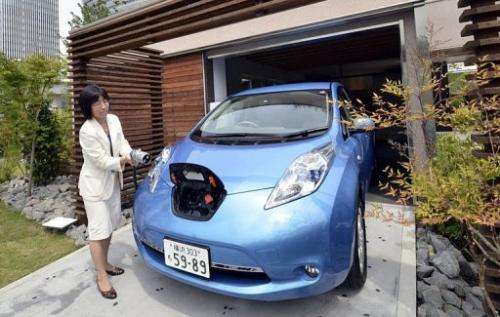
A Nissan employee demonstrates the Leaf car

A Nissan employee demonstrates how to use the company's electric vehicle "Leaf" to power a smart home near their headquarters in Yokohama, suburban Tokyo. Nissan's Leaf electric car can feed power from its battery back into a family home and run appliances for up to two days.

Nissan's Leaf electric car can feed power from its battery back into a family home and run appliances for up to two days under a new project the Japanese car-maker unveiled Tuesday.

Using the "Leaf to Home" system, the lithium-ion batteries of the zero tailpipe emission Leaf can be used as an emergency power backup for the home during a natural disaster or a power blackout, said.

Nissan, 44 percent owned by Renault of France, said it aims to commercialize the technology in Japan by March 2012.

The system works by linking the car via a quick charging port to the house's electricity distribution panel. Power can also be fed the other way if the house generates its own electricity with rooftop .

The Leaf batteries have a capacity of 24 kilowatt hours when fully charged, equivalent to the electricity used by the average Japanese household in two days, said the company.

The output from the vehicle comes to six kilowatts, enough to power electricity-guzzling appliances such as a refrigerator, air conditioner and washing machine at the same time, the company said.

Nissan says as well as its potential use in blackouts, the car can be charged during night time off-peak hours and the used by households during high-demand periods.

(c) 2011 AFP

Filter


Move the slider to adjust rank threshold, so that you can hide some of the comments.


Display comments: newest first

antialias_physorg
Aug 02, 2011

Rank: 3.7 / 5 (3)
Makes sense for japan - especially in the rural areas.
Arkaleus
Aug 02, 2011

Rank: 1.8 / 5 (5)
This would probably not be very economical, considering the battery has a limited number of charge cycles before it must be replaced, at a cost of anywhere between $5,000 and $10,000 US dollars.

Sounds like more marketing nonsense.

If manufacturers were serious about electric vehicles (which they are not) then we would hear about:

Firefly batteries (Why did they have to flee to India instead of finding capital in the USA? If they work, then WTF?)

Rossi's ECat LENR generators (There is no way the cabals will ever let this into the USA)

Existing Li-ion and lead acid batteries are sufficient for aluminum frame and other light material personal vehicles already, but the reason we can't get them is because they won't provide the ECONOMIC GAIN required by "Fifth Avenue" business models. They work TOO well, provide users too much freedom, and don't require dependency on the oil cabals.

The name of the game isn't freedom, it's continual obligation and consumption.
mahvin
Aug 02, 2011

Rank: 1.5 / 5 (2)
Two questions:
How can Nissan's battery technology be translated to stationary platforms, like a house or business. What's the economics of installing and maintaining this system in a stationary location?
dollymop
Aug 02, 2011

Rank: 5 / 5 (4)
It could sure get us through a 2 day power outage in a snow or ice storm. would really be useful instead of a generator that sits around most of the time taking up space.
Newbeak
Aug 02, 2011

Rank: 5 / 5 (1)
What's the economics of installing and maintaining this system in a stationary location?

Read somewhere,maybe here,that Li-ion batteries can continue to be used in stationary apps after their useful life in cars is over.
Shadetree_Engineer
Aug 03, 2011

Rank: 4 / 5 (4)
The average american passenger car powered by gasoline, produces enough energy to power three to five households at once with normal electrical usage. And then consider how many households have more than one of these cars, some with even more power under the hood. All vehicles should be required to state their horsepower in terms of kilowatts, along with the curb weight. But then more people might be tempted to start thinking for themselves...
BenjaminButton
Aug 03, 2011

Rank: 5 / 5 (1)
@ Arkaleus: You're unfortunately right...the lag in commercialisation of technology is due to market forces and vested interests. However it happens for a more moral reason also, for example, the rate of advance of technology across all areas is greater than society's ability to accept change. Unleash some of our most recent technological marvels, such as 3D printing, at their maximum deployment and you would create a highly socially destructive paradigm shift. Now Personally I'd be up for that...and I believe we probably need to live faster (by which I mean embrace change more deeply)...but that's not going to happen.
antialias_physorg
Aug 03, 2011

Rank: 5 / 5 (2)
considering the battery has a limited number of charge cycles before it must be replaced, at a cost of anywhere between $5,000 and $10,000 US dollars.

The article says it's supposed to be an emergency system. Not to be used for contunially shifting energy back and forth between car and house/grid (like this inane idea of using car batteries as grid energy storage devices which was propagated a while back by the media)
Eikka
Aug 03, 2011

Rank: 5 / 5 (1)
What's the economics of installing and maintaining this system in a stationary location?

Read somewhere,maybe here,that Li-ion batteries can continue to be used in stationary apps after their useful life in cars is over.


They can, because the power demands of a house are smaller than of a car. You can squeeze 1-2 years more use out of a battery by using it at low power, but it's still going to lose capacity at an accelerating rate because the process that destroys the lithium battery gets faster the older the battery is.
CreepyD
Aug 03, 2011

Rank: 1 / 5 (1)
It's a funny use of a car, not a bad idea I guess.
Maybe it will make a more useful backup generator than it will a useful car.
antialias_physorg
Aug 03, 2011

Rank: 2 / 5 (1)
I wonder how the people in the skyrise in the background will connect their cars. The depicted house does not seem to be the norm in Japan.

But it certainly beats buying a car and a separate emergency generator

Newbeak
Aug 03, 2011

Rank: not rated yet
Reminds me of the guy who powered his house for three days during an ice storm in Massachusetts with his Prius.
Lord_jag
Aug 04, 2011

Rank: 3 / 5 (2)
It's a funny use of a car, not a bad idea I guess.
Maybe it will make a more useful backup generator than it will a useful car.


The Leaf has no gasoline engine. It doesn't produce any power, it only stores power.
Arkaleus
Aug 06, 2011

Rank: not rated yet
Gasoline (or other hydrocarbons) can power electric cars now with current technology. They would be cleaner and more efficient than piston internal combustion and can be built with existing designs.

Replace the drive train with electric motors powered by a turbine generator and you have real progress.
Newbeak
Aug 06, 2011

Rank: not rated yet
Gasoline (or other hydrocarbons) can power electric cars now with current technology. They would be cleaner and more efficient than piston internal combustion and can be built with existing designs.

Replace the drive train with electric motors powered by a turbine generator and you have real progress.


Don't know what you are smoking,dude,but there is no way to power pure electrics with any combustible fuel.Are you talking about hybrids? I like series hybrids,as you can run on battery power alone until they run down and need recharging.At that point,an auxiliary engine kicks in to recharge the batteries.Under certain circumstances,cars like the Volt would not burn a drop of gas for months.
Newbeak
Aug 06, 2011

Rank: not rated yet
The Leaf has no gasoline engine. It doesn't produce any power, it only stores power.

I hope he means battery backup.Can't see anyone reading articles on this website being so ignorant.
Newbeak
Aug 18, 2011

Rank: not rated yet
What's the economics of installing and maintaining this system in a stationary location?

Read somewhere,maybe here,that Li-ion batteries can continue to be used in stationary apps after their useful life in cars is over.


They can, because the power demands of a house are smaller than of a car. You can squeeze 1-2 years more use out of a battery by using it at low power, but it's still going to lose capacity at an accelerating rate because the process that destroys the lithium battery gets faster the older the battery is.


Check this out: http://mattermore...in-mind/
Rank 5 /5 (14 votes)
Relevant PhysicsForums posts

More news stories

Browser wars flare in mobile space

The browser wars are heating up again, but this time the fight is for dominance of the mobile Internet.

Technology / Software

created 8 hours ago | popularity 5 / 5 (1) | comments 3

Probability of contamination from severe nuclear reactor accidents is higher than expected: study

Catastrophic nuclear accidents such as the core meltdowns in Chernobyl and Fukushima are more likely to happen than previously assumed. Based on the operating hours of all civil nuclear reactors and the number ...

Technology / Energy & Green Tech

created May 22, 2012 | popularity 3.6 / 5 (22) | comments 56 | with audio podcast

SpotterRF debuts Radar Backpack Kit (w/ Video)

(Phys.org) -- SpotterRF has announced a special radar backpack kit designed to enhance situational awareness for soldiers on the ground. The company says its special radar is designed for warfighters as part ...

Technology / Hi Tech & Innovation

created May 26, 2012 | popularity 5 / 5 (5) | comments 13 | with audio podcast report

HyperSolar shows dirty water no barrier to power world

(Phys.org) -- The Santa Barbara, California, company, HyperSolar, is set to transparently share the ups and downs of its research experiences toward the company’s ultimate vision, successfully producing ...

Technology / Energy & Green Tech

created May 24, 2012 | popularity 4.8 / 5 (16) | comments 17 | with audio podcast report

Tesla to launch electric sedan in US on June 22

Tesla Motors said Tuesday it would begin deliveries of "the world's first premium electric sedan" on June 22, slightly ahead of schedule.

Technology / Energy & Green Tech

created May 22, 2012 | popularity 4.5 / 5 (12) | comments 18


Computer model used to pinpoint prime materials for efficient carbon capture

When power plants begin capturing their carbon emissions to reduce greenhouse gases – and to most in the electric power industry, it's a question of when, not if – it will be an expensive undertaking.

'Unzipped' carbon nanotubes could help energize fuel cells, batteries

Multi-walled carbon nanotubes riddled with defects and impurities on the outside could replace some of the expensive platinum catalysts used in fuel cells and metal-air batteries, according to scientists at ...

T cells 'hunt' parasites like animal predators seek prey, study shows

By pairing an intimate knowledge of immune-system function with a deep understanding of statistical physics, a cross-disciplinary team at the University of Pennsylvania has arrived at a surprising finding: T cells use a movement ...

Yale study concludes public apathy over climate change unrelated to science literacy

Are members of the public divided about climate change because they don't understand the science behind it? If Americans knew more basic science and were more proficient in technical reasoning, would public consensus match ...

Same gene that stunts infants' growth also makes them grow too big: research

UCLA geneticists have identified the mutation responsible for IMAGe* syndrome, a rare disorder that stunts infants' growth. The twist? The mutation occurs on the same gene that causes Beckwith-Wiedemann syndrome, which makes ...

Change in developmental timing was crucial in the evolutionary shift from dinosaurs to birds: study

At first glance, it's hard to see how a common house sparrow and a Tyrannosaurus Rex might have anything in common. After all, one is a bird that weighs less than an ounce, and the other is a dinosaur that ...