NASA sees warmer cloud tops in infrared imagery of Tropical Storm Eugene
Aug 06, 2011
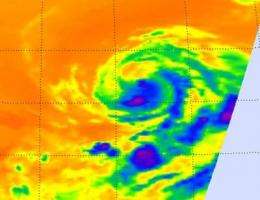
NASA's Aqua satellite passed over Eugene in the eastern Pacific Ocean on Aug. 5 at 10:05 UTC (6:05 a.m. EDT) This infrared image was taken from the AIRS instrument on NASA's Aqua satellite and it revealed a weakening storm with warmer (blue) cloud top temperatures. Coldest temperatures appear in purple. Credit: NASA JPL, Ed Olsen

Warmer cloud top temperatures mean that cloud heights in a tropical cyclone are dropping and the storm doesn't have as much power to push them higher in the atmosphere. That's what NASA infrared satellite imagery has revealed about Tropical Storm Eugene this morning.

During the very early morning hours (Eastern Daylight Time) on August 5, Eugene was still hurricane strength. Then the storm ran into cooler waters and a more stable atmosphere, weakening into a tropical storm.

That weakening was confirmed in satellite imagery from the Atmospheric Infrared Sounder (AIRS) instrument (that flies on NASA's Aqua satellite) on August 5 at 10:05 UTC (6:05 a.m. EDT). basically takes an object's temperature. The AIRS infrared image showed that the cloud top temperatures had warmed since midnight, indicating that the cloud heights dropped and the power behind the uplift that creates the thunderstorms had waned quickly.

At 11 a.m. EDT (8 a.m. PDT) on August 5, Tropical Storm Eugene's were near 65 mph (100 kmh). It was located at sea near 17.9 North and 123.3 West, about 935 miles (1500 km) west-southwest of the southern tip of Baja California. Eugene was still moving to the west-northwest at 13 mph (20 kmh) and had a minimum central pressure of 996 millibars.

The National Hurricane Center expect that Eugene will become a remnant low by Sunday, August 7 as it continues to move into a more stable environment and cooler waters.

Explore further: Alaska volcano shoots ash 15,000 feet into the air

add to favorites email to friend print save as pdf

Related Stories

Recommended for you

Alaska volcano shoots ash 15,000 feet into the air

7 hours ago

(AP)—One of Alaska's most restless volcanoes has shot an ash cloud 15,000 feet into the air in an ongoing eruption that has drawn attention from a nearby community but isn't expected to threaten air traffic.

NASA sees Cyclone Mahasen hit Bangladesh

19 hours ago

NASA's Tropical Rainfall Measuring Mission satellite known as TRMM measured Cyclone Mahasen's rainfall rates from space as it made landfall on May 16. Mahasen has since dissipated over eastern India.

Rapid climate change ruled out ice age trees

May 17, 2013

Short, sharp fluctuations in the Earth's climate throughout the last ice age may have stopped trees from getting a foothold in Europe and northern Asia, scientists say.

Earth's iron core is surprisingly weak, researchers say

May 17, 2013

The massive ball of iron sitting at the center of Earth is not quite as "rock-solid" as has been thought, say two Stanford mineral physicists. By conducting experiments that simulate the immense pressures deep in the planet's ...

User comments : 0

More news stories

Alaska volcano shoots ash 15,000 feet into the air

(AP)—One of Alaska's most restless volcanoes has shot an ash cloud 15,000 feet into the air in an ongoing eruption that has drawn attention from a nearby community but isn't expected to threaten air traffic.

Chinese, Indian airlines face EU pollution fines

Eight Chinese and two Indian airlines face fines of up to several million euros for not paying for their greenhouse gas emissions during flights within the bloc, the European Commission said on Friday.

US seizes Bitcoin operator accounts

US authorities seized the accounts of a Bitcoin digital currency exchange operator, claiming it was functioning as an "unlicensed money service business," court documents showed Friday.

Temporal processing in the olfactory system

The neural machinery underlying our olfactory sense continues to be an enigma for neuroscience. A recent review in Neuron seeks to expand traditional ideas about how neurons in the olfactory bulb might encode information about ...