NASA launches spacecraft on 5-year trip to Jupiter
August 5, 2011 By MARCIA DUNN , AP Aerospace Writer
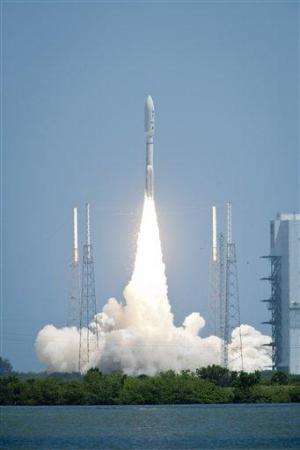
In this photo provided by NASA, an Atlas V rocket launches with the Juno spacecraft payload from Space Launch Complex 41 at Cape Canaveral Air Force Station in Florida on Friday, Aug. 5, 2011. NASA launched the spacecraft atop an unmanned rocket that blasted into a clear midday sky as scientists cheered and yelled "Go Juno!" It was the first step in Juno's 1.7 billion-mile voyage to the gas giant Jupiter, just two planets away but altogether different from Earth and next-door neighbor Mars. (AP Photo/NASA, Bill Ingalls)
(AP) -- A sun-powered robotic explorer named Juno rocketed away Friday on a five-year journey to Jupiter, the solar system's most massive and ancient planet.
Hundreds of scientists and their families and friends watched from just a few miles away, cheering and yelling, "Go Juno!" as the NASA spacecraft soared into a clear midday sky atop an unmanned rocket.
"It's fantastic!" said Fran Bagenal, a planetary scientist at the University of Colorado at Boulder, who is part of the project. "Just great to see the thing lift off."
It was the first step in Juno's 1.7 billion-mile voyage to the gas giant Jupiter, just two planets away but altogether different from Earth and next-door neighbor Mars.
Juno is solar powered, a first for a spacecraft meant to roam so far from the sun. It has three huge solar panels that were folded for launch. Once opened, they should each stretch as long and wide as a tractor-trailer. Previous spacecraft to the outer planets have relied on nuclear energy.
With Juno, scientists hope to answer some of the most fundamental questions of our solar system.
"How Jupiter formed. How it evolved. What really happened early in the solar system that eventually led to all of us," said Juno's chief investigator Scott Bolton, an astrophysicist at Southwest Research Institute in San Antonio.
Bolton said Jupiter is like a time capsule. It got most of the leftovers from the sun's creation nearly 5 billion years ago - hence the planet's immense size - and its enormous gravity field has enabled it to hold onto that original material.
Jupiter is so big it could hold everything in the solar system, minus the sun, and still be twice as massive. Astronomers say it probably was the first planet in the solar system to form.
Juno will venture much closer to Jupiter than any of the eight spacecraft that have visited Jupiter since the 1970s. Juno represents the next step, Bolton said.
"We look deeper. We go much closer. We're going over the poles. So we're doing a lot of new things that have never been done, and we're going to get all this brand-new information," Bolton said.
The $1.1 billion mission - which will end with Juno taking a fatal plunge into Jupiter in 2017 - kicks off a flurry of astronomy missions by NASA.
Juno's liftoff appeared to create more buzz than usual, given the hiatus in human launches from the United States - the space shuttle program ended two weeks ago. NASA's long-term goal is to send astronauts to an asteroid by 2025 and to Mars in the mid-2030s.
There are a few special passengers aboard Juno, though.
Attached to the probe are three little Lego figures specially made of space-grade aluminum. They represent the Italian physicist Galileo, who discovered Jupiter's four biggest moons; the Roman god Jupiter; and his wife Juno, for whom the spacecraft is named.
If all goes well, Juno will go into orbit around Jupiter's poles - a first - on July 4, 2016.
The oblong orbit will bring Juno within 3,100 miles of the cloudtops and right over the most powerful auroras in the solar system. In fact, that's how the spacecraft got its name - Juno peered through clouds to keep tabs on her husband, Jupiter.
Juno will circle the planet 33 times, each orbit lasting 11 days for a grand total of one year.
With each orbit, the spacecraft will pass over a different longitude so that by mission's end, "we've essentially dropped a net around the planet with all of our measurements," Bolton said. That's crucial for understanding Jupiter's invisible gravity and magnetic force fields, he noted.
Radiation is so intense around Jupiter that Bolton and his team put Juno's most sensitive electronics inside a titanium vault - an armored tank, as he calls it.
Juno's experiments also will attempt to ascertain the abundance of water, and oxygen, in Jupiter's atmosphere, and determine whether the core of the planet is solid or gaseous.
After Juno, next up is Grail, twin spacecraft that will be launched next month and go into orbit around Earth's moon. Then comes Curiosity, a six-wheeled, jeep-size rover that will blast off for Mars at the end of November in search of environments conducive to life.
All the upcoming astronomy probes show "we still continue an exciting group of missions," said Colleen Hartman of NASA's science mission office. Robotic missions "have a role to play in how humans explore the universe, and so it's important that, in fact, both these sides of the house do well."
Juno bears nine instruments, including a wide-angle color camera, JunoCam, that will beam back images that the public can turn into photos.
The spacecraft also bears a small Italian-supplied plaque honoring Galileo. It shows his self-portrait, as well as his description of observing Jupiter's moons, in his own handwriting from 1610.
Unlike many other NASA missions, this one came in on cost and on time. It's relatively inexpensive; the Cassini probe launched in 1997 to Saturn, by way of Jupiter, cost $3.4 billion.
©2011 The Associated Press. All rights reserved. This material may not be published, broadcast, rewritten or redistributed.
-
From lemons to lemonade: Reaction uses carbon dioxide to make carbon-based semiconductor,
32 comments
-
Thioridazine kills cancer stem cells in human while avoiding toxic side-effects of conventional cancer treatments,
3 comments
-
SpaceX private rocket blasts off for space station (Update),
42 comments
-
Climate scientists say they have solved riddle of rising sea,
31 comments
-
SpaceX capsule has 'new car' smell, astronauts say (Update),
3 comments
-
revamping general concept and cosmological principle
May 25, 2012
-
Transiting Exoplanet Light Curve
May 25, 2012
-
Math behind Theoretical Physics
May 24, 2012
-
Do we know whats at the center of galaxies yet?
May 23, 2012
-
Structure of the Milky Way?
May 20, 2012
-
What would it take to terraform Pluto and Charon?
May 19, 2012
- More from Physics Forums - General Astronomy
More news stories
Yale study concludes public apathy over climate change unrelated to science literacy
Are members of the public divided about climate change because they don't understand the science behind it? If Americans knew more basic science and were more proficient in technical reasoning, would public consensus match ...
1 hour ago |
not rated yet |
4
|
10 million years needed to recover from mass extinction
It took some 10 million years for Earth to recover from the greatest mass extinction of all time, latest research has revealed.
Space & Earth / Earth Sciences
1 hour ago |
not rated yet |
1
|
Sophisticated simulations predict future warming
The chances of our planet being hit by a global warming of 3 degrees Celsius by 2050 is as likely as it being hit by an increase of 1.4 degrees, new research shows. Presented in the journal Nature Geoscience, the British study ...
Space & Earth / Earth Sciences
May 22, 2012 |
4.4 / 5 (9) |
51
Aliens don't want to eat us, says former SETI director
Alien life probably isnt interested in having us for dinner, enslaving us or laying eggs in our bellies, according to a recent statement by former SETI director Jill Tarter.
Space & Earth / Space Exploration
May 25, 2012 |
4.4 / 5 (13) |
39
Kyoto Protocol architect 'frustrated' by climate dialogue
UN climate talks are going nowhere, as politicians dither or bicker while the pace of warming dangerously speeds up, one of the architects of the Kyoto Protocol told AFP.
May 23, 2012 |
3.7 / 5 (7) |
39
Computer model used to pinpoint prime materials for efficient carbon capture
When power plants begin capturing their carbon emissions to reduce greenhouse gases and to most in the electric power industry, it's a question of when, not if it will be an expensive undertaking.
'Unzipped' carbon nanotubes could help energize fuel cells, batteries
Multi-walled carbon nanotubes riddled with defects and impurities on the outside could replace some of the expensive platinum catalysts used in fuel cells and metal-air batteries, according to scientists at ...
T cells 'hunt' parasites like animal predators seek prey, study shows
By pairing an intimate knowledge of immune-system function with a deep understanding of statistical physics, a cross-disciplinary team at the University of Pennsylvania has arrived at a surprising finding: T cells use a movement ...
Same gene that stunts infants' growth also makes them grow too big: research
UCLA geneticists have identified the mutation responsible for IMAGe* syndrome, a rare disorder that stunts infants' growth. The twist? The mutation occurs on the same gene that causes Beckwith-Wiedemann syndrome, which makes ...
Change in developmental timing was crucial in the evolutionary shift from dinosaurs to birds: study
At first glance, it's hard to see how a common house sparrow and a Tyrannosaurus Rex might have anything in common. After all, one is a bird that weighs less than an ounce, and the other is a dinosaur that ...
Scientists develop ultra-sensitive test that detects diseases in their earliest stages
Scientists have developed an ultra-sensitive test that should enable them to detect signs of a disease in its earliest stages, in research published today in the journal Nature Materials.
Aug 06, 2011
Rank: 1 / 5 (2)
Aug 06, 2011
Rank: 1 / 5 (2)
By the time we're ready to set up orbiting colonies around Jupiter, we'll have evolved as a species to be immune to the radiation, since Fukushima and other nuclear disasters have already begun the process.
Aug 10, 2011
Rank: 5 / 5 (1)
Cassini isn't really a good comparrison. It is a far more complex mission. The political environment is also different. Cassini came along when NASA was doing all that internal review stuff. Lots of projects got off schedule because of that.
Congratulations to the Juno team though. JPL is without question the prodigy of NASA.