Nanoscientists invent better etching technique
August 19, 2011 By Jared Sagoff and Louise Lerner

nanoscientists invent better etching technique

Enlarge

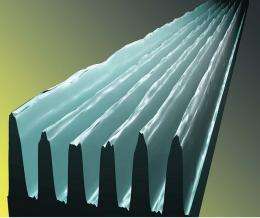
Deep canyons can be etched into materials at the nanoscale with a new SIS-based lithography technique by Argonne National Laboratory scientists.

(PhysOrg.com) -- Imagine yourself nano-sized, standing on the edge of a soon-to-be computer chip. Down shoots a beam of electrons, carving precise topography that is then etched the depth of the Grand Canyon into the chip. From the perspective of scientists at the U.S. Department of Energy’s Argonne National Laboratory, this improved form of etching could open the door to new technologies.

Argonne nanoscientist Seth Darling and colleagues at Argonne’s Center for Nanoscale Materials and Energy Systems Division say it has the potential to revolutionize how patterns are transferred onto different materials, paving a new approach for the next generation of energy, electronics and memory technologies.

The innovation combines new tricks with an old technology.

One of the biggest recent questions facing materials science has involved the development of better techniques for high-resolution lithographies such as electron-beam, or e-beam, lithography. E-beam lithography is used to manufacture the tiniest of structures, including microelectronics and advanced sensors; beams of are part of a process that "prints" desired patterns into the substance.

Transferring patterns more deeply into materials would allow scientists to craft better electronics.

To create a pattern using e-beam lithography, researchers have conventionally traced a pattern within a layer called a “resist,” which is then etched into the underlying substrate.

Because the resist is thin and fragile, an intermediate “hard mask" is generally laid between the resist and the substrate. Ideally, the hard mask would stick to the substrate long enough for the desired features to be etched and then be cleanly removed—though the extra layer often results in blurriness, rough edges and additional costs and complications.

But over the course of the past several years, Darling and his colleagues have developed a technique called sequential infiltration synthesis (SIS). Another method of building custom designs at the nanoscale level, SIS involves the controlled growth of inorganic materials within polymer films. This means that scientists can construct materials with unique properties and even with complex, 3-D geometries.

"With SIS, we can take that thin, delicate resist film and make it robust by infiltrating it with inorganic material," Darling explained. "That way, you don't need an intermediate mask, so you get around all the problems associated with that extra layer."

Although some resists might work better than others under certain conditions, no single approach had yet demonstrated the ability to ingrain a pattern with the ease, depth and fidelity of the Argonne approach, Darling said.

“It’s possible we might be able to create very narrow features well over a micron deep using only a very thin, SIS-enhanced etch mask, which from our perspective would be a breakthrough capability,” he said.

By combining sequential infiltration synthesis with block copolymers, molecules that can assemble themselves into a variety of tunable nanostructures, this technique can be extended to create even smaller features than are possible using e-beam lithography. The key is to design a selective reaction between the inorganic precursor molecules and one of the components in the block copolymer.

"This opens a wide range of possibilities," said Argonne chemist Jeff Elam, who helped create the process. "You can imagine applications for solar cells, electronics, filters, catalysts—all sorts of different devices that require nanostructures, but also the functionality of inorganic materials."

The work is published in two studies, "Enhanced polymeric lithography resists via sequential infiltration synthesis" in the Journal of Materials Chemistry and “Enhanced block copolymer lithography using sequential infiltration synthesis” in the Journal of Physical Chemistry C.

“Hopefully, our discovery gives scientists an extra advantage when it comes to creating deeper patterns with higher resolution,” Darling said.

Provided by Argonne National Laboratory search and more info website

4.8 /5 (4 votes)  

Filter


Move the slider to adjust rank threshold, so that you can hide some of the comments.


Display comments: newest first

hyongx
Aug 19, 2011

Rank: not rated yet
So the Grand Canyon, at its deepest, is 1800 meters. Assuming a person's height of 1.8 meters, the grand Canyon is 1000 times the height.
If SIS can etch micron depth, then I have to be 1 nanometer tall in order for their etchings to be comparable relative depth. That is like 9 Si atoms stacked up, disregarding the crystal structure.
Nanobanano
Aug 19, 2011

Rank: not rated yet
Purchase the full text...

Damn, this is rich. Now they want to charge you money just to tell you about a technology, product or service.
fmfbrestel
Aug 19, 2011

Rank: 1 / 5 (1)
@nanobanano yeah its almost as bad as magazines, newspapers, and books. how dare they charge for copyrighted material.
Rank 4.8 /5 (4 votes)
Relevant PhysicsForums posts
  • Water flow question
    created3 hours ago
  • [Drift velocity] Factors affecting velocity
    created5 hours ago
  • does cold gasoline have less energy
    created6 hours ago
  • distribution of molecules throughout the atmosphere
    created8 hours ago
  • The Global Positioning System !
    created9 hours ago
  • A Question relating Power
    created10 hours ago
  • More from Physics Forums - General Physics

More news stories

'Unzipped' carbon nanotubes could help energize fuel cells, batteries

Multi-walled carbon nanotubes riddled with defects and impurities on the outside could replace some of the expensive platinum catalysts used in fuel cells and metal-air batteries, according to scientists at ...

Nanotechnology / Nanomaterials

created 37 minutes ago | popularity not rated yet | comments 0 | with audio podcast

In nanorod crystal growth, nanoparticles seen as artificial atoms

In the growth of crystals, do nanoparticles act as "artificial atoms" forming molecular-type building blocks that can assemble into complex structures? This is the contention of a major but controversial theory ...

Nanotechnology / Nanophysics

created May 24, 2012 | popularity 4.8 / 5 (6) | comments 0 | with audio podcast

Dopant gives graphene solar cells highest efficiency yet

(Phys.org) -- By taking advantage of graphene’s favorable electrical and optical properties, and then adding an organic dopant, researchers have achieved the highest power conversion efficiency yet for ...

Nanotechnology / Nanophysics

created May 21, 2012 | popularity 5 / 5 (10) | comments 14 | with audio podcast feature

First direct observation of oriented attachment in nanocrystal growth

Berkeley Lab researchers have reported the first direct observation of nanoparticles undergoing oriented attachment, the critical step in biomineralization and the growth of nanocrystals. A better understanding ...

Nanotechnology / Nanophysics

created May 24, 2012 | popularity 4.7 / 5 (3) | comments 0 | with audio podcast

Synthetic nano-waste does not disappear

(Phys.org) -- Tiny particles of cerium oxide do not burn or change in the heat of a waste incineration plant. They remain intact on combustion residues or in the incineration system, as a new study by Swiss ...

Nanotechnology / Bio & Medicine

created May 25, 2012 | popularity 5 / 5 (2) | comments 1 | with audio podcast


Change in developmental timing was crucial in the evolutionary shift from dinosaurs to birds: study

At first glance, it's hard to see how a common house sparrow and a Tyrannosaurus Rex might have anything in common. After all, one is a bird that weighs less than an ounce, and the other is a dinosaur that ...

Computer model used to pinpoint prime materials for efficient carbon capture

When power plants begin capturing their carbon emissions to reduce greenhouse gases – and to most in the electric power industry, it's a question of when, not if – it will be an expensive undertaking.

T cells 'hunt' parasites like animal predators seek prey, study shows

By pairing an intimate knowledge of immune-system function with a deep understanding of statistical physics, a cross-disciplinary team at the University of Pennsylvania has arrived at a surprising finding: T cells use a movement ...

Manufacturing genes to attack flu virus

An international research team has manufactured a new protein that can combat deadly flu epidemics.

Yale study concludes public apathy over climate change unrelated to science literacy

Are members of the public divided about climate change because they don't understand the science behind it? If Americans knew more basic science and were more proficient in technical reasoning, would public consensus match ...

Same gene that stunts infants' growth also makes them grow too big: research

UCLA geneticists have identified the mutation responsible for IMAGe* syndrome, a rare disorder that stunts infants' growth. The twist? The mutation occurs on the same gene that causes Beckwith-Wiedemann syndrome, which makes ...