Unlocking the mystery of the disappearing bats
August 8, 2011 By Chantall Van Raay

Unlocking the mystery of the disappearing bats

Enlarge

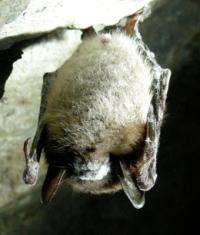
A little brown bat with white-nose syndrome in a Vermont mine. Jianping Xu, an associate professor of biology and member of the Institute for Infectious Disease Research, is collaborating with leading microbiologists across the continent to better understand the Geomyces destructans fungal disease, which is attacking bats in the northeastern U.S., Ontario and Quebec. Credit: U.S. Fish and Wildlife Service.

A McMaster researcher is working to pull one of North America's most common bats back from the brink of extinction.

Jianping Xu, an associate professor of biology and member of the Institute for Infectious Disease Research, is collaborating with leading across the continent to better understand the Geomyces destructans , better known as white-nose syndrome. The grows on the bats' skin while they hibernate, causing them to wake up and deplete their deposits of fat prematurely. The infection eventually kills them.

First discovered in 2006 in and mines around Albany, New York, the fungus, thought to have already killed more than one million , is now rampant throughout the northeastern U.S., Ontario and Quebec. Research indicates that at the current rate of infection, the little brown bat could be nearly extinct in less than 20 years.

To understand the fungus, its origin and spread, researchers analyzed the DNA of 16 from caves in seven New York counties and one from Vermont. They then compared Geomyces destructans with a closely related species called Geomyces panoma and found that all the Geomyces destructans strains were genetically identical. This led them to believe that white-nose syndrome in northeastern North America is caused by a single strain that has undergone rapid dispersal to cause all of the bat deaths, from New York to Tennessee and from Oklahoma to Quebec.

"While the exact cause of death is still unknown, one of the things scientists have identified is that the fungus can disrupt the tissue membrane in a whim and that makes them unable to fly effectively," said Xu. "It also makes them lose circulation, water and the mechanism to regulate body temperature."

Researchers have discovered a treatment that could help preserve the species. They tested the response of six strains of the fungus to drugs already used to treat people and animals for ranging from athlete's foot to life-threatening infections. The drugs include fluconazole, the most widely used antifungal drug. The fungus was found to be susceptible to all of the drugs.

Xu said researchers are working quickly to understand white-nose syndrome before it's too late.

"While bats are carriers of certain disease, including rabies, the loss of the bat population would be detrimental," he said. "There would be serious consequences: first, many plants require bats for pollination, and second, bats are predators for insects such as flies and mosquitoes, and many of those insects are vectors for human disease like West Nile and malaria. If these bats are gone there would be no natural predator, so we would probably experience an increase in insect-borne ."

Researchers have made headway, but little else is known about the fungus.

"Scientists do not know how the fungus affects bats at the cellular and molecular level or even how it reproduces in nature or in bats themselves," said Xu. "But by having the opportunity to collaborate on an international scale with researchers looking at fungal population biology and epidemiology, scientists can work quickly to understand the fungus. There are no boundaries to understanding disease when you have a global perspective."

The findings appear in the journal Emerging Infectious Diseases.

More information: DOI: 10.3201/eid1707.102056

Provided by McMaster University search and more info website


Rank 5 /5 (2 votes)
Relevant PhysicsForums posts

More news stories

Manufacturing genes to attack flu virus

An international research team has manufactured a new protein that can combat deadly flu epidemics.

Biology / Biotechnology

created 1 hour ago | popularity not rated yet | comments 0 | with audio podcast

Scientist: Evolution debate will soon be history

(AP) -- Richard Leakey predicts skepticism over evolution will soon be history. Not that the avowed atheist has any doubts himself.

Biology / Evolution

created 19 hours ago | popularity 3.3 / 5 (18) | comments 73

More plant species responding to global warming than previously thought

(Phys.org) -- Far more wild plant species may be responding to global warming than previous large-scale estimates have suggested.

Biology / Ecology

created May 22, 2012 | popularity 4.6 / 5 (14) | comments 18 | with audio podcast

Thousands of shellfish found dead in Peru

Thousands of crustaceans were found dead off the coast of Lima following the mystery mass death of dolphins and pelicans, the Peruvian Navy said Friday.

Biology / Ecology

created May 26, 2012 | popularity 4.8 / 5 (4) | comments 7

For monogamous sparrows, it doesn't pay to stray (but they do it anyway)

It's quite common for a female song sparrow to stray from her breeding partner and mate with the male next door, but a new study shows that sleeping around can be costly.

Biology / Plants & Animals

created May 22, 2012 | popularity 5 / 5 (2) | comments 8 | with audio podcast


Computer model used to pinpoint prime materials for efficient carbon capture

When power plants begin capturing their carbon emissions to reduce greenhouse gases – and to most in the electric power industry, it's a question of when, not if – it will be an expensive undertaking.

'Unzipped' carbon nanotubes could help energize fuel cells, batteries

Multi-walled carbon nanotubes riddled with defects and impurities on the outside could replace some of the expensive platinum catalysts used in fuel cells and metal-air batteries, according to scientists at ...

T cells 'hunt' parasites like animal predators seek prey, study shows

By pairing an intimate knowledge of immune-system function with a deep understanding of statistical physics, a cross-disciplinary team at the University of Pennsylvania has arrived at a surprising finding: T cells use a movement ...

Yale study concludes public apathy over climate change unrelated to science literacy

Are members of the public divided about climate change because they don't understand the science behind it? If Americans knew more basic science and were more proficient in technical reasoning, would public consensus match ...

Same gene that stunts infants' growth also makes them grow too big: research

UCLA geneticists have identified the mutation responsible for IMAGe* syndrome, a rare disorder that stunts infants' growth. The twist? The mutation occurs on the same gene that causes Beckwith-Wiedemann syndrome, which makes ...

Change in developmental timing was crucial in the evolutionary shift from dinosaurs to birds: study

At first glance, it's hard to see how a common house sparrow and a Tyrannosaurus Rex might have anything in common. After all, one is a bird that weighs less than an ounce, and the other is a dinosaur that ...