Monkeying around in Belgian zoos brings girls out on top
August 24, 2011 by Yann Ollivier
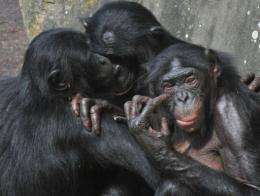
A female bonobo has been named "the world's smartest ape" after beating chimpanzees distracted by male rivalry in a contest between two Belgian zoos.
A female bonobo has been named "the world's smartest ape" after beating chimpanzees distracted by male rivalry in a contest between two Belgian zoos, whose results took scientists by surprise.
The chimps, generally a more aggressive, male-dominated species than bonobos, were expected to take the title.
But the winner turned out to be a non-dominant female named Djanoa who showed proof of uncommon patience and perseverance, said Jeroen Stevens, a primatologist with the Royal Society of Zoology of Antwerp.
Or, maybe she just liked nuts more than the others, he added.
"Now the real research begins" on personality and social order and .. snack food preference in the monkey world, he said.
The match this summer was organised "above all as a game", said Stevens.
It pit the bonobo team at Planckendael Zoo in Mechelen against the chimp team at Antwerp Zoo, both in Belgium's northwestern Flemish region, just as the latest incarnation of the Planet of the Apes movies was to hit big screens the world over.
The initiative meant to draw attention and raise funds for a campaign aimed at cutting down on monkey hunts in Cameroon, where "bush meat" is often considered a prized delicacy.
Inspired by a popular Flemish quiz show, "The Smartest Person in the World", the contest put the two closely related species through six tests in which the apes had to use rudimentary tools like branches to extract nuts or oranges from hiding places.
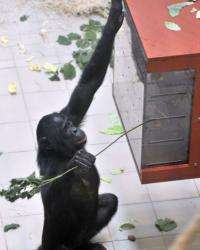
Female bonobo Djanoa (pictured) uses a branch to gather a nut in a special box set up at Belgium's Planckendael zoo to test her intelligence.
Chimps do this in nature, to pry out ants or termites to eat. They also use stones to open nuts but bonobos, reputedly less dexterous, had never been seen doing this in the wild, Stevens said.What's more, the chimps' handlers had trained them on the labyrinths ahead of the contest whereas the uninitiated bonobos were at first afraid of the games.
What Stevens hadn't banked on was a political struggle in the chimp troop, where two younger males were challenging the dominant member of the last decade.
With such primordial concerns, the agitated chimps forgot about the "human" challenge as the focused Djanoa came first in four of the six tests while only one male champ won a single game, Stevens said.
Bonobos are considered more peaceful than chimps, though less is known about their group structure other than it seems female dominated and they are readier to use sex to resolve conflict than chimp-type fighting.
And in both species -- which share 98 percent of their genes with man -- "the females were more gifted when it came to using tools," the primatologist said.
But Stevens warned it was dangerous to generalise about an entire species -- "the same way it would be to draw parallels between man and monkeys."
(c) 2011 AFP
-
From lemons to lemonade: Reaction uses carbon dioxide to make carbon-based semiconductor,
32 comments
-
Thioridazine kills cancer stem cells in human while avoiding toxic side-effects of conventional cancer treatments,
3 comments
-
SpaceX private rocket blasts off for space station (Update),
42 comments
-
Climate scientists say they have solved riddle of rising sea,
31 comments
-
SpaceX capsule has 'new car' smell, astronauts say (Update),
3 comments
-
What would stain as translucent on light-coloured fabric?
20 hours ago
-
How do I identify different bacteria on culture plates?
May 26, 2012
-
Why Do Dogs do Strange things...
May 25, 2012
-
What does exophillic and endophillic mean in terms of mosquito and their control?
May 24, 2012
-
Semen stains glows under black lights (uv light)?
May 23, 2012
-
Question on Human Chromosome 2
May 23, 2012
- More from Physics Forums - Biology
More news stories
Manufacturing genes to attack flu virus
An international research team has manufactured a new protein that can combat deadly flu epidemics.
34 minutes ago |
not rated yet |
0
|
Scientist: Evolution debate will soon be history
(AP) -- Richard Leakey predicts skepticism over evolution will soon be history. Not that the avowed atheist has any doubts himself.
19 hours ago |
3.3 / 5 (18) |
69
More plant species responding to global warming than previously thought
(Phys.org) -- Far more wild plant species may be responding to global warming than previous large-scale estimates have suggested.
May 22, 2012 |
4.6 / 5 (14) |
18
|
Thousands of shellfish found dead in Peru
Thousands of crustaceans were found dead off the coast of Lima following the mystery mass death of dolphins and pelicans, the Peruvian Navy said Friday.
May 26, 2012 |
4.8 / 5 (4) |
7
For monogamous sparrows, it doesn't pay to stray (but they do it anyway)
It's quite common for a female song sparrow to stray from her breeding partner and mate with the male next door, but a new study shows that sleeping around can be costly.
May 22, 2012 |
5 / 5 (2) |
7
|
Change in developmental timing was crucial in the evolutionary shift from dinosaurs to birds: study
At first glance, it's hard to see how a common house sparrow and a Tyrannosaurus Rex might have anything in common. After all, one is a bird that weighs less than an ounce, and the other is a dinosaur that ...
Computer model used to pinpoint prime materials for efficient carbon capture
When power plants begin capturing their carbon emissions to reduce greenhouse gases and to most in the electric power industry, it's a question of when, not if it will be an expensive undertaking.
'Unzipped' carbon nanotubes could help energize fuel cells, batteries
Multi-walled carbon nanotubes riddled with defects and impurities on the outside could replace some of the expensive platinum catalysts used in fuel cells and metal-air batteries, according to scientists at ...
T cells 'hunt' parasites like animal predators seek prey, study shows
By pairing an intimate knowledge of immune-system function with a deep understanding of statistical physics, a cross-disciplinary team at the University of Pennsylvania has arrived at a surprising finding: T cells use a movement ...
Yale study concludes public apathy over climate change unrelated to science literacy
Are members of the public divided about climate change because they don't understand the science behind it? If Americans knew more basic science and were more proficient in technical reasoning, would public consensus match ...
Same gene that stunts infants' growth also makes them grow too big: research
UCLA geneticists have identified the mutation responsible for IMAGe* syndrome, a rare disorder that stunts infants' growth. The twist? The mutation occurs on the same gene that causes Beckwith-Wiedemann syndrome, which makes ...

Aug 24, 2011
Rank: not rated yet