Ions control shape of nanofibers grown on clear substrate
August 16, 2011

Ions control shape of nanofibers grown on clear substrate

Enlarge

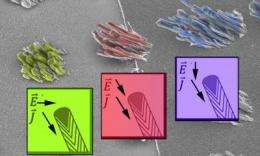
Carbon nanofibers at the interface between non-conductive (left) and conductive (right) substrates do not align with the electrical field (E), but rather orient along the ion flux lines. Controlling the direction of the ion flux provides the means to grow oriented nanofibers even on insulating materials, thereby greatly extending the application space for this important nanoscale material. Credit: Anatoli Melechko, North Carolina State University

Researchers from North Carolina State University have found a new way to develop straight carbon nanofibers on a transparent substrate. Growing such nanofiber coatings is important for use in novel biomedical research tools, solar cells, water repellent coatings and others. The technique utilizes a charged chromium grid, and relies on ions to ensure the nanofibers are straight, rather than curling – which limits their utility.

"This is the first time, that I know of, where someone has been able to grow straight on a clear substrate," says Dr. Anatoli Melechko, an associate professor of materials science and engineering at NC State and co-author of a paper describing the research. "Such nanofibers can be used as gene-delivery tools. And a transparent substrate allows researchers to see how the nanofibers interact with cells, and to manipulate this interaction."

Specifically, the nanofibers can be coated with genetic material and then inserted into the nucleus of a cell – for example, to facilitate gene therapy research. The transparent substrate improves visibility because researchers can shine light through it, creating better contrast and making it easier to see what's going on.

The researchers also learned that play a key role in ensuring that the carbon nanofibers are straight. To understand that role, you need to know how the technique works.

This video is not supported by your browser at this time.

NC State researchers have found a new way to develop straight carbon nanofibers on a transparent substrate. Growing such nanofiber coatings is important for use in novel biomedical research tools, solar cells, water repellent coatings and others. The technique utilizes a charged chromium grid, and relies on ions to ensure the nanofibers are straight, rather than curling -- which limits their utility. Credit: Anatoli Melechko, North Carolina State University

The nanofibers are made by distributing nickel nanoparticles evenly on a substrate made of fused silicon (which is pure silicon dioxide). The substrate is then overlaid with a fine grid made of , which serves as an electrode. The substrate and grid are then placed in a chamber at 700 degrees Celsius, which is then filled with acetylene and ammonia gas. The chrome grid is a negatively charged electrode, and the top of the chamber contains a positively charged electrode.

Electric voltage is then applied to the two electrodes, creating an electric field in the chamber that excites the atoms in the acetylene and ammonia gas. Some of the electrons in these atoms break away, creating free electrons and positively charged atoms called ions. The free electrons accelerate around the chamber, knocking loose even more electrons. The positively charged ions are drawn to the negatively charged grid on the floor of the chamber.

Meanwhile, the nickel nanoparticles are serving as catalysts, reacting with the carbon in the acetylene gas (C2H2) to create graphitic carbon nanofibers. The catalyst rides on the tip of the nanofiber that forms beneath it, like a rapidly growing pillar. The term graphitic means that the nanofibers have carbon atoms arranged in a hexagonal structure – like graphite.

One problem with growing carbon nanofibers is that the surface of the catalyst can become obstructed by a carbon film that blocks catalytic action, preventing further nanofibers growth. Here's where those ions come in.

The ions being drawn to the chromium grid are moving very quickly, and they choose the shortest possible route to reach the negatively-charged metal. In their rush to reach the grid, the ions often collide with the nickel catalysts, knocking off the excess – and allowing further nanofibers growth.

Because the ions are being drawn to the chromium grid, the angle at which they strike the catalysts depends on where the catalyst is located relative to the grid. For example, if you are looking down at the grid, a catalyst just to the right of the grid will appear to be leaning right – because ions would have been striking the right side of the catalyst in an attempt to reach the grid. These nanofibers are still straight – they don't curl up – they simply lean in one direction. The bulk of the nanofibers, however, are both straight and vertically aligned.

"This finding gives us an opportunity to create new reactors for creating nanofibers, building in the chromium grid," Melechko says.

More information: The paper, "Role of ion flux on alignment of carbon nanofibers synthesized by DC plasma on transparent insulating substrates," is forthcoming from the ACS journal Applied Materials & Interfaces.

Provided by North Carolina State University search and more info website

Filter


Move the slider to adjust rank threshold, so that you can hide some of the comments.


Display comments: newest first

Net Energy
Aug 16, 2011

Rank: not rated yet
Materials science that I can dance to. Fascinating!
Rank 5 /5 (3 votes)
Relevant PhysicsForums posts
  • microstructure of titanium
    created20 hours ago
  • Steam in My Espresso Machine
    createdMay 26, 2012
  • Density question
    createdMay 24, 2012
  • Mass transport originating from a point source at a solid gas interface
    createdMay 22, 2012
  • Ammonia dispersion in Air
    createdMay 22, 2012
  • Multi Choice Help
    createdMay 21, 2012
  • More from Physics Forums - Materials & Chemical Engineering

More news stories

In nanorod crystal growth, nanoparticles seen as artificial atoms

In the growth of crystals, do nanoparticles act as "artificial atoms" forming molecular-type building blocks that can assemble into complex structures? This is the contention of a major but controversial theory ...

Nanotechnology / Nanophysics

created May 24, 2012 | popularity 4.8 / 5 (6) | comments 0 | with audio podcast

First direct observation of oriented attachment in nanocrystal growth

Berkeley Lab researchers have reported the first direct observation of nanoparticles undergoing oriented attachment, the critical step in biomineralization and the growth of nanocrystals. A better understanding ...

Nanotechnology / Nanophysics

created May 24, 2012 | popularity 4.7 / 5 (3) | comments 0 | with audio podcast

Dopant gives graphene solar cells highest efficiency yet

(Phys.org) -- By taking advantage of graphene’s favorable electrical and optical properties, and then adding an organic dopant, researchers have achieved the highest power conversion efficiency yet for ...

Nanotechnology / Nanophysics

created May 21, 2012 | popularity 5 / 5 (10) | comments 14 | with audio podcast feature

Synthetic nano-waste does not disappear

(Phys.org) -- Tiny particles of cerium oxide do not burn or change in the heat of a waste incineration plant. They remain intact on combustion residues or in the incineration system, as a new study by Swiss ...

Nanotechnology / Bio & Medicine

created May 25, 2012 | popularity 5 / 5 (2) | comments 1 | with audio podcast

'Metamaterials,' quantum dots show promise for new technologies

(Phys.org) -- Researchers are edging toward the creation of new optical technologies using "nanostructured metamaterials" capable of ultra-efficient transmission of light, with potential applications including ...

Nanotechnology / Nanophysics

created May 24, 2012 | popularity 5 / 5 (7) | comments 1 | with audio podcast


Nvidia trumpets Tegra 3 phone design wins for 2012

(Phys.org) -- Nvidia’s competitive war paint has a name, Tegra 3. On the heels of Nvidia announcements about lowering costs of its Tegra 3 processors and Nvidia-enabled tablets running Android Ice Cream ...

Browser wars flare in mobile space

The browser wars are heating up again, but this time the fight is for dominance of the mobile Internet.

Scientist: Evolution debate will soon be history

(AP) -- Richard Leakey predicts skepticism over evolution will soon be history. Not that the avowed atheist has any doubts himself.

Dell tablet leak: 10.1-inch display, two-battery choice

(Phys.org) -- Headline after headline talks about vendors’ tablets in the wings as likely number-one contenders for the iPad. Such claims have justifiably been taken with a grain of salt, considering ...

Keep food safety in mind this memorial day weekend

(HealthDay) -- Picnics, parades and cookouts are as much a part of Memorial Day weekend as tributes to the United States' war veterans.

Social welfare cuts ultimately come with heavy price, researchers say

(Phys.org) -- Slashing government funding for Medicaid, food stamps and other programs that serve the poor – while politically popular with some lawmakers and many conservatives – may do more harm ...