Hubble captures image of the Arp 274 group of galaxies
Aug 25, 2011
Credit: NASA, ESA, and M. Livio and the Hubble Heritage Team (STScI/AURA)

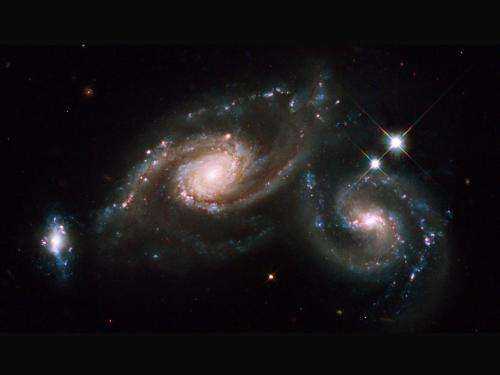
(PhysOrg.com) -- Arp 274, also known as NGC 5679, is a system of three galaxies that appear to be partially overlapping in the image, although they may be at somewhat different distances. The spiral shapes of two of these galaxies appear mostly intact. The third galaxy (to the far left) is more compact, but shows evidence of star formation.

Two of the three are forming at a high rate. This is evident in the bright blue knots of that are strung along the arms of the galaxy on the right and along the small galaxy on the left.

The largest component is located in the middle of the three. It appears as a , which may be barred. The entire system resides at about 400 million light-years away from Earth in the constellation Virgo.

Hubble’s Wide Field Planetary Camera 2 was used to image Arp 274 in april 2011. Blue, visible and infrared filters were combined with a filter that isolates hydrogen emission. The colors in this image reflect the intrinsic color of the different stellar populations that make up the galaxies. Yellowish older stars can be seen in the central bulge of each galaxy. A bright central cluster of stars pinpoint each nucleus. Younger blue stars trace the spiral arms, along with pinkish nebulae that are illuminated by new star formation. Interstellar dust is silhouetted against the starry population. A pair of foreground stars inside our own Milky Way are at far right.

Explore further: South Africa's new radio telescope reveals giant outbursts from binary star system

add to favorites email to friend print save as pdf

Related Stories

Image: Pinwheel of star birth

Oct 19, 2010

Though the universe is chock full of spiral-shaped galaxies, no two look exactly the same. This face-on spiral galaxy, called NGC 3982, is striking for its rich tapestry of star birth, along with its winding ...

Hubble's view of barred spiral galaxy NGC 1672

Apr 03, 2007

NGC 1672, visible from the Southern Hemisphere, is seen almost face on and shows regions of intense star formation. The greatest concentrations of star formation are found in the so-called starburst regions ...

Image: Galaxy at the edge

Aug 30, 2010

Spiral galaxy NGC 4921 presently is estimated to be 320 million light years distant.

An elegant galaxy in an unusual light (w/ Video)

Sep 22, 2010

(PhysOrg.com) -- A new image taken with the powerful HAWK-I camera on ESO's Very Large Telescope at Paranal Observatory in Chile shows the beautiful barred spiral galaxy NGC 1365 in infrared light. NGC 1365 ...

A galactic rose highlights Hubble's 21st anniversary

Apr 20, 2011

(PhysOrg.com) -- In celebration of the 21st anniversary of the Hubble Space Telescope’s deployment into space, astronomers pointed Hubble at an especially photogenic group of interacting galaxies called ...

Recommended for you

4C+29.30: Black hole powered jets plow into galaxy

May 15, 2013

(Phys.org) —This composite image of a galaxy illustrates how the intense gravity of a supermassive black hole can be tapped to generate immense power. The image contains X-ray data from NASA's Chandra X-ray ...

A space-time magnifying glass

May 15, 2013

(Phys.org) —Bright arcs are smeared around the heart of galaxy cluster Abell S1077 in this image taken by the NASA/ESA Hubble space telescope. The arcs are stretched images of distant galaxies distorted ...

Orion's hidden fiery ribbon

May 15, 2013

(Phys.org) —This dramatic new image of cosmic clouds in the constellation of Orion reveals what seems to be a fiery ribbon in the sky. This orange glow represents faint light coming from grains of cold ...

User comments : 5

Adjust slider to filter visible comments by rank

Display comments: newest first

omatumr
1 / 5 (3) Aug 25, 2011
Thank you for this interesting report on Arp 274 galaxies.

Professor Arp was and is a great asset to science, an astronomer who made and reported observations even when they were unpopular with those following the old USSR system of science (and mind) control, Lysenkoism:

www.skepdic.com/lysenko.html

The temporary success of government-financed Lysenkoism in Western science is fading today as the pubic awakens to reality.

With kind regards,
Oliver K. Manuel
Former NASA Principal
Investigator for Apollo

Tuxford
1 / 5 (2) Aug 25, 2011
Galactic evolution? From where did these galaxies form, if not from deep within via core ejections of new matter? Is it not evident that the oldest is the largest? And if these galaxies are gravitationally linked, would we not see more distortion in the outer spiral arms? Nothing conclusive, but another example of suggestive evidence.
yyz
5 / 5 (2) Aug 25, 2011
"Is it not evident that the oldest is the largest?"

No, do you have a published source for the mass of the larger component?

"And if these galaxies are gravitationally linked, would we not see more distortion in the outer spiral arms? Nothing conclusive, but another example of suggestive evidence."

Evidence for the ongoing interaction has been studied by many astronomers. See: http://iopscience..._783.pdf

...and refs therein.

Not all galaxies in the early stages of gravitational interaction exhibit obvious signs of gravitational distortion. One well known example: http://en.wikiped..._IC_2163

Where does LaViolette specifically discuss observations of either of these systems and show conclusively these galaxies were formed by the fragmentation of a central massive body?

And Tuxford, you have still avoided commenting on my last 3 points wrt Arp 302: http://www.physor...ion.html
bystander53
not rated yet Aug 25, 2011
I actually think this is misidentified. I think the photo is from April 3, 2009, not 2011 as reported on NASA IOTD. See the Hubble Heritage April 2009 release "Galaxy Triplet Arp 274". STScI (hubblesite.org) and ESA/HEIC (spacetelescope.org) have press releases on April 3, 2009.
yyz
5 / 5 (1) Aug 25, 2011
"I actually think this is misidentified. I think the photo is from April 3, 2009, not 2011 as reported on NASA IOTD...."

I've seen the same sources and a few others. I think the pic has just been (re?)chosen as a NASA IOTD (and dated 2009 in the caption): http://www.nasa.g...045.html

More news stories

Alaska volcano shoots ash 15,000 feet into the air

(AP)—One of Alaska's most restless volcanoes has shot an ash cloud 15,000 feet into the air in an ongoing eruption that has drawn attention from a nearby community but isn't expected to threaten air traffic.

Chinese, Indian airlines face EU pollution fines

Eight Chinese and two Indian airlines face fines of up to several million euros for not paying for their greenhouse gas emissions during flights within the bloc, the European Commission said on Friday.

Bright explosion on the Moon

For the past 8 years, NASA astronomers have been monitoring the Moon for signs of explosions caused by meteoroids hitting the lunar surface. "Lunar meteor showers" have turned out to be more common than anyone ...

US seizes Bitcoin operator accounts

US authorities seized the accounts of a Bitcoin digital currency exchange operator, claiming it was functioning as an "unlicensed money service business," court documents showed Friday.