Hewlett-Packard overhaul exposes underdog status
(AP) -- Hewlett-Packard, one of the world's largest technology companies, finds itself the underdog as it ditches most of its consumer businesses to become more like the well-oiled, corporate-focused machines of rivals IBM and Oracle.
HP will no longer make smartphones and tablet computers and wants to leave the PC business after spending a decade assembling itself into a technology conglomerate by buying such companies as computer maker Compaq Computer for $19 billion in 2002 and smartphone pioneer Palm for $1.8 billion last year.
HP's stock plunged 20 percent on Friday, a day after the restructuring announcement. That's a strong signal that investors are doubtful about HP's ability to thrive without businesses that have helped set it apart from rivals. Even though the PC division that HP wants to sell or spin off is the company's least profitable, it accounts for nearly a third of revenue.
Rumors have been circulating for months that HP might try to exit the PC business, which is under pressure from tablet computers and smartphones - the ones made by Apple, not HP. Analysts generally agree that HP would be better off in shedding a thinly profitable business that faces fierce competition.
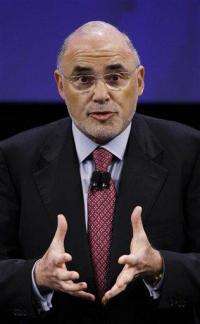
However, their anxiety spiked because of how HP went about it. Some analysts worry that CEO Leo Apotheker may have done irreversible damage to the PC business by throwing its future into question. He said HP is merely considering possibilities for the business and may not shed it at all after 12 to 18 months of exploration.
That uncertainty could lead to an exodus of customers, which would lower the price that HP could fetch for the division if it's able to sell it. Or it could damage its value so much that HP isn't able to unload it and is stuck with a business in decline.
Even if HP does shed its PC unit, it's left with businesses that are already under pressure. In many cases, those businesses are playing catch-up to IBM, Oracle and Cisco Systems Inc., which is going through its own restructuring.
HP would be left with only one major business in which it is the clear leader - printers and printer ink, a longtime cash cow. It would also still sell servers, but it is running even with IBM in that area.
In other, more lucrative areas, HP is far behind. IBM is the market leader in technical services. Cisco is the leader in computer networking equipment. IBM, Oracle and Apotheker's former employer, SAP AG, rule in business software.
Losing the PC business would leave a giant hole. In the past nine months, for instance, it supplied nearly $30 billion of HP's revenue of $95 billion. And that doesn't include ancillary sales, such as selling a printer to a company that has already bought a PC. HP will likely lose some leverage in those relationships, and other divisions could suffer as a result.
Tablets and smartphones were a much smaller factor. HP doesn't break out that category and had included it in a catch-all category of corporate investments, which supplied just $416 million in revenue since the fiscal year started in November. But the businesses were clearly in trouble. That division lost nearly twice that amount during the same period.
Jayson Noland, an analyst with Robert W. Baird & Co., said the restructuring plan raises questions about HP's viability.
He has downgraded HP stock to "neutral," after HP's latest quarterly results showed falling profit margins in its services and printer and ink businesses. Those are HP's most profitable divisions and would take on an even more prominent role after the restructuring. Noland said HP no longer would be a "safe haven" when the economy is rough. The transformation plan, he said, is expensive, protracted and risky.
In announcing the sweeping changes, HP is trying to emulate IBM.
IBM rescued itself from the brink of collapse in the 1990s by ditching its consumer businesses and focusing on services and software. But following that model puts HP at a disadvantage, because IBM has had nearly a decade to perfect it.
IBM's head start confers many advantages, especially stronger investor support for the market leader. IBM enjoys a market value of about $190 billion as of Friday, nearly four times as large as HP's $50 billion.
And IBM has had years to invest in areas that HP is just now exploring.
More than 90 percent of IBM's income comes from services and software, areas in which it has spent billions of dollars on research and acquisitions. By contrast, just over 40 percent of HP's income is from those businesses. HP is still largely dependent on legacy businesses, particularly printer ink, PCs and servers.
Services became HP's most profitable division with its $14 billion acquisition of Electronic Data Systems in 2008. But that business has suffered, and Apotheker has blamed years of neglect by his predecessor, Mark Hurd, who resigned under pressure a year ago in a scandal over ties with a former contractor.
And IBM is far ahead here. Its revenue from services and software is twice as big as HP's.
IBM has been down this road before.
IBM's decision to sell its PC business in 2005 was one of the last steps of its transformation, but IBM's PC business was substantially smaller then than HP's. IBM had just 5 percent of the worldwide PC market at the time. By contrast, HP commands nearly 20 percent of the worldwide PC market today, making it the world's top computer maker. And its PC business makes money, unlike IBM's at the time.
The fact that HP's PC business is thinly profitable will limit how much HP can fetch for it. Brian White, an analyst with Ticonderoga Securities, warned investors that even if HP sold it for $12.5 billion, it would only add 6 cents per share to annual income.
"A possible PC divestiture won't cure the near-term challenges," he said.
Apotheker, in an interview with The Associated Press, was reluctant to discuss how IBM played into his decisions.
But he said that the differences between the companies' PC businesses would allow HP to extract a higher price. IBM, which is based in Armonk, N.Y., got $1.75 billion from Chinese computer maker Lenovo Group Ltd. for its PC operations.
"When IBM spun out their PC business, they spun out a money-losing business," Apotheker said. "We are very proud to have a money-making, market-leading business with the best margins in the business. We are going at this from a position of strength."
The transformation Apotheker envisions would strip HP of valuable levers that have set the company apart. The consumer businesses have helped insulate HP from swings in how businesses and governments buy information technology.
A downbeat report from PC maker Dell Inc. this week, and HP's cut to its full-year revenue guidance on Thursday, reinforced fears that companies and government agencies have dialed back their spending on technology.
To some analysts, the restructuring has a make-or-break quality.
Investor sentiment is likely to turn on the fate of the PC business. How it's handled could have ramifications for Apotheker's job security as well. He is in his 10th month on the job.
By announcing the deliberations "without a clear plan or buyer in place, the company effectively set the clock ticking on the profitable PC business's viability - and value," analysts from IDC wrote in a research note. In 18 months, that business "may be unrecognizable."
Shares of HP, which is based in Palo Alto, Calif., fell $5.91, or 20 percent, to close Friday at $23.60.
©2011 The Associated Press. All rights reserved. This material may not be published, broadcast, rewritten or redistributed.


