Green gasoline comes closer to fueling your car
August 19, 2011

Green gasoline comes closer to fueling your car

Enlarge

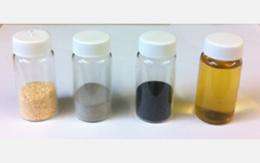
Vials containing sawdust, catalyst, charred catalyst and gasoline made from sawdust. Credit: Robert Coolman, UMass Amherst

The backbone of our energy infrastructure is carbon-based fuel. In the form of oil, coal and natural gas, carbon compounds run our cars, heat our homes and cook our food. For reasons of energy security and limiting carbon dioxide (CO2) emissions, we need to transition to alternative and sustainable fuels. We can minimize the shock of transitioning away from fossil fuels to sustainable sources by using as much existing carbon-based infrastructure as possible.

All life is carbon based. Plants are the only source of sustainable carbon, in that there are no other means to simply capture carbon from the air to make carbon-based fuel. That is the beauty of plant-based biofuels and why they must have a role in our sustainable-energy future. To convert plant-based carbon into fuels we can use in our cars, we must first understand the composition of the plants.

Plants as energy

First, think of how your body stores energy: as fat but also in a structurally different type of molecule called protein; plants have a similar dichotomy. A plant stores energy as starch, sugar and fat, but is also structurally composed of lignin and cellulose (or 'lignocellulose'). Take corn as an example: from kernels comes starch and sugar that can be fermented to make ethanol; corn oil can be used to make biodiesel.

While these energy conversion technologies deserve study in their own right, we must not ignore the remaining cobs, husks and stalks--the structural materials made of lignin and cellulose. Woods and grasses are composed of the same structural materials.

The structural materials of are the cheapest and most abundant forms of biomass available--plus, humans can't eat them (cows and beavers can, only because their guts have special bacteria). Fuel made from inedible material has the benefit of never directly interfering with food production.

Green gasoline

Research conducted at the University of Massachusetts, Amherst, and headed by George Huber focuses on converting sawdust and switchgrass into "green gasoline"--a fuel that we can use within our current infrastructure. In a few years, consumers may start to see it blended with what they buy at the pump.

"Unless there's a sign that tells you so, you won't even know your gas is 'green,'" said Huber. "It has zero carbon footprint. The CO2 from your car is recycled to the plant when it re-grows."

Green gasoline comes closer to fueling your car
Enlarge

Structure of zeolite in a catalyst. Each tetrahedron represents either SiO2 (silicon dioxide) or HAlO2 (hydrogen aluminum dioxide). The spaces in the structure (highlighted) are called "micropores" and are roughly the same size as gasoline molecules. Credit: Image courtesy of the University of Wisconsin-Madison Materials Research Science and Engineering Center

A technique called catalytic fast pyrolysis in a fluidized bed is one used for making green gasoline. Let's break this process down by the terms and techniques used:

'Catalytic'

A catalyst is a material used to make a specific chemical reaction happen quicker than it normally would. The reaction in question? Turning lignocellulose into gasoline. The catalyst that does that uses a special class of materials called "zeolites," materials made of silicon, aluminum and oxygen atoms that are arranged in intricate geometrical frameworks in a crystal-like pattern.

Spaces between the atoms held together in these frameworks are called micropores, which hold carbon-based molecules on the catalyst surface in an arrangement that causes them to form molecular products of the same size as the pore. The trick is to select a zeolite with a pore size equal to that of gasoline molecules. The catalysts the Huber lab uses are inexpensive materials currently used in the petrochemical industry.

'Fast pyrolysis'

Pyrolysis is the high-temperature breakdown of large molecules (such as cellulose or plastic) into small-molecule vapors. The pyrolysis is "fast" because quick heating is necessary to turn the plant carbon into vapors instead of char. "Slow pyrolysis" is how charcoal is made.

In a camp fire, the flames you see are actually wood-pyrolysis vapors reacting with oxygen. Flame heat causes the log to pyrolyze more and maintains itself until the log's surface becomes too covered in char to produce more vapors. In the lab, pyrolysis of sawdust is done in the absence of oxygen so the vapors can't burn like they do in a fire--the vapors instead react on the catalyst surface to form gasoline.

'Fluidized bed'

Fluidization is a technique for maximizing contact and mixing between the gas vapors from the pyrolysis and solid catalysts. Envision how a bed of gravel dances beneath the end of a syphon tube when someone is cleaning a fish tank; the gravel is fluidized by the water. In the lab, the role of gravel is assumed by a bed of sand-like zeolite catalyst particles and sawdust undergoing pyrolysis. The water is replaced with a stream of hot gas entering from the bottom, called a "fluidizer." Vapors leaving the catalyst surface get blown out of the reactor where they are condensed as fuel with an octane rating typically near 108.

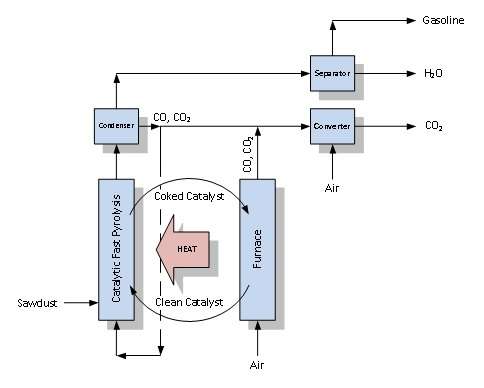
A catalytic fast pyrolysis chemical plant

Because lignocelluose contains more oxygen than gasoline, a portion of the carbon (roughly 25 percent) must leave as carbon monoxide and .

Green gasoline comes closer to fueling your car

A diagram of catalytic pyrolysis. Credit: Robert Coolman, UMass Amherst

At scales larger than in the lab, a fraction of the stream will be used as the fluidizer gas. The remaining 75 percent of carbon is theoretically available for producing gasoline, but char formation cuts into this number.

The char forms a black coat on the catalyst particles. For the reaction process to run for long periods, particles of charred catalyst must be recycled through a furnace where char is burned off, producing more carbon oxides. The furnace creates enough heat to power catalytic fast pyrolysis. Currently, 30 percent of the carbon from the sawdust fed into the system leaves the facility as gasoline.

It takes 45 pounds of sawdust to make a gallon of gasoline. However, there is an advantage. Notice how a facility using the technology needs no inputs other than the sawdust and air--the pyrolysis technology would be possible for isolated, off-the-grid locations where lots of plant materials are available.

Onward

Pilot-scale tests have proven successful and will be scaled up into a demonstration chemical plant soon.

"This is a great time to be in this field. As the price of oil increases, it gives opportunities to future engineers," said Huber. "It's up to the new generation to find solutions for the future."

Provided by National Science Foundation search and more info website

Filter


Move the slider to adjust rank threshold, so that you can hide some of the comments.


Display comments: newest first

Lightfeet
Aug 19, 2011

Rank: not rated yet
Love to see it work. I just hope it doesn't turn into another ethanol mess.
krwhite
Aug 19, 2011

Rank: 5 / 5 (1)
How many pounds of inedible vegetation can be grown in a sustained way per day, for all of the gallons of gasoline used per day? That would be interesting to see if this could work on a worldwide scale.
OldBlackCrow
Aug 19, 2011

Rank: not rated yet
I would also like to see real world projections on price per gallon. Would it initially be the same amount or more per gallon? And how long til the prices drop?
Shakescene21
Aug 19, 2011

Rank: not rated yet
If I read this right the catalyst is made from relatively cheap and available materials --silicon, aluminum, and oxygen. I'm always skeptical when some scientist announces a great new technology based on Platinum/Gold/Rhodium catalysts.
pianoman
Aug 19, 2011

Rank: 1 / 5 (1)
The real unlimited very cheap energy is at area 51 complex but a very big tea party is the only way to get it exposed to the mass public.
Roland
Aug 19, 2011

Rank: not rated yet
Instead of injecting air into the furnace and getting CO2, why not inject something with lots of hydrogen (but no O2)in it, like methane (natural gas), and hydrolyse tat carbon. Result: more mid-chain hydrocarbons.
Vendicar_Decarian
Aug 20, 2011

Rank: not rated yet
It takes 45 pounds of sawdust to make a gallon of gasoline." - article

1 gallon of gasoline (US) weighs 6 pounds.

The average U.S. commuter consumes about 1 gallon of gasoline per day, so would require 45 pounds of wood, which turns out to be about 45 liters of wood.

Tree volumes are typically 500,000 liters per hectare, so clear cutting that area of forest, would produce 11,000 gallons of gasoline.

U.S. gasoline consumption is about 9 million gallons per day so
the U.S would have to deforest 260,000 hectares per year or 2,600 square kilometers of land to provide for it's gasoline consumption.

In comparison the U.S. has a total forest area of about 3,040,220 square kilometers.

So about .1% of the U.S. forested area needs to be cleared every year to produce the gasoline consumed by Americans.

Given a growth period of 75 years, 7.5 percent of the U.S. forested area would need to be harvested in total.
ubavontuba
Aug 20, 2011

Rank: 1 / 5 (1)
Every time you convert energy from one form to another, energy is lost. And, internal combustion engines are woefully inefficient, themselves.

I wonder, wouldn't it be more efficient to use the biomass to generate electricity?

Sanescience
Aug 20, 2011

Rank: not rated yet
This might work well in California where there are vast areas of bush and undergrowth that needs to be cleared. If some harvest techniques could gather it fairly effectively it could be a great source of energy that usually burns anyways in wild fires.
walkeryea
Aug 20, 2011

Rank: not rated yet
given all you assume Vendicar the truth is: i am a timber owner. we harvest 25% of the mature trees in a 10 year period or on average 2.5 % a year. The mature forest represents only 25% of the growing biomass, there is much shrub and smaller trees that are pre merchantable. this forest is grown including the 2.5% cut at a level of 10% over sustained yield. so you are correct in all you say except in your conclusion which seems to be driven by denial of the idea of forest growth.
_nigmatic10
Aug 21, 2011

Rank: not rated yet
It takes 45lbs of sawdust to make one gallon of this green gas? How the heck is this suppose to be better? You realize the stress on the lumber industry this would induce? It would be unsustainable. This Ben Franklins gift shop science experiment will not be the answer.
Rank 5 /5 (6 votes)
Relevant PhysicsForums posts

More news stories

Browser wars flare in mobile space

The browser wars are heating up again, but this time the fight is for dominance of the mobile Internet.

Technology / Software

created 6 hours ago | popularity 5 / 5 (1) | comments 2

Probability of contamination from severe nuclear reactor accidents is higher than expected: study

Catastrophic nuclear accidents such as the core meltdowns in Chernobyl and Fukushima are more likely to happen than previously assumed. Based on the operating hours of all civil nuclear reactors and the number ...

Technology / Energy & Green Tech

created May 22, 2012 | popularity 3.6 / 5 (22) | comments 56 | with audio podcast

SpotterRF debuts Radar Backpack Kit (w/ Video)

(Phys.org) -- SpotterRF has announced a special radar backpack kit designed to enhance situational awareness for soldiers on the ground. The company says its special radar is designed for warfighters as part ...

Technology / Hi Tech & Innovation

created May 26, 2012 | popularity 5 / 5 (5) | comments 13 | with audio podcast report

HyperSolar shows dirty water no barrier to power world

(Phys.org) -- The Santa Barbara, California, company, HyperSolar, is set to transparently share the ups and downs of its research experiences toward the company’s ultimate vision, successfully producing ...

Technology / Energy & Green Tech

created May 24, 2012 | popularity 4.8 / 5 (16) | comments 17 | with audio podcast report

Tesla to launch electric sedan in US on June 22

Tesla Motors said Tuesday it would begin deliveries of "the world's first premium electric sedan" on June 22, slightly ahead of schedule.

Technology / Energy & Green Tech

created May 22, 2012 | popularity 4.5 / 5 (11) | comments 18


Nvidia trumpets Tegra 3 phone design wins for 2012

(Phys.org) -- Nvidia’s competitive war paint has a name, Tegra 3. On the heels of Nvidia announcements about lowering costs of its Tegra 3 processors and Nvidia-enabled tablets running Android Ice Cream ...

Scientist: Evolution debate will soon be history

(AP) -- Richard Leakey predicts skepticism over evolution will soon be history. Not that the avowed atheist has any doubts himself.

Dell tablet leak: 10.1-inch display, two-battery choice

(Phys.org) -- Headline after headline talks about vendors’ tablets in the wings as likely number-one contenders for the iPad. Such claims have justifiably been taken with a grain of salt, considering ...

Keep food safety in mind this memorial day weekend

(HealthDay) -- Picnics, parades and cookouts are as much a part of Memorial Day weekend as tributes to the United States' war veterans.

Social welfare cuts ultimately come with heavy price, researchers say

(Phys.org) -- Slashing government funding for Medicaid, food stamps and other programs that serve the poor – while politically popular with some lawmakers and many conservatives – may do more harm ...

Is a classical electrodynamics law incompatible with special relativity?

(Phys.org) -- The laws of classical electromagnetism that were developed in the 19th century are the same laws that scientists use today. They include Maxwell’s four equations along with the Lorentz la ...