Faster organic semiconductors for flexible displays can be developed quickly with new method
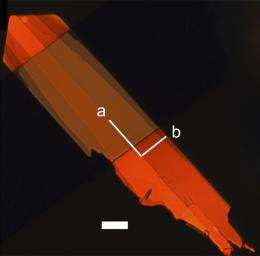
(PhysOrg.com) -- Organic semiconductors hold immense promise for use in thin film and flexible displays – picture an iPad you can roll up – but they haven’t yet reached the speeds needed to drive high definition displays. Inorganic materials such as silicon are fast and durable, but don’t bend, so the search for a fast, durable organic semiconductor continues.
Now a team led by researchers at Stanford and Harvard universities has developed a new organic semiconductor material that is among the speediest yet. The scientists also accelerated the development process by using a predictive approach that lopped many months – and could lop years – off the typical timeline.
For the most part, developing a new organic electronic material has been a time-intensive, somewhat hit-or-miss process, requiring researchers to synthesize large numbers of candidate materials and then test them.
The Stanford and Harvard-led group decided to try a computational predictive approach to substantially narrow the field of candidates before expending the time and energy to make any of them.
“Synthesizing some of these compounds can take years,” said Anatoliy Sokolov, a postdoctoral researcher in chemical engineering at Stanford, who worked on synthesizing the material the team eventually settled on. “It is not a simple thing to do.”
Sokolov works in the laboratory of Zhenan Bao, an associate professor of chemical engineering at Stanford. They are among the authors of a paper describing the work, published in the Aug. 16 issue of Nature Communications. Alán Aspuru-Guzik, an associate professor of chemistry and chemical biology at Harvard, led the research group there and directed the theory and computation efforts.
The researchers used a material known as DNTT, which had already been shown to be a good organic semiconductor, as their starting point, then considered various compounds possessing chemical and electrical properties that seemed likely to enhance the parent material’s performance if they were attached.
They came up with seven promising candidates.
Semiconductors are all about moving an electrical charge from one place to another as fast as possible. How well a material performs that task is determined by how easy is it for a charge to hop onto the material and how easily that charge can move from one molecule to another within the material.
Using the expected chemical and structural properties of the modified materials, the Harvard team predicted that two of the seven candidates would most readily accept a charge. They calculated that one of those two was markedly faster in passing that charge from molecule to molecule, so that became their choice. From their analysis, they expected the new material to be about twice as fast as its parent.
Sokolov, the Stanford researcher, said it took about a year and a half to perfect the synthesis of the new compound and make enough of it to test. “Our final yield from what we produced was something like 3 percent usable material and then we still had to purify it.”
When the team members tested the final product, their predictions were borne out. The modified material doubled the speed of the parent material. For comparison, the new material is more than 30 times faster than the amorphous silicon currently used for liquid crystal displays in products such as flat panel televisions and computer monitors.
“It would have taken several years to both synthesize and characterize all the seven candidate compounds. With this approach, we were able to focus on the most promising candidate with the best performance, as predicted by theory,” Bao said. "This is a rare example of truly 'rational' design of new high performance materials.”
The researchers hope their predictive approach can serve as a blueprint for other research groups working to find a better material for organic semiconductors.
And they’re eager to apply their method to the development of new, high-efficiency material for organic solar cells.
"In the case of renewable energy, we have no time for synthesizing all the possible candidates, we need theory to complement synthetic approaches to accelerate materials discovery,” said Aspuru-Guzik.
Other Stanford researchers contributing to the research include Rajib Mondal and Hylke Akkerman, postdoctoral fellows in the department of chemical engineering when the research was done; Stefan Mannsfeld, a staff scientist at the Stanford Synchrotron Radiation Lightsource; and Arjan Zoombelt, a postdoctoral fellow in chemical engineering.
Provided by Stanford University


