Wind farm in North Sea has positive net impact on fauna
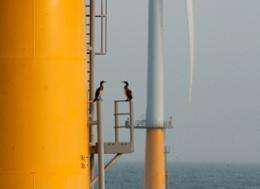
A North-Sea wind farm has hardly any negative effects on fauna. At most, a few bird species will avoid such a wind farm. It turns out that a wind farm also provides a new natural habitat for organisms living on the sea bed such as mussels, anemones, and crabs, thereby contributing to increased biodiversity. For fish and marine mammals, it provides an oasis of calm in a relatively busy coastal area, according to researcher Prof. Han Lindeboom at IMARES, part of Wageningen UR, and several of his colleagues and fellow scientists at Bureau Waardenburg and Royal Netherlands Institute for Sea Research (NIOZ).
The team of researchers focused on the short-term ecological effects of a wind farm in the North Sea. To do so, they analysed the effects of the offshore wind farm near Egmond aan Zee (OWEZ) on benthic organisms, fish, birds and marine mammals. The researchers described their findings in an article that was recently published on the scientific website, Environmental Research Letters online, in which they summarised the results of the first two years of their research.
Increased biodiversity
The research carried out within the OWEZ wind farm revealed little effect during the first few years on the benthic organisms in the sandy areas between the wind turbines. New species establish themselves, and communities of animals arise on the wind turbine piles and the rocks piled around the columns, leading to a local increase in biodiversity. The fish fauna turns out to be very variable, and some minor positive effects have been observed so far. For example, the wind farm seems to provide shelter to cod. Porpoises were also heard more often inside the wind farm than outside it. A striking feature is that various bird species, including the gannet, avoid the wind farm, whereas others, such as seagulls, do not seem to be bothered by the wind turbines. Cormorants were even observed in greater numbers. The number of birds that collided with the turbines was not determined but was estimated to be quite low on the basis of observations and model calculations.
After the construction of a wind farm, whereby the driving of piles into the sea bed can have a disruptive influence, potential effects were expected from the presence of new hard substrate in the form of piles and protective rocks. Effects might also result from the presence of rotating wind turbine blades, possible underwater noise and the absence of other human activities such as commercial fishing.
Overall, the OWEZ wind farm functions as a new type of habitat with more species of benthic organisms and a possibly increased use of the area by fish, marine mammals and some bird species, whereas the presence of other bird species is reduced.
On the basis of comparisons with results found elsewhere, the scientists conclude that the impact of a wind farm depends on the location of the wind farm and the depth of the surrounding sea. The location of the OWEZ wind farm is favorable due to the relatively low numbers of birds that fly through the area at this distance from the coast. The presence of various habitat types and the intensity with which the area is used by others also play a role. In the busy Dutch coastal zone, the wind farm seems to offer a relative oasis of calm, according to the researchers. In the Anthropocene era, the present era during which humans have an impact on almost everything on earth, the effects of intensive fishing, pollution, gas oil and sand extraction, and intensive shipping have already resulted in changes to the ecosystem. Against such a background, a wind farm can contribute to a more diverse habitat and even help nature to recover. However, the rotating blades can also have a significant disruptive effect on some species of birds. The researchers therefore suggest that, for the purpose of generating energy, special areas be designated in the sea for wind farms. Unavoidable effects, such as a local reduction in the numbers of some bird species would then have to be accepted, but by choosing the location appropriately, these effects can be minimised.
The research was funded by NoordzeeWind, a joint venture of Nuon and Shell Wind Energy, and was carried out by a consortium consisting of IMARES, Koninklijk NIOZ and Bureau Waardenburg.
More information: The article, H.J.Lindeboom et al, Short-term ecological effects of an offshore wind farm in the Dutch coastal zone; a compilation can be found on the website of Environmental Research Letters , doi: 10.1088/1748-9326/6/3/035101
Provided by Wageningen University


