Experts praise decisions to evacuate from Irene
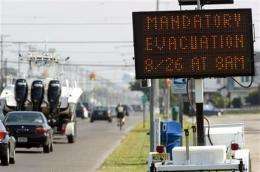
(AP) -- They were life and death decisions made by politicians, bureaucrats and everyday people. Hurricane Irene was barreling toward the East Coast. It was big. It was scary. Flooding was certain. The choice: Flee or stay put.
Disaster experts unanimously said evacuating was the right choice and it saved lives. But these were tough nail-biting calls that are now being second-guessed.
In New York City, it was debated during a critical staff meeting in City Hall where the deadly specter of Katrina and New Orleans was raised. On Friday, Mayor Michael Bloomberg, saying he worried about deadly flooding in low-lying areas, made the first ever call for hundreds of thousands of New Yorkers to leave their homes.
New Jersey Gov. Chris Christie was trademark blunt in his order: "Get the hell off the beach."
Since Irene didn't hit most areas with the advertised fury, those decisions and others up and down the Eastern Seaboard are being reexamined. Experts in hurricanes and disaster preparations and risk analysis, though, only had praise Monday, pointing out it takes a long time to evacuate densely populated areas and the hurricane's forecasts left little room for error.
"Second-guessing is easy, making those evacuation calls is not," said George Washington University risk sciences professor George Gray, a former senior Environmental Protection Agency official in the George W. Bush administration. "Given available information, I think risk analysts would say the right choices were made."
Traditionally, larger areas and more people have to be evacuated than turns out to be necessary, said Florida State University professor Jay Baker, who has studied hurricane evacuation.
"That's just an artifact of the uncertainty," said Baker.
Meteorologists have gotten pretty good at figuring out a storm's path, but predicting its strength is a struggle. They nailed Irene's track but it weakened more than forecast as it moved north.
Irene "was a very dangerous storm," said Kathleen Tierney, director of the Natural Hazards Center at the University of Colorado, saying this storm was handled far better than 2005's Katrina. "I don't think there's any doubt that lives were saved."
Jack and Sue Holloway are probably two of those lives. The Delaware residents dithered about staying at their beach home in coastal Lewes. They decided to stay, and then changed their minds when Delaware Gov. Jack Markell urged an evacuation at a news conference.
Saturday night, strong winds from what officials believe was a tornado spun off by Irene damaged several homes in Lewes, ripping off the top of the Holloways' home, blasting apart the garage.
Along the Connecticut shore, East Haven firefighters went door-to-door to tell residents to leave. Some residents wouldn't go and needed to be rescued, fire Chief Doug Jackson said. Twenty-five beachfront homes were destroyed.
"They jeopardize themselves when they stay there. They also jeopardize my people," Jackson said. "Now I have to make rescues that should not have been necessary."
East Haven's Bill Cowles, 55, never considered leaving his home. The water rose to just below the electrical sockets on the first floor and he could see neighbors' houses crashing around him.
"When the water started coming in the front door, I knew we were in trouble," he said. Still, Cowles said he was glad he stayed because he had to chase away people who were watching the storm and taking pictures from his yard.
New Jersey's governor was certain he did the right thing.
"I want to make one thing really clear for the folks who will now say, `Well, there wasn't abject destruction up and down the coastline, therefore we shouldn't have left,'" Christie said Sunday. "Let me tell you those types of second-guessers won't be tolerated. We saved lives."
Officials "are always going to err on the side of caution," said Susan Cutter, director of the Hazards and Vulnerability Research Institute at the University of South Carolina. Emergency officials, in general, plan for a hurricane at least one category higher than what's forecast, said Dennis Feltgen, a meteorologist and spokesman at the National Hurricane Center.
Vermont Gov. Peter Shumlin defended his state's decision not to do more extensive evacuations before the storm arrived, even though Irene ravaged Vermont in its final hours. He said it would have been impossible to predict which towns would be hardest-hit.
"What are you going to do, evacuate the entire state of Vermont?""Shumlin asked. "... You can see one community that looks like it didn't get hit at all, and two miles down the road a community that is totally devastated. And obviously there's no one that can predict which community, where, why or how."
New York's Bloomberg later explained that timing was key in his decision. He was faced with getting 370,000 people out of low-lying areas before the subway was shut down by the governor. He said, "People need time to leave, to make decisions, to plan with their family. You can't just say `go' and have everybody go."
His deputy mayor for operations, Cas Holloway, said two factors were forcing officials' hands: more than half of the city's residents don't have cars and the evacuation zone included 7,000 people in hospitals, nursing homes and senior citizen centers.
"We had limited time frames to move the populations we had to move," he said Monday.
While the orders came from authorities, the decision was ultimately up to individuals. Unlike Southerners, those in the Northeast aren't used to the summertime drill of hurricanes and evacuation zones.
Decades of study show that it is not unusual to get only half to two-thirds of the people to actually evacuate, Florida State's Baker said. And because of that "we've been lucky in this country not to have huge losses of life like we saw in Katrina" he said.
Some people fear that storms that seem to peter out - like Irene - will only make that worse. But Baker said that's not the case. In past storms - such as in 1985, when western Florida evacuated three times and didn't get hit - the "cry wolf" syndrome did not materialize, Baker said. The same number of people evacuated for each of those storms.
And post-storm surveys show only around 5 percent of people would change their decision.
Every year, emergency managers and elected officials come to the National Hurricane Center in Miami and learn about the complexities of hurricane forecasts. They practice scenarios much like Irene's, said retired center director Max Mayfield.
Mayfield said the many evacuation orders showed that they understood what they were taught.
"They knew they had to get people out early," Mayfield said.
Cutter said the death count from Irene, so far around three dozen, is extraordinarily low considering where it hit, the rainfall, tornadoes and the large size of the storm.
For Bloomberg, that's the real key. He said Sunday, "the bottom line is, I would make the same decisions again without hesitation."
©2011 The Associated Press. All rights reserved. This material may not be published, broadcast, rewritten or redistributed.


