Low emission cars under NREL's microscope

Cars that plug into solar panels for electricity or run on hydrogen may sound like something found only on the pages of science fiction novels, but engineers at the U.S. Department of Energy's (DOE) National Renewable Energy Laboratory (NREL) are driving these futuristic vehicles today.
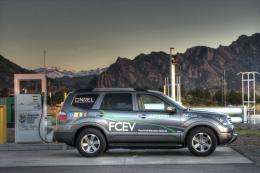
Recently, NREL engineers were able to spend six weeks kicking the tires on a Kia Borrego Hydrogen Fuel Cell Electric Vehicle (FCEV) and ongoing agreements with Toyota and Mitsubishi mean a plug-in Prius and Mitsubishi i MiEV electric vehicle will be demonstrated and tested at NREL for the foreseeable future.
"DOE wants people to see that these vehicles are not just drawings on some designer's table," NREL Vehicle Systems Engineer Mike Simpson said. "These technologies are practical, real and getting out into the marketplace."
Simpson is leading a DOE/NREL program to acquire advanced technology vehicles to support research at NREL with a secondary goal of displaying and demonstrating the technologies to consumers. "We have displayed all of these vehicles at public events this summer to help consumers see how all of these technologies can meet the needs of today's drivers," Simpson said.
Vehicles in NREL's fleet feature promising technologies designed to increase efficiency, reduce emissions, and use renewable resources without sacrificing safety or comfort.
NREL engineers collect real-world data on these vehicles to evaluate their performance. The research findings are made available to vehicle manufacturers along with the DOE and other national laboratories. In addition to the Prius and i MiEV, NREL has evaluated a Mercedes-Benz A-Class F-Cell vehicle and is actively looking to expand.
"We are currently working with a number of manufacturers to bring more plug-in and fuel call vehicles to NREL," Simpson said. "We are bringing them in to support testing in areas unique to NREL like grid integration and thermal effects on comfort and batteries."
Kia's Quick Test Run
While the i MiEV and Prius are under a longer-term lease and loan to NREL, the lab recently had an opportunity to evaluate the Kia Borrego FCEV, a vehicle that features one of the most advanced hydrogen fuel cell systems being tested.
"The benefit of having the Kia at NREL was direct, hands-on exposure to the technology," said NREL Senior Engineer Keith Wipke. "NREL staff work on all aspects of the hydrogen cycle— from production to storage to delivery — and having the vehicle at the lab lets them see one of the key applications for the hydrogen technology."
According to Wipke, Kia is scaling up facilities to support FCEV production in 2014-2015, and the automaker is representative of several other car companies that are actively pursuing adding hydrogen fuel cell vehicles to their consumer offerings.
"Part of this step is to demonstrate the power train technology to make sure it works in all different climates and that they haven't overlooked anything," said Wipke.
"By partnering with NREL during this evaluation period, Kia's engineers were able to obtain valuable data about the FCEV's performance from multiple users who accumulated test mileage in various driving situations and conditions," said Orth Hedrick, director, Product Planning, Kia Motors America. "We also received valuable feedback from NREL engineers regarding the development and tuning of the fuel cell."
The Kia FCEV has a 115 kw-fuel cell stack, which is housed under the floor of the passenger compartment. Rather than using gasoline or electricity, the SUV-sized vehicle is fueled with compressed hydrogen at 700 bar and has a range of 466 miles per fill-up, which is the equivalent of 59 mpg. The demonstration vehicle had a 110 kw traction motor 100 kw ultracpacitor rather than a battery.
"This vehicle was unique because it had something I've never experienced, which is an ultracapacitor instead of a battery," Wipke said. "It seems to be very powerful, with great pick up."
Wipke sees the hydrogen fuel cell vehicles potentially appealing to consumers whose needs cannot fully be met by battery electric cars, but who want a low carbon footprint. "One of the key things about the impact of hydrogen technology is that these are full-function vehicles with no limitations on range or refueling rate so they are a direct replacement for any vehicle. For instance, if you drive a full sized SUV and pull a boat up into the mountains, you can do that with this technology and you can't with current battery-only vehicles, which are more geared toward city driving."
NREL Makes Emissions a Zero Sum Game
NREL engineers are able to boast a truly zero emissions fuel cycle for the Kia FCEV's hydrogen fuel. The Borrego was fueled with hydrogen made from wind and solar energy as part of the Wind2H2 project where wind turbines and solar panels are linked to electrolyzers, which pass the renewably -generated electricity through water to split it into hydrogen and oxygen. The hydrogen can then be stored and used later to generate electricity from a fuel cell.
"Having a FCEV vehicle here helps people draw the connection and say, 'I get it.' We have a vehicle technology today where you can make the fuel onsite using renewables, where the process is zero emissions."
The manufacturer also has an eye toward the future of emissions friendly vehicles.
"Kia is one of the auto industry's current fuel economy leaders and we are actively researching and developing several advanced powertrain solutions designed to increase efficiency and reduce emissions," Hedrick said. "While there is still much that needs to be done in terms of fuel cell electric vehicle development, partnerships like the one with the NREL continue to help Kia make significant strides in the area of powertrain development and will help the brand achieve longer term objectives of reducing fleet emissions while meeting or exceeding more stringent government requirements."
As more and more advanced vehicles hit the market, there will still be a role for NREL and other DOE labs to help manufacturers refine and improve their products.
"There are going to be next generation improvements in the fuel cell and the production pathways and storage, which means there will continue to be research into hydrogen fuel cell technology after products start coming on the market," Wipke said. "Hybrid vehicles, such as the Prius, have been on the market for 10 years in this country and there is still a very active Vehicle Technologies program at DOE and NREL looking into improving hybrids and batteries."
Provided by National Renewable Energy Laboratory


